Woman found shot to death in Conecuh County mobile home
The Conecuh County Sheriff's Office is investigating after Haley Etheridge was found shot to death in an Owassa Road mobile home.
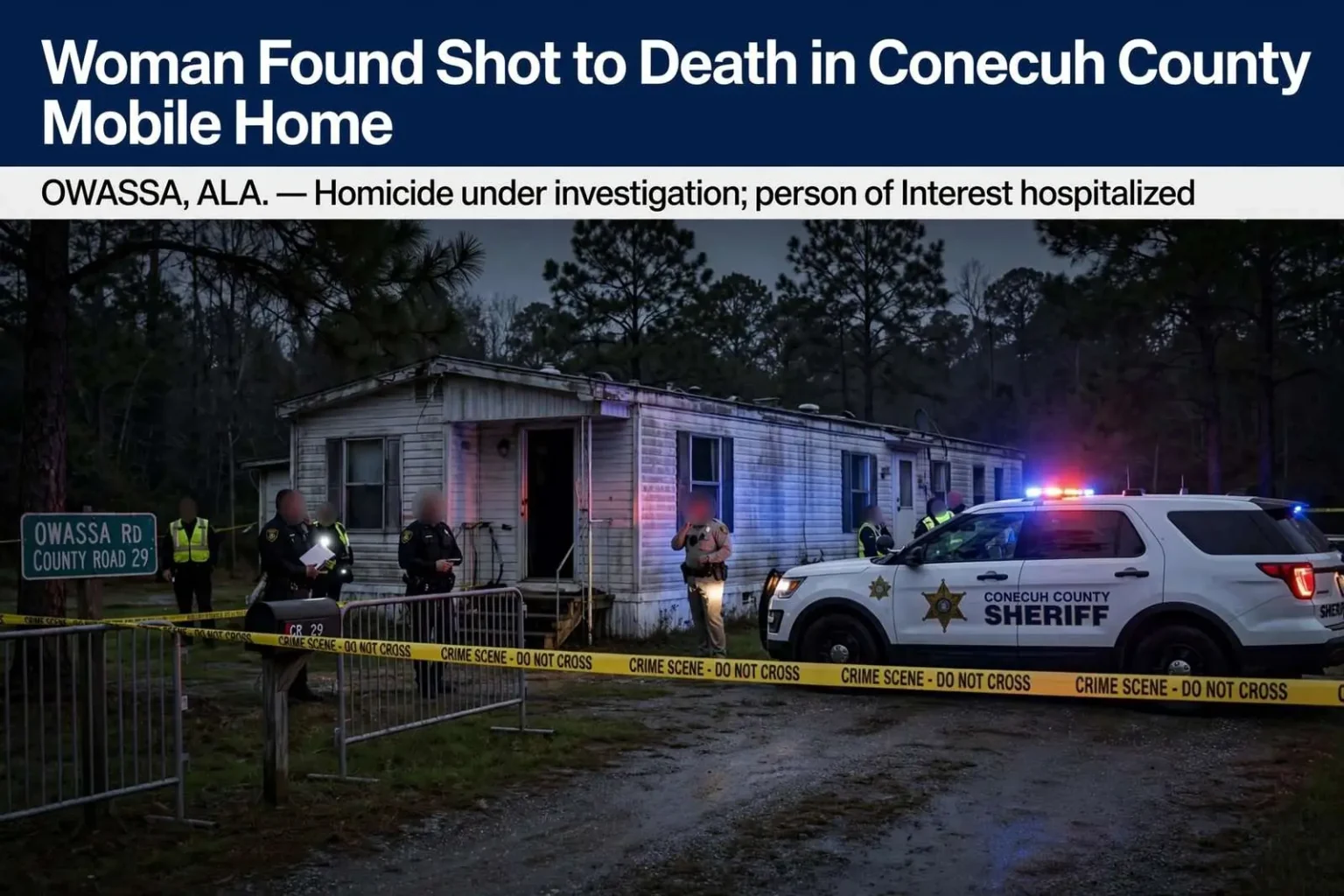
OWASSA, Ala. — The Conecuh County Sheriff’s Office is investigating a homicide after a woman was found shot to death inside a mobile home early Monday morning. Sheriff’s officials said Haley Etheridge was found shot inside a mobile home on Owassa Road, also known as County Road 29, around 2 a.m. A person of interest was hospitalized with a gunshot wound to the side. No other details were released as the investigation continues.
The discovery set in motion the early-morning response that rural Alabama law enforcement agencies know well: deputies securing the scene in the dark, investigators requesting support from state agencies, and a small community waking up to word that a deadly shooting had occurred just down the road. In a county with only a handful of homicides in a typical year, such a case draws immediate attention and careful handling, and it routinely becomes a multi-agency effort involving the District Attorney’s office and the state’s investigative resources.
Details remained limited as the investigation got underway, which is standard practice in the early stages of a homicide case. Authorities declined to discuss what led up to the shooting, how the person of interest was wounded, or what relationship, if any, existed between the individuals involved. Those questions are typically answered — if they are answered publicly at all — through search warrants, forensic work, and interviews conducted over the days and weeks after the initial discovery.
Conecuh County and the Owassa community
Conecuh County sits in south-central Alabama, in the Black Belt’s piney woods fringe, with Evergreen serving as the county seat. The county is sparsely populated, home to only around 11,000 residents spread across several small communities. Owassa is one of them — an unincorporated community in the northern part of the county, a quiet stretch of houses, churches, and family land along Owassa Road, which doubles as County Road 29. In communities of this size, a violent crime is not a distant headline; it happens within a few miles of nearly everyone, and news of it travels by word of mouth faster than any official release.
The Conecuh County Sheriff’s Office is a small department by any measure, as is typical of rural Alabama counties, with a sheriff and a modest corps of deputies responsible for patrol, investigations, and jail operations across hundreds of square miles of unincorporated territory. That reality shapes how major cases unfold. When a homicide occurs in unincorporated Conecuh County, the sheriff’s office commonly turns to the Alabama Law Enforcement Agency and its State Bureau of Investigation for assistance with crime scene processing, evidence analysis, and interviews, while the District Attorney oversees the case as it moves toward potential charges.
Mobile homes are a common form of housing across rural south Alabama, where land is more available than large-lot subdivisions and manufactured housing offers an affordable path to homeownership. They dot the roadsides in communities like Owassa, often set back from the highway on family property, sometimes clustered a few to a lot. Investigations inside such residences carry their own practical challenges — smaller living spaces can complicate scene work, and rural locations can mean longer response times and more limited access to forensic resources than investigators in urban jurisdictions would have.
How a rural homicide investigation proceeds
When a shooting death is discovered, the first hours are devoted to securing the scene. Deputies establish a perimeter, keep bystanders and media at a distance, and begin documenting everything inside and around the residence before anything is moved. Investigators photograph the scene from every angle, sketch the layout, and collect physical evidence — shell casings, firearms, personal items, phones — each of which may later matter in court. The medical examiner’s office will conduct an autopsy to establish the exact cause and manner of death, findings that formally anchor the criminal case.
Interviews happen in parallel. Detectives speak with neighbors, family members, and anyone else who may have seen or heard something in the hours before the discovery, and they canvass for surveillance video from homes, businesses, and doorbell cameras along the road. In a rural area, that canvass can cover a lot of ground — the nearest neighbor may be a quarter-mile away, and the pool of potential witnesses is small, which cuts both ways for investigators.
The presence of a person of interest hospitalized with a gunshot wound adds another dimension. Investigators will want to speak with that person as soon as medical staff allow, and they will work to establish the sequence of events that left one person dead and another wounded. Until that picture is clear, authorities typically hold back details, both to protect the integrity of the investigation and to avoid prejudicing any eventual prosecution. What authorities release publicly, and when, is coordinated with the District Attorney, particularly if charges are anticipated.
Gun violence in rural Alabama
Shootings that end with both a death and a wounded survivor often involve circumstances that investigators trace to a limited set of scenarios, and law enforcement officials generally caution the public against early speculation. What can be said with confidence is that firearms are deeply woven into daily life in rural Alabama, where hunting is a common tradition and gun ownership is widespread. That context does not determine how any individual case will be resolved, but it shapes both the availability of firearms and the questions investigators ask when violence occurs.
The Conecuh County Coroner’s Office also plays a role in cases like this one, as it does in every unattended death in the county. The coroner works alongside investigators to confirm identity, notify next of kin, and coordinate the transfer of the deceased to the forensic facility that will perform the autopsy. In rural counties, where the coroner is often a part-time position, that coordination matters, and families frequently learn the fullest account of what happened only after autopsy results are finalized and investigators are able to release findings. It is a slow and painful process, but one designed to make sure that whatever is ultimately presented in court rests on verified fact rather than early impressions.
Homicide clearance in rural counties often benefits from intimacy and suffers from it at the same time. Investigators know the families involved, the landowners along the road, and the history of disputes in the community, which can speed up identification of persons of interest. But small communities can also close ranks, and witnesses may be reluctant to talk, especially when the people involved are neighbors, relatives, or acquaintances. Investigators typically spend days building a timeline from phone records, financial transactions, and digital traces before they feel they understand what happened inside the home on Owassa Road.
For the victim’s family, the process is agonizing in its pace. Family members often learn details through the same channels as everyone else, and they may wait months for answers as forensic testing, autopsy findings, and witness interviews accumulate. Victim advocates, available through the District Attorney’s office and through state programs, can help families understand their rights, stay informed of case developments, and access services during the investigation and any prosecution that follows.
What comes next
Assuming the investigation identifies a suspect, the case would move through the Conecuh County court system — first an arrest warrant and initial appearance, then a preliminary hearing or grand jury review depending on how the case is presented. Alabama’s courts handle homicide cases at the circuit court level, and a capital or especially serious charge can add years of pretrial litigation. If the evidence instead points to self-defense or some other justification, the District Attorney may decline to file charges, a determination that would itself be explained, at least in general terms, once the investigation concluded.
Sheriff’s officials have not indicated when more information will be released, and it is common for rural agencies to say little publicly until an arrest is made. Residents with any knowledge of the incident are typically encouraged to contact the sheriff’s office directly, and tip lines remain open even after an arrest, since late-developing details can strengthen or reshape a case.
For now, the community along Owassa Road is left to process a death that struck close to home. Deputies will continue to work the case, state investigators will continue to assist, and the courthouse in Evergreen will eventually hear the results of it all. In the meantime, the small community at the north end of Conecuh County joins the long list of Alabama places where an early-morning phone call brought word that a neighbor was gone, and where the work of answering why has only just begun.
Anyone with information about the case is asked to contact the Conecuh County Sheriff’s Office. Investigators have not said how long the investigation is expected to take, but cases of this kind routinely remain active for months as evidence is analyzed and interviews are completed.