Wilcox County Commission Primary Still Unresolved as Alabama Democratic Party Reconsiders Vote-Buying Allegations
A Contest Committee decision certifying Jeffery Saulsberry was voided over improper notice. Challenger Charilyn McConnico's attorney says 12 to 14 voters cast ballots after alleged bribery.
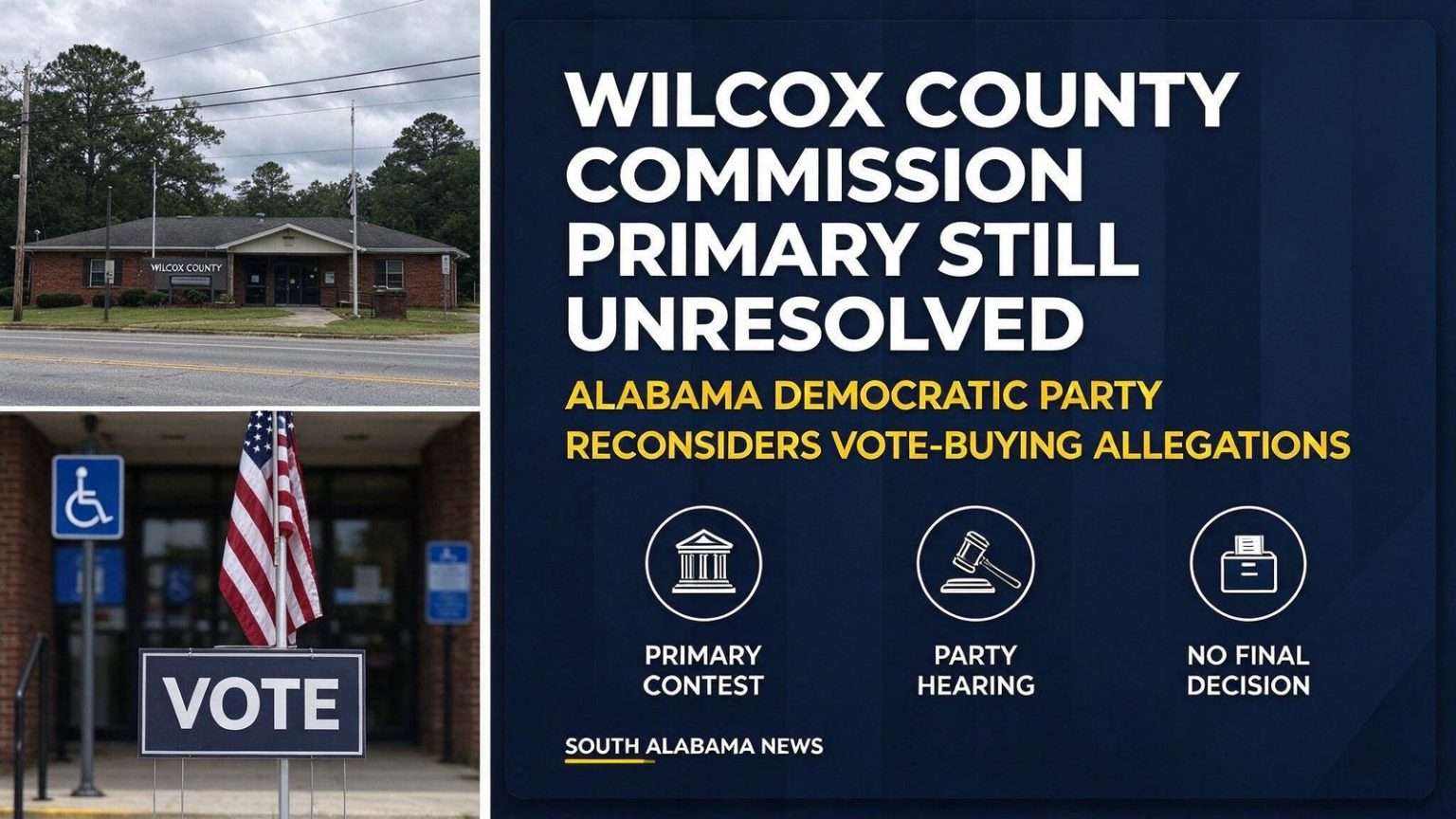
The outcome of the Wilcox County Commission District 3 Democratic primary remained unresolved Monday following a hearing before the Alabama Democratic Party concerning allegations of illegal vote buying.
The Candidates and the Contest
The dispute involves incumbent Jeffery Saulsberry and challenger Charilyn McConnico.
McConnico challenged the election results after initially holding the lead on election night, before absentee ballots shifted the race in Saulsberry’s favor.
A lead that reverses when absentee ballots are counted is not unusual on its own — absentee electorates frequently differ from election-day electorates — but in this case it became the starting point for a formal contest.
A Certification Undone
On Friday, the party’s Contest Committee de-certified McConnico and certified Saulsberry.
That decision was subsequently determined to be invalid because proper notice had not been provided to all parties involved, prompting Monday’s hearing to reconsider the matter. The party had not announced a final decision by press time.
Notice failures of this kind are procedural rather than substantive, but they are not trivial. A party contest process functions as a quasi-judicial proceeding, and a determination reached without notifying every party is vulnerable regardless of its merits — which is precisely what happened here.
The Allegations
McConnico and her legal team allege that voters were offered money and, in some instances, transportation in exchange for voting for Saulsberry.
McConnico said she began investigating the election after receiving information from a voter who claimed to have been paid. She said that person helped connect her with additional people willing to discuss what allegedly occurred on video.
McConnico’s attorney, Bryan Taylor, said his team believes between 12 and 14 voters cast illegal ballots as a result of alleged bribery. McConnico said the individuals interviewed on video agreed to discuss the allegations after the election.
Why the Number Matters
In a county commission district primary, 12 to 14 votes can be decisive. That is the essential claim behind any election contest: not merely that irregularities occurred, but that they were numerous enough to have changed the outcome.
Contests that cannot clear that threshold generally fail even when the underlying allegations have merit, because the remedy — overturning a result — requires showing the result would have been different.
The Incumbent’s Response
Saulsberry has denied any involvement in vote buying, saying neither he nor anyone associated with his campaign paid voters.
“I spent a lot of time and money on fighting this appeal and now it’s over with,” Saulsberry said. “I hope I can get back to serving the people of my district in Wilcox County.”
The Transportation Question
One element of the allegations warrants a distinction. Providing transportation to the polls is not by itself unlawful — parties, campaigns and civic organizations across the country routinely offer rides, and doing so is a long-standing practice in rural counties where distance to a polling place is a real barrier.
What the contest alleges is transportation offered as part of an exchange for a vote, alongside money. That framing is what separates a get-out-the-vote effort from the conduct described in the complaint.
What Comes Next
With the Contest Committee’s Friday decision voided and Monday’s hearing concluded without an announced outcome, the seat’s Democratic nomination remains formally unsettled.
South Alabama News will report the Alabama Democratic Party’s decision when it is issued.