Federal Complaint Accuses Texas Woman of $400,000 Bank Fraud Scheme After Saraland Arrest
A federal criminal complaint accuses a 61-year-old Dallas woman of taking more than $400,000 through a multistate bank fraud and identity theft scheme, ending with her arrest at a Regions Bank branch in Saraland. She is presumed innocent.
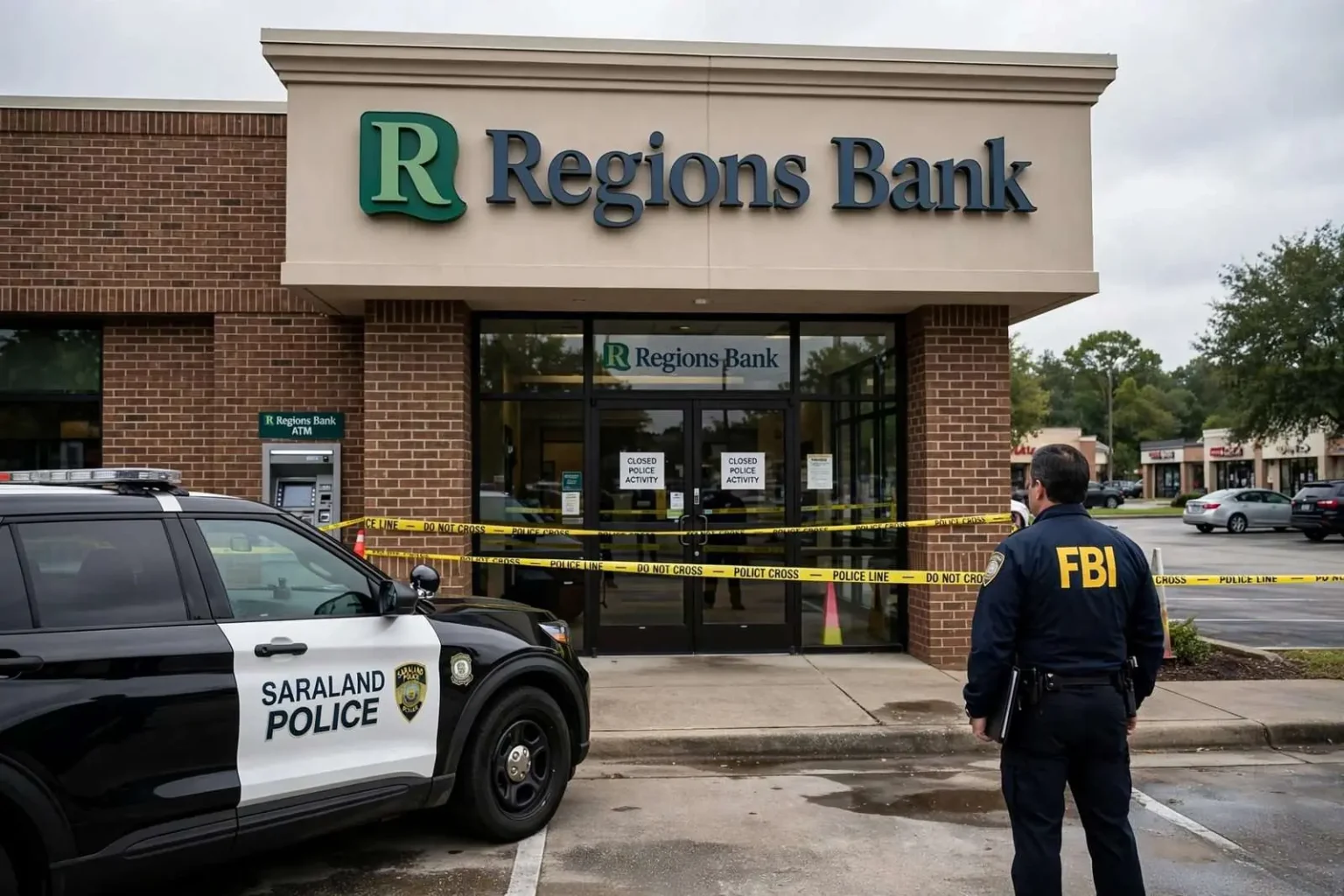
SARALAND — A Dallas woman is accused in a federal criminal complaint of taking more than $400,000 through a multistate bank fraud and identity theft scheme that ended when employees at a Regions Bank branch in Saraland grew suspicious of a large wire transfer request.
Federal investigators say Stephanie Sean Strother, 61, also known as Stephanie Sean Cummings, is connected to more than $820,000 in attempted fraudulent transactions at Regions Bank locations in several states. She has been charged federally with bank fraud and aggravated identity theft.
The charges are accusations. Strother has not been convicted of anything, and she is presumed innocent unless and until the government proves its case beyond a reasonable doubt.
What Investigators Say Happened at the Branch
According to the complaint, Saraland police were called to the bank on Aug. 26 after a report that a woman was attempting to send a $50,000 wire transfer to an account in Fort Worth, Texas, while also trying to withdraw roughly $8,500 in cash.
The woman presented a Louisiana driver’s license and a Social Security card in another woman’s name, investigators said. Officers determined she was not the person identified on those documents.
Investigators say Strother acknowledged during questioning that she had attempted the transactions. A subsequent search of her motel room in Saraland allegedly turned up additional driver’s licenses, Social Security cards and credit cards bearing other people’s names.
The Instructions Came Over Telegram, the Affidavit Says
An FBI affidavit filed in support of the complaint states that Strother told investigators she received instructions on which bank transactions to attempt from another person, identified in the document only as “Don,” through the encrypted messaging application Telegram.
That structure is a familiar one to financial crime investigators. In many identity theft operations, the person who physically walks into a branch is at the end of a chain rather than at the top of it. Stolen account credentials and personal identifying information are gathered elsewhere — through data breaches, mail theft, phishing or purchases on illicit marketplaces — and then handed to someone willing to appear in person and absorb the risk of being recorded on camera and questioned by a teller.
Encrypted messaging platforms complicate that investigative picture. Message content that is encrypted end to end is generally not available to investigators even with legal process served on the platform, which pushes agents toward other avenues: device forensics on a seized phone, financial records tracing where funds were directed, surveillance video, and the accounts that received the wires.
The court document does not say whether investigators have identified the person referred to as “Don,” and no one by that description has been publicly charged in the case.
What a Federal Criminal Complaint Is
A criminal complaint is not a conviction, and it is not the same thing as an indictment. It is a sworn written statement — here, an affidavit from an FBI agent — presented to a federal magistrate judge, who decides whether it establishes probable cause to believe a federal crime was committed and that the named person committed it. Probable cause is a low threshold compared with the standard at trial.
Complaints exist because they can be filed quickly. When someone is arrested in the middle of an alleged scheme, prosecutors need a charging document immediately, and a grand jury may not be sitting that day. Under federal law, a defendant charged by complaint must generally be indicted by a grand jury or waive indictment within 30 days of arrest, so a complaint is ordinarily a bridge to an indictment rather than the final charging instrument.
After a complaint is filed, the defendant appears before a magistrate judge for an initial appearance, is advised of the charges and the right to counsel, and the court addresses detention or release conditions. If the case is not resolved, the defendant is entitled to a preliminary hearing at which the government must again show probable cause — a hearing that becomes unnecessary once a grand jury returns an indictment.
The Charges and What They Carry
Bank fraud, under federal law, covers schemes to defraud a financial institution or to obtain money or property under a financial institution’s control by false pretenses. Because federally insured banks are involved, the offense carries an unusually long statutory maximum — up to 30 years in prison and a fine of up to $1 million per count.
Aggravated identity theft is a different kind of statute. It applies when someone knowingly uses another real person’s means of identification during and in relation to certain other felonies, including bank fraud. Its defining feature is the sentence: a mandatory two years in prison that must run consecutively to whatever sentence is imposed on the underlying offense. A judge cannot suspend it or run it concurrently. That is why prosecutors frequently pair the two charges, and why the identity theft count often carries more practical weight in plea negotiations than its short length suggests.
Federal sentences are not determined by statutory maximums alone. Judges calculate an advisory range under the federal sentencing guidelines, where the driving factor in a fraud case is usually the loss amount — both actual and intended — along with the number of victims, the defendant’s role in the offense, and criminal history. The complaint’s reference to more than $820,000 in attempted transactions against roughly $400,000 in claimed actual losses matters for exactly that reason: attempted or intended loss can drive a guidelines calculation even where a transaction was stopped at the counter.
Why Bank Counters Are the Choke Point
Federally insured banks operate under anti-money-laundering rules that require customer identification procedures, monitoring for suspicious activity and the filing of suspicious activity reports with the Treasury Department’s Financial Crimes Enforcement Network. Large cash withdrawals and outgoing wires to unfamiliar accounts are among the transaction types most likely to trigger a second look.
Wire transfers draw particular scrutiny because they are fast and difficult to reverse. Unlike a check, which can be returned, a completed wire moves funds to the receiving institution within hours, and recovery depends on how quickly the originating bank can request a recall and whether the money is still sitting in the destination account.
In this case, according to the complaint, the transaction did not clear. The report to police came from the bank, and the mismatch between the woman at the counter and the identity documents she presented was resolved by responding officers.
What Happens Next
The case is a federal one, meaning it will proceed in U.S. District Court rather than in Mobile County Circuit Court, with the U.S. Attorney’s office prosecuting and the FBI as the lead investigative agency alongside the Saraland Police Department. The next procedural steps are grand jury consideration and, if an indictment is returned, arraignment and the setting of a trial schedule.
Investigators have described the alleged scheme as spanning multiple states. Where a scheme crosses district lines, prosecutors have some discretion about where to charge it, and related conduct in other states can be consolidated into a single case or charged separately.
Anyone who believes their identity has been used without permission can place a fraud alert or a security freeze with the three national credit bureaus at no cost, request their free annual credit reports, and file a report with the Federal Trade Commission, which generates the identity theft affidavit many banks require before reversing fraudulent transactions.