Chase in South Baldwin County Ends With Five Arrested in Car Theft, Break-In Spree
A pursuit on Highway 59 in south Baldwin County led to five arrests in a stolen car case and a string of Spanish Fort vehicle break-ins.
A short chase in south Baldwin County ended with five people under arrest in connection with a stolen car and a string of vehicle break-ins in Spanish Fort. The break-ins began over a weekend and continued into Monday night, Jan. 4, when a car was stolen from a Spanish Fort home — the theft that ultimately put deputies on the suspects’ trail and ended the spree.
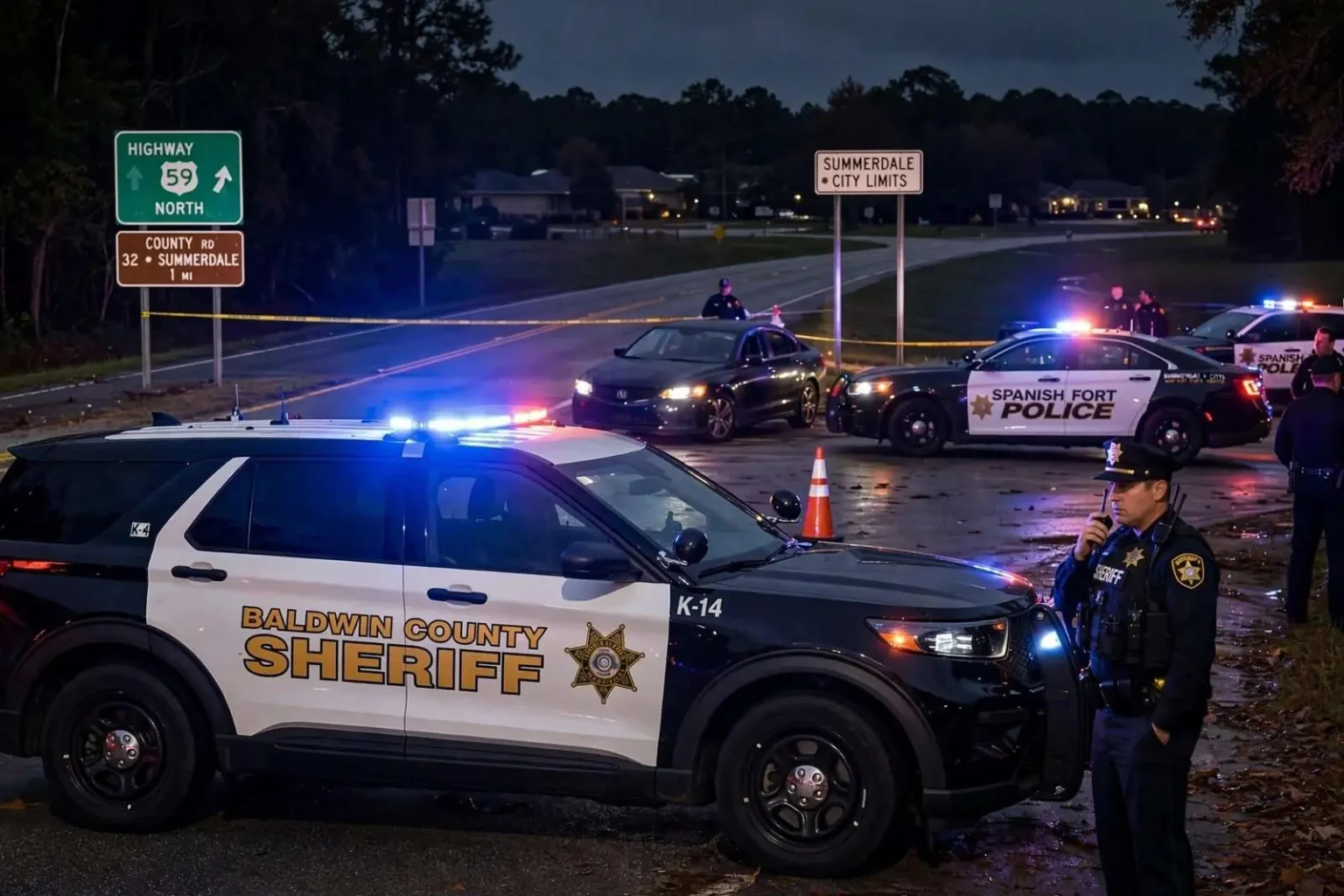
Baldwin County sheriff’s deputies spotted the vehicle on Highway 59 and tried to stop it. The pursuit started at Highway 59 and County Road 32 in Summerdale and ended a short distance later with all five occupants taken into custody. Though brief, the chase drew resources from multiple agencies along a corridor where Highway 59 cuts through the heart of south Baldwin County, linking the beach communities to the north with Summerdale, Foley and the growing residential areas around it.
Spanish Fort Police Chief John Barber said several firearms were found in the vehicle, one of them reported stolen. The discovery raised the stakes of an arrest that might otherwise have been a straightforward property-crime case, and it added weapons charges to the list of allegations the five occupants face. Firearms recovered in a traffic stop are checked against national records to determine whether any have been reported stolen or connected to other offenses — a process that can take days and sometimes expands the case significantly.
The three adults were identified as Kendon Eugene Allen, Terrell Smith-Dickerson and Brandon Levon Ely, all from the Mobile area; the other two arrestees were not immediately identified publicly. The Mobile-area connection fit a pattern Baldwin County deputies see regularly: property crimes committed in Baldwin County by suspects crossing Mobile Bay, where the causeway and interstate links put the two counties within minutes of each other. Coordinating cases across jurisdiction lines — warrants, evidence transfers, witness interviews — is routine work for the agencies on both sides.
From break-ins to an arrest
The investigation began as a pattern, not a single incident. Vehicle break-ins rolled through Spanish Fort neighborhoods over the weekend, with thieves working through unlocked cars in residential areas — a low-risk, high-volume style of crime that tends to produce a cluster of reports in a single night. When the same pattern continued into Monday night and a car was stolen from a home, the case shifted from nuisance to felony, and the stolen vehicle became the thread investigators could pull.
Neighbors’ surveillance videos captured some of the weekend break-ins near the Spanish Village area, giving investigators both timestamps and images to work from. Doorbell and home security cameras have changed this kind of investigation substantially in recent years; in subdivisions across Baldwin County, footage that once would never have existed now routinely gives detectives a starting point, and police departments increasingly ask residents to review and preserve recordings after any neighborhood crime spree.
By the time deputies found the stolen car on Highway 59, the case already spanned two counties and multiple agencies. The stop attempt in Summerdale ended the vehicle part of the story, but the criminal part was only beginning: five people in custody, a stolen car, several firearms, and a series of break-ins still being sorted by victim and location.
Barber announced the arrests as he launched “Fort Knocks,” a new community policing effort that sent officers door to door in the affected neighborhoods urging residents to lock their cars and report suspicious activity. The name is a play on the city’s own — a reminder that the strongest defense against this kind of crime is a neighborhood that makes itself hard to hit. Officers walking the affected streets did more than pass along a warning; they collected accounts of the weekend’s incidents face to face and let residents attach names and videos to reports that might otherwise have sat as anonymous case numbers.
One stop on that route happened to be the home where the stolen car was taken — allowing Barber to tell its owner the vehicle had already been recovered. The moment captured the double purpose of the door-to-door push: immediate, personal communication about an active case, and a longer-term effort to build the habit of reporting that gives investigators the pattern they need to connect incidents. Unreported break-ins are among the most common obstacles in cases like this one, because victims who find nothing missing but a rummaged console often never call.
Police believe additional people may have been involved, and two guns stolen during the weekend break-ins remain missing. Those two open items keep the case from closing with the arrests. Additional suspects could surface through evidence recovered from the vehicle, through the surveillance footage, or through tips from the canvass, and the missing firearms give the continuing investigation an urgency that property loss alone would not — stolen guns circulate, and every one of them is a potential weapon in a later, more violent crime.
What the charges involve
The five arrested face a bundle of potential charges that reflects the arc of the spree: unlawful breaking and entering of a vehicle for the break-ins, first-degree theft of property for the stolen car, and charges tied to the firearms recovered, including possession of a stolen firearm. How charges are ultimately filed will depend on what the district attorney’s office concludes from the evidence, and the two unidentified arrestees — likely juveniles or individuals still being processed — had not been named publicly when the arrests were announced.
Investigators hope the arrests help clear cases both in Spanish Fort and other jurisdictions. Break-in sprees of this kind rarely respect city limits; the same crew working Spanish Fort neighborhoods on a weekend may have hit carports in Daphne, Loxley or unincorporated Baldwin County along the way. Once suspects are in custody, detectives compare methods, property recovery and forensic results across open cases, and a single arrest night can close a dozen files across multiple departments.
The case is also a lesson in the ordinary precautions that determine who becomes a victim. Nearly every vehicle entered in the spree was, by investigators’ account, unlocked — the pattern that “Fort Knocks” was designed to break. Baldwin County deputies repeat the same guidance after every similar spree: remove firearms and valuables from vehicles, lock the doors, take the key fob inside, and report anything suspicious, even if nothing appears to be missing.
For the affected Spanish Fort neighborhoods, the week’s events traced a familiar arc: a quiet weekend broken by a rash of rummaged cars, a stolen vehicle that turned fear into anger, and then the rapid arrests that Chief Barber was able to pair with a visible police response. Speed mattered to how the case landed with residents. When suspects are caught within days and an officer is standing at the door with an update, the neighborhood’s sense of security recovers faster than it does when cases drag.
The wider picture in Baldwin County
Vehicle break-ins and car thefts have been a recurring problem across Baldwin County’s fast-growing suburbs, where residential development has spread quickly and where a car parked in a dark driveway is often the easiest target available. Agencies in the county have increasingly leaned on shared intelligence — countywide crime analysts, camera registries and mutual-aid agreements — to spot patterns that no single department could see alone. The Highway 59 corridor, running as it does from the beaches through Summerdale, Foley, Robertsdale and up toward I-10, is a natural route for mobile offenders, and deputies keep a close watch on it.
The Mobile-area home addresses of the three named suspects underline the cross-bay nature of the problem. The Interstate 10 and U.S. 98 causeway links mean a car stolen in Spanish Fort can be in Mobile County in under half an hour, and stolen property moves in the same direction as the suspects. Joint investigations between the Baldwin County Sheriff’s Office, municipal departments and Mobile-area agencies are how cases like this one get untangled, and the five arrests here represent one end of a process that may still reach into other jurisdictions.
The two guns still missing remain the loose end most likely to draw continued attention. Guns stolen from vehicles are a leading source of firearms used in later crimes, which is why departments across the Gulf Coast treat car break-ins involving firearms as more than property cases. Residents who believe a firearm was taken in the spree are urged to report it with the weapon’s make, model and serial number so it can be entered into national databases — the step that turns a later traffic stop anywhere in the country into an answer to a Baldwin County case.
As the prosecutions move forward, the case will turn on the evidence gathered in a single night and a single weekend: the surveillance videos from the Spanish Village area, the firearms recovered from the vehicle, the fingerprint and forensic work from the break-in scenes, and the statements gathered during the door-to-door canvass. For now, Spanish Fort residents have the outcome every neighborhood hopes for after a spree — arrests, a recovered car, and a police department that showed up at the door to say so.