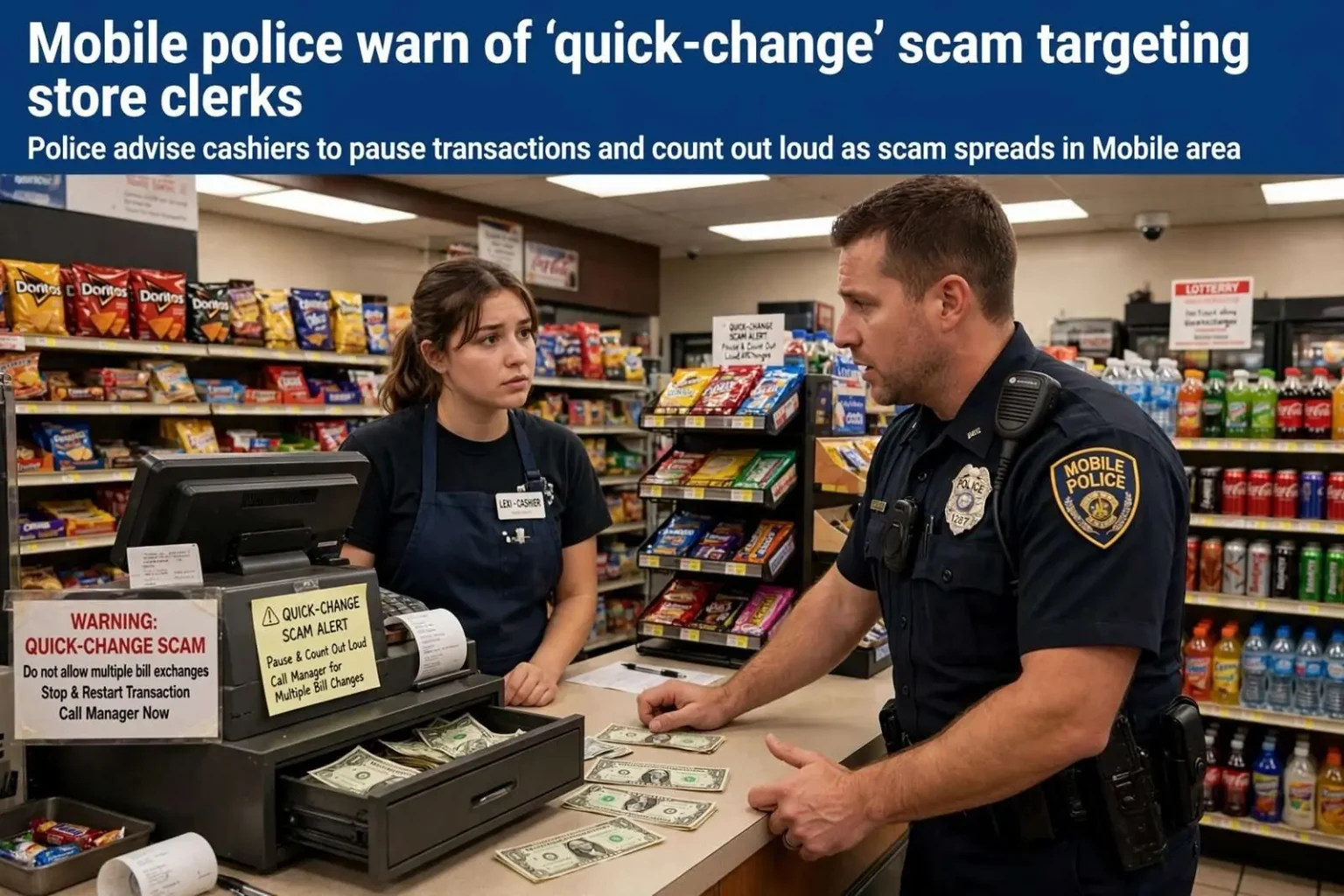
Mobile police recently issued an alert about a crime that often flies under the radar: the “quick-change” or “change-raising” scam. The scheme is designed to confuse a store clerk or bank teller into handing over too much change during a transaction, and it succeeds not through force or technology but through speed, patter and the natural awkwardness of a busy checkout counter. Unlike a smash-and-grab or a card skimmer, it leaves no damaged locks and no cloned cards — just a cash drawer that comes up short at the end of a shift, with no obvious suspect.
The technique has been around for generations, passed along among confidence artists precisely because it works on busy, well-meaning employees. A scammer approaches a register with a small purchase, pays with a large bill, and then — mid-transaction — requests a series of rapid changes: breaking the large bill into smaller ones, deciding against the purchase, asking for the big bill back, or mixing in smaller bills that make the arithmetic nearly impossible to track. Done smoothly, the exchange spirals faster than a clerk can reason through, and the scammer walks away with more cash than the drawer ever owed.
The gift of being able to talk
“A lot of it is the gift of being able to talk, say the right things — ‘I’m absent-minded today, I’m so sorry, I made a mistake,'” said retired police officer Bruce Walstad, an expert on fraud and confidence games. The apology is not decoration; it is the load-bearing part of the con. By framing every step as a harmless accident, the scammer lowers the clerk’s guard and makes it socially uncomfortable to slow down, re-count the money or call a manager. politeness, in this scheme, is the weapon.
Walstad’s career investigating frauds and confidence games has made him a frequent voice on schemes like this one, and his description matches what loss-prevention professionals across the country report: the quick-change artist is rarely threatening, rarely rushed and rarely memorable. The scammer relies on the moment feeling too trivial to escalate. By the time anyone suspects something, the transaction is over and the customer is gone.
Why so many cases never get reported
Much of the scam goes unreported, Walstad said, because the suspects usually walk away with only a few dollars at a time. A missing five or ten dollars in a busy register is easy to write off — machines miscount, employees make change mistakes, receipts get misplaced. If a clerk or manager notices the shortage, they may simply shrug it off. And if they do suspect a con and call police, the scammer’s entire script is built for that moment too: passed off as an honest mistake, an innocent customer who fumbled the math, the encounter tends to end without charges.
That low per-hit yield is exactly what makes the scheme viable for its practitioners. Individually forgettable, the losses are designed to fall below the radar of both store management and law enforcement — but they are not small forever.
When the losses add up
Some cases add up to far more than pocket change. Walstad said he has personally investigated instances where $150 to $180 was missing — a figure large enough to matter to any small business, and large enough to make clear that the “few dollars” framing hides real losses. Skilled scammers can hit multiple stores in a single day, working the same smooth routine at a gas station, a pharmacy, a grocery store and a big-box retailer before any one location realizes what happened.
Surveillance video posted by police departments around the country shows the thefts in action, and the footage is often startling in its ordinariness. In one widely circulated case, a scammer walked away with $220 from a convenience store after a frantic few minutes of bill-swapping. In another, at a Walmart in Albuquerque, scammers got away with $2,100 — a haul that turned a routine retail shift into a four-figure loss for a single location. Videos like these circulate in part because they double as training material: clerks who have watched a quick-change attempt on screen are far less likely to fall for one in person.
Why clerks fall for it
Understanding the scam starts with understanding the register itself. A cash drawer is a fixed arithmetic system: money in should equal sales plus change out. The quick-change attack deliberately scrambles that equation by nesting multiple exchanges inside a single transaction, so that no single step looks wrong even though the total is. A clerk who counts each handful of bills accurately can still lose money, because the error is not in any one count — it is in the sequence, which was engineered from the start.
Investigators also point to the social dynamic. Most cashiers are trained to keep lines moving and to accommodate customers, and questioning a polite shopper’s math feels rude. The scammer weaponizes that hesitation, adding apologies, small talk and false urgency at exactly the moments when the clerk might pause to re-count. What looks like conversation is actually a script, refined through repetition, designed to keep the clerk’s hands busy and the clerk’s mind one step behind.
Why Mobile’s alert fits in
Police departments issue alerts like Mobile’s when pattern behavior shows up locally — a series of similar attempts across stores in a short period, or a specific description circulating among loss-prevention networks. The alert is aimed primarily at the people on the front line: cashiers, tellers, shift managers and convenience store clerks, the employees who handle dozens of transactions an hour and cannot afford to slow every one of them down.
The standard advice from fraud investigators is consistent. When a customer begins changing instructions mid-transaction, stop the exchange and start over with the bills laid out on the counter, one denomination at a time. Close the drawer between steps. Never take back change while handing out new bills simultaneously. Count out loud. If the customer becomes insistent or the arithmetic becomes confusing, call a manager — the moment a second set of eyes arrives, the con collapses, because the scheme depends on isolating one employee in a fast-moving exchange.
A crime built for the holiday-season rush
Quick-change artists tend to time their work for maximum confusion — busy shifts, short-handed registers, new employees still learning the drawer. A flustered teenager on a Friday evening rush is a far better target than a veteran manager on a slow Tuesday morning, which is why retailers across the Gulf Coast see surges in attempted scams during peak shopping periods and summer months when staff turnover is highest. The Mobile alert serves as a reminder that the scheme costs stores real money precisely when they can least afford distraction at the register.
The crime is also cheap to attempt. There is no equipment to buy, no accomplice to split the take with and no risk of an alarm, which is why the quick-change artist is often a repeat offender who treats scamming as a routine rather than an opportunistic once-a-year crime. Stores that train their staff on the routine — and share descriptions across neighboring locations — take the profitability out of it, because a scammer who is recognized on entry will simply move on.
What local businesses can do now
For Mobile-area retailers, the practical steps are low-cost. Brief every cashier and drive-thru operator on the scheme, including the apology script that makes it work, so employees recognize the pattern in the moment. Post a simple rule at registers: one transaction, one exchange of money, no exceptions. Empower clerks to pause and call a manager without fear of slowing the line, and make sure managers know that small, repeated shortages are worth logging — a pattern in the register log is often the first evidence that a scammer is working the area.
Businesses that do fall victim should still report the loss, even when the amount is small. Unreported attempts are invisible to police, which means departments cannot warn other stores, connect descriptions across locations or spot the multi-store pattern that Walstad described. A series of “trivial” reports can add up to a case; scattered shrugs cannot.
The bottom line for clerks and customers
The quick-change scam persists because it exploits ordinary human traits — helpfulness, politeness and a reluctance to accuse a friendly customer of theft. The antidote is procedure, not suspicion: a cashier who follows a fixed money-exchange routine is immune to the patter, no matter how smooth the talker. Mobile police’s alert is less a warning about a new crime than a refresher on an old one, and the departments that share surveillance footage nationwide have proven the same lesson repeatedly — the stores that slow down the transaction keep their money, and the ones that let the conversation stay fast do not.
For everyday customers, the alert carries its own small lesson: if you see someone at a neighboring register spinning a clerk through an endless loop of bill exchanges, the best response is the one the scammer fears most — a manager walking over to ask if everything is all right.