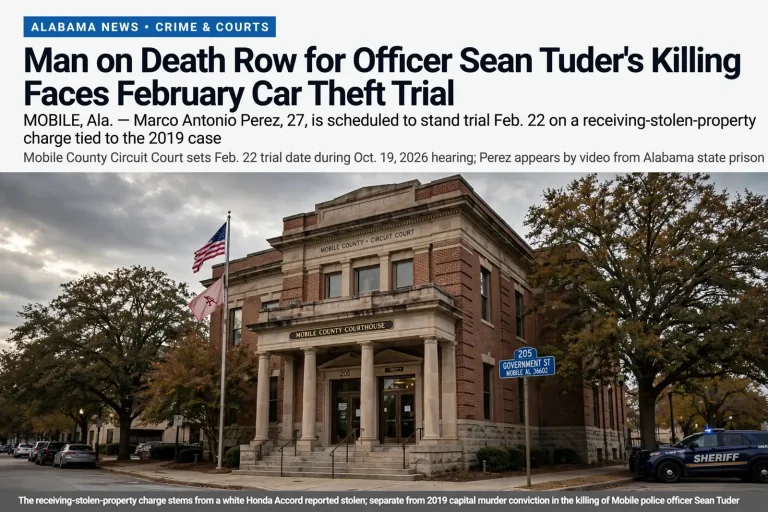
Juvenile in Custody in Andalusia as AI ‘Cat in the Hat’ Threat Trend Reaches Alabama Schools
Andalusia police say a juvenile is in custody after a threat was sent to a high school student on Snapchat, part of a national trend using AI-generated images of the Cat in the Hat character. Investigators say more suspects are possible.
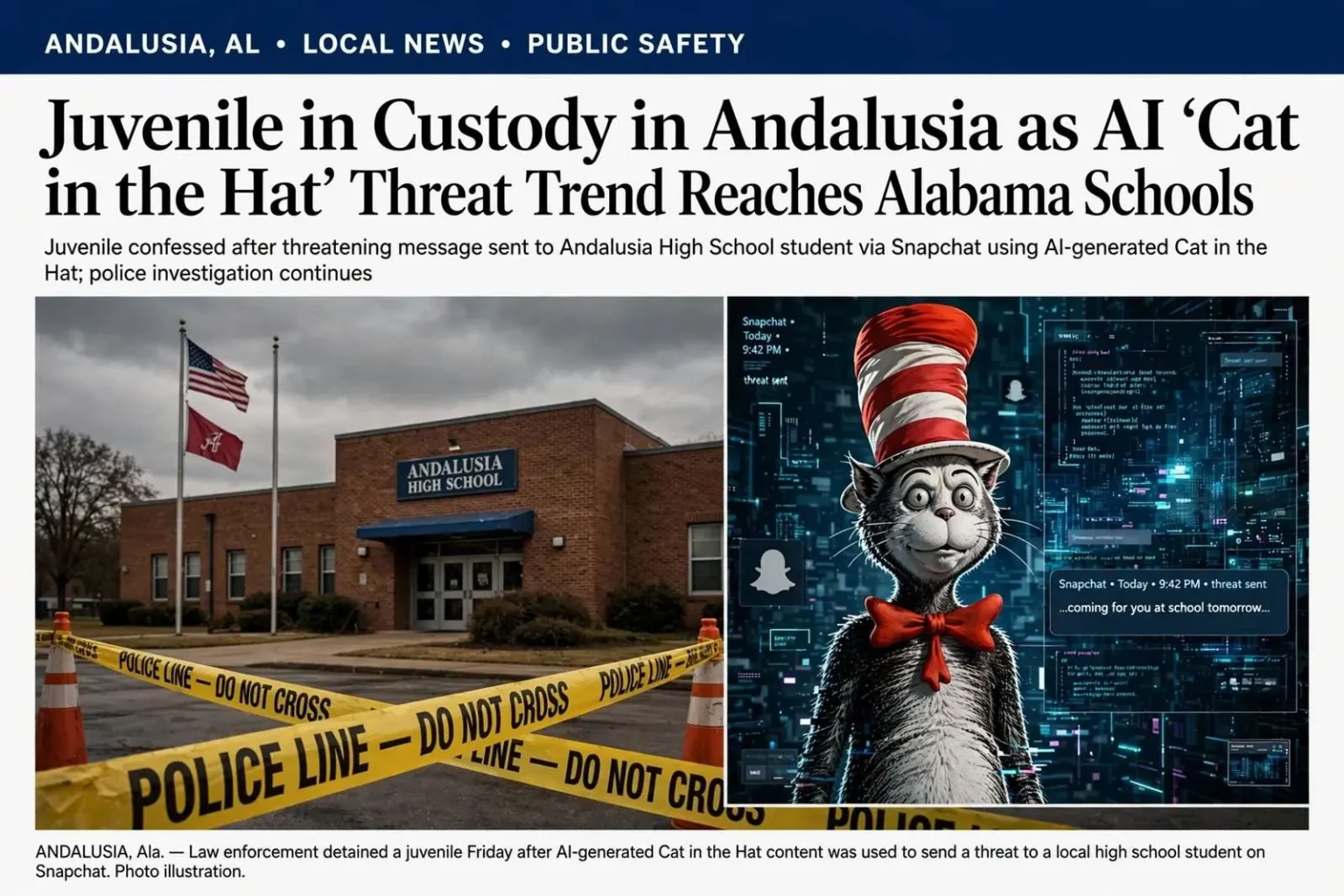
ANDALUSIA — A juvenile is in custody in south Alabama in connection with a national social media trend in which AI-generated images and videos of the “Cat in the Hat” character are used to make threats, authorities in Andalusia said.
School and police officials first received reports on a Sunday of a threat sent to an Andalusia High School student through Snapchat, according to the Andalusia Police Department. Because the suspect is a juvenile, authorities have not released a name, and this account does not include identifying details.
How Investigators Traced the Account
School resource officers and a detective identified the Snapchat account used to send the threat, then obtained a warrant, Andalusia police said. The warrant allowed investigators to determine who the account belonged to, which phone had been used to log into the platform and the IP address associated with the activity.
On Friday, the juvenile was interviewed and confessed, Capt. Brett Holmes said. Police did not say whether the juvenile is a student.
“In this case, the parent was 100 percent cooperative,” Holmes said. “She understood the severity of this cause and the disruption it has caused and continues to cause.”
Holmes said there are other potential suspects as the investigation continues.
The investigative sequence described by police is the standard one for anonymous online threats. Social media accounts feel anonymous to the people who create them, but the platforms retain subscriber and login records, and law enforcement can compel their production with a search warrant or other legal process. Login records typically include timestamps, device identifiers and the IP addresses used to connect. An IP address, in turn, can be traced back through an internet service provider to a subscriber account and a physical address, and mobile carrier records can narrow it further.
The practical result is that a message sent from a throwaway account is rarely anonymous once a warrant is served, and the interval between a threat and an identification is now often measured in days.
What the Trend Is
The trend began as a practical joke built on AI-generated imagery of the character from the 2003 live-action “The Cat in the Hat” film starring Mike Myers. Users generated unsettling images and short videos of the character and shared them for shock value.
Some observers have compared the spread of the material to the 2016 “killer clown” panic, in which sightings and hoax reports circulated widely, generated a heavy police response in many communities and produced far more disruption than actual violence.
What has changed since 2016 is the production cost. Generative image and video tools have collapsed the effort required to create realistic-looking content, and the same tools that let a person make a joke image in seconds let them make a threatening one just as fast. That has moved a category of content that once required real skill into the hands of anyone with a phone.
From Joke to Targeted Threats
Anonymous users have since escalated the trend to target children. Accounts using the Cat in the Hat name or likeness have called out individual students or schools “along with language suggesting that the character is ‘coming for them,’” according to a Facebook post from the Flemingsburg Police Department in Kentucky.
The content has spread across TikTok, Snapchat and Instagram. As of Sept. 2, none of those platforms had responded publicly to the trend.
The shift from generic creepy content to messages naming a specific school or a specific child is the point at which the trend stops being a meme and becomes a police matter. A message addressed to an identifiable student is a threat directed at a person, regardless of the cartoon wrapper around it.
What the School System Is Telling Parents
Andalusia City Schools Superintendent Dr. Daniel Shakespeare issued a statement about the local incidents and asked parents to take an active role.
“What we are asking of parents. Talk with your child about this trend,” he wrote. “Most of these videos are made with Ai and are not real, but a post or message that names a school or a student is treated as a real threat no matter who made it or why.”
“If an account connected to the trend messages your child, or your child sees a post naming one of our schools, our community, or a student, do not reply, share or comment,” the superintendent wrote.
He instructed parents and students to instead take a screenshot showing the account name and the date, and to report it the same day to school or police officials.
That advice reflects two practical realities. Replying or resharing amplifies the content and can push it to a wider audience of students, and the platforms’ own ephemerality features mean evidence can vanish: Snapchat messages are designed to disappear, and a screenshot captured at the moment may be the only durable record a school or investigator ever sees. Capturing the account name and date preserves the two details investigators need to serve legal process on the platform.
Why a Fake Threat Still Draws a Real Response
Schools and police departments do not have the option of waiting to see whether a threat is credible before responding. The standard practice is to treat every threat as real until it is investigated and cleared, which means officers deployed to campuses, administrators pulled into crisis response, counselors handling frightened students and, in many districts, parents pulling children out of school for the day.
Alabama law addresses threats of this kind through its criminal statutes on making a terrorist threat, which cover threats to commit violence that cause the evacuation or serious disruption of a building or public place, or the response of emergency personnel. The offense can be charged as a felony depending on the circumstances. Harassing communications and related statutes can also apply to threatening electronic messages.
Andalusia Police Chief Paul Hudson said the department has not previously sought restitution for the time involved in investigating a case of this kind but would do so if a case warranted it.
“We take all threats seriously,” he said. “This was a case of our kids at our school creating an issue. There were multiple events, and we encourage mamas and daddies to check their children’s phones to help prevent similar cases in the future.”
How Juvenile Cases Move Through Alabama Courts
A case involving a juvenile does not follow the adult track. In Alabama, delinquency petitions are filed in juvenile court, a division of the circuit court, and the proceedings are closed to the public. Juvenile records are confidential by statute, which is why agencies release so little identifying information — it is a legal requirement, not a courtesy.
Juvenile court is oriented toward supervision and rehabilitation rather than punishment. Dispositions can include probation, counseling, restitution to victims, community service, restrictions on device and internet use, and, in more serious cases, placement in a residential program. A juvenile is adjudicated delinquent rather than convicted, and the language reflects the different purpose of the system.
Serious offenses can be moved to adult court through a transfer hearing, at which a judge weighs factors including the nature of the alleged offense, the juvenile’s age and prior record, and the prospects for rehabilitation within the juvenile system. Restitution — the mechanism Chief Hudson referenced — is available in juvenile court and is typically ordered to compensate identifiable losses caused by the conduct.
What Parents Are Being Asked to Do
The guidance from both the school system and police converges on a few concrete steps: talk with children about the trend before they encounter it; do not reply to, share or comment on threatening posts; screenshot the account name and date; and report it the same day rather than waiting.
Officials also emphasized the point that appears to be least obvious to the people generating this content: the fact that an image was made by a machine does not make the consequences imaginary. A threat naming a school or a student is investigated as a threat, and the person who sent it is identified in nearly every case.
The Andalusia investigation is ongoing, and police have said additional suspects are possible.