Two Drivers Killed, Two Passengers Hurt in U.S. 31 Crash East of Evergreen
A Brewton man and a 19-year-old from Anniston were killed when two pickup trucks collided on U.S. 31 about two miles east of Evergreen. Two passengers were taken to a Montgomery hospital, and state troopers are still investigating.
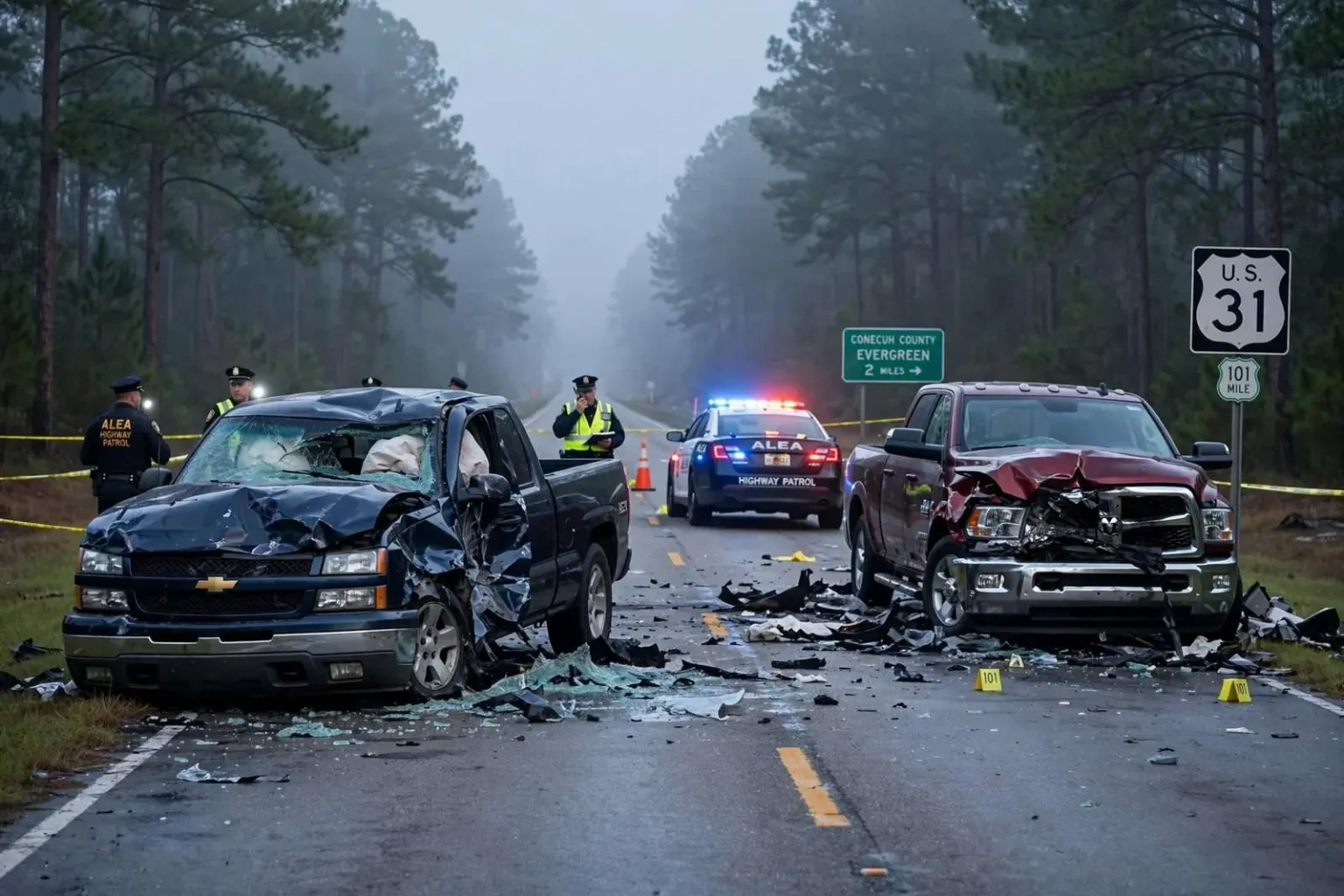
EVERGREEN — Two drivers were killed and two passengers were injured when a pair of pickup trucks collided on U.S. 31 in Conecuh County early Thursday morning, according to the Alabama Law Enforcement Agency.
The crash happened around 6 a.m. Thursday, Sept. 3, near the 101 mile marker on U.S. 31, roughly two miles east of Evergreen. Troopers with ALEA’s Highway Patrol Division are still working the case, and the agency said no additional information was available as the investigation continues.
The Two Drivers Who Died
ALEA identified the men killed as Willie L. Likely Jr., 47, of Brewton, and Dalton G. Dustin, 19, of Anniston. Both were driving the vehicles involved, according to the agency.
Likely was at the wheel of a 2005 Chevrolet Silverado. Dustin was driving a 2012 Ram 2500. The two trucks collided, and both men were pronounced dead at the scene. Troopers said Dustin was not wearing a seat belt.
Two passengers in the Chevrolet were hurt. ALEA identified them as Raylen A. Best, 26, of Eastaboga, and Joshua T. Weber, 24, of Ranburne — both east Alabama communities. Neither was using a seat belt at the time of the collision, according to the agency. Both were taken to Baptist Medical Center South in Montgomery for treatment.
The agency has not released the conditions of the two injured passengers, and it has not said which direction either truck was traveling or what caused the vehicles to collide.
Why the Location Matters
Evergreen is the seat of Conecuh County and sits at the point where Interstate 65 and U.S. 31 run close together through the pine belt of south-central Alabama. U.S. 31 is the older of the two roads — a two-lane federal highway that carried most of the north-south traffic between Mobile and Montgomery before the interstate was built alongside it.
Roads like that one still carry a heavy mix of local commuters, agricultural equipment, log trucks and long-haul traffic that leaves the interstate for fuel or a shorter route. Two-lane undivided highways account for a disproportionate share of fatal crashes nationally, because there is no median or barrier separating opposing traffic and because closing speeds in a collision between two vehicles traveling in opposite directions are far higher than in a same-direction crash.
The 6 a.m. timing places the crash in the pre-dawn commute, when light is low and the roadway is often shared by drivers heading to early shifts.
What Troopers Do at a Fatal Crash Scene
ALEA was created in 2015 when Alabama consolidated a group of separate state law enforcement agencies, including the old Department of Public Safety, under a single umbrella. Its Highway Patrol Division is the primary investigating agency for crashes on state and federal highways outside municipal limits, which is why troopers rather than a city police department are handling this one.
A fatal crash investigation is a slower and more technical process than a typical wreck report. Troopers document the scene before anything is moved: the final resting positions of the vehicles, tire marks, gouges in the pavement, debris fields and the point of impact. Many agencies now use total-station survey equipment or drone photogrammetry to build a scaled diagram of the scene that can later be used to calculate speeds and angles.
Investigators also examine the vehicles themselves. Most modern passenger vehicles store a few seconds of pre-crash data — speed, throttle position, braking, seat belt status — in an event data recorder, sometimes described as the vehicle’s black box. Downloading that data typically requires a warrant or consent and is done after the vehicles are towed.
Toxicology results, when they are sought, are processed by the Alabama Department of Forensic Sciences and generally take weeks to months to return. That is one reason state agencies routinely decline to discuss cause in the days after a fatal crash: the analytical work that would support any conclusion has not been completed.
The Seat Belt Detail in the Report
ALEA specifically noted that three of the four people involved — one driver and both passengers — were not wearing seat belts. Troopers include that detail in nearly every fatal crash release, and it is not incidental.
Alabama law requires drivers and front-seat passengers to wear seat belts, and the requirement was extended in 2019 to cover passengers in every seating position, including the rear seat. Front-seat belt violations are enforced as a primary offense in Alabama, meaning an officer can stop a vehicle for that reason alone.
The safety rationale is straightforward. In a collision, an unrestrained occupant continues moving at the vehicle’s pre-impact speed until something stops them — a steering wheel, a windshield, a door pillar or the pavement. Ejection from a vehicle is among the most lethal outcomes in a crash, and it is overwhelmingly associated with unrestrained occupants. Airbags are designed as a supplemental restraint intended to work with a belt, not in place of one; an unbelted occupant can be thrown out of position before the airbag can do its job.
Rural crashes carry an additional layer of risk. Emergency response times are longer, the nearest trauma center may be an hour or more away, and the interval between the crash and definitive surgical care — what trauma physicians call the golden hour — is harder to protect. In this case, the two injured passengers were transported to Montgomery, roughly 80 miles north of the crash site.
What Happens Next
Troopers will complete a crash reconstruction and forward their findings, along with any toxicology and vehicle data, to the district attorney’s office for the judicial circuit that includes Conecuh County. Prosecutors then decide whether the evidence supports any charge. In a crash where both drivers were killed, there may be no living person to charge, and the investigation ends with a determination of cause for the official crash report.
Those reports feed into ALEA’s statewide crash database, which the state and the Alabama Department of Transportation use to identify road segments with clusters of severe crashes. Engineering responses to such clusters can include centerline rumble strips, wider paved shoulders, improved striping, added lighting or changes to intersection geometry.
ALEA said nothing further was available Thursday. The agency typically releases a fuller account only after the reconstruction is finished, which can take several weeks.