Three Golden Ages and a Silver One: Reading Mobile’s History in Its Buildings
In a March 2005 series on Mobile's golden age, attorney Palmer Hamilton argued the city had three of them, and that the proof stands in its churches, schools and antebellum houses.
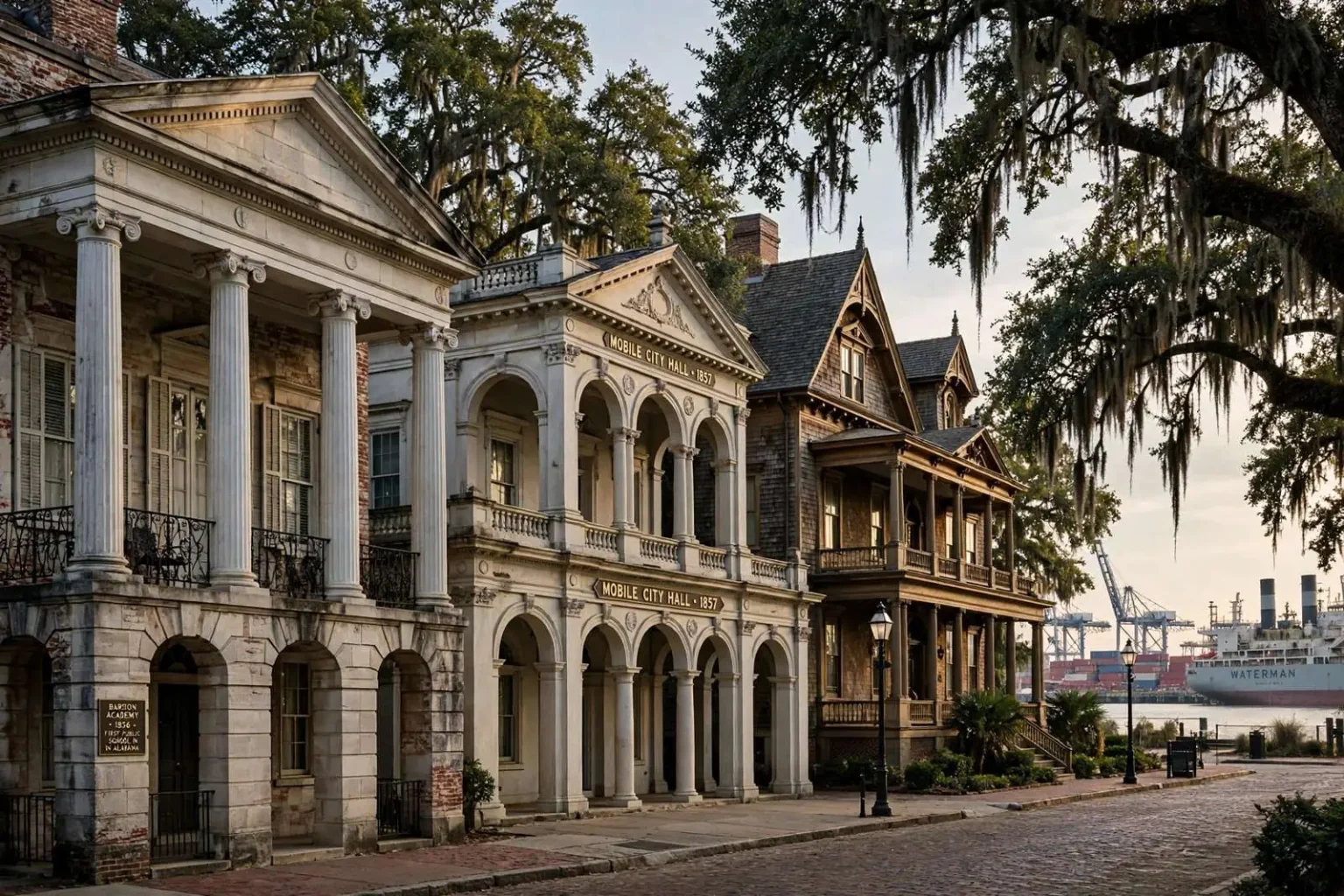
MOBILE — When Mobilians were invited in the spring of 2005 to name the city’s golden age, the attorney Palmer C. Hamilton declined to pick just one. There were, he argued, three golden ages — and one silver one — and the evidence for each is still standing on the streets of the city, legible to anyone who knows how to read a facade.
The first: boom and bust, 1830s
The first golden age ran from the early 1830s to the Panic of 1837, when cotton prices collapsed. It was brief and it was spectacular. Mobile boomed, the population skyrocketed, and the building that followed produced some of the city’s enduring landmarks: Barton Academy, Government Street Presbyterian Church, Christ Episcopal Church and the Cathedral.
The boom of the 1830s rode the twin engines of cotton and steam. Alabama’s Black Belt was filling with plantations, and Mobile — the only deepwater port on the northern Gulf — became the funnel through which the crop reached the mills of Liverpool and New England. Bales flowed downriver; credit, goods and people flowed back up. In little more than a decade a frontier river town acquired an institutional skyline, and the buildings raised in those years still anchor the street grid: Barton Academy, the state’s first public school building and now its education landmark; Government Street Presbyterian, one of the finest Greek Revival interiors in America; Christ Episcopal; and the Cathedral of the Immaculate Conception, the seat of the archdiocese that made Mobile the Catholic center of the Deep South.
Prosperity alone does not produce great architecture, Hamilton noted. Leadership does — and in this case, one man in particular: Henry Hitchcock.
Hitchcock was Alabama’s first man of great wealth, and a grandson of Ethan Allen of Revolutionary War fame, from whom he inherited a considerable religious skepticism. In the mid-1830s he was converted by the Rev. William T. Hamilton of Government Street Presbyterian Church. It was the minister’s good fortune that Hitchcock then put his fortune behind the church — and, crucially, that he encouraged the noted Greek Revival architects Charles Dakin and James Gallier to relocate to Mobile.
The Hitchcock story explains why a modest river port got first-rank architecture rather than merely adequate buildings. Wealthy men in boomtowns typically spend on themselves; Hitchcock spent on institutions, and he recruited at the highest level of the profession to do it. Gallier went on to fame as the architect of New Orleans, and Dakin’s practice shaped both cities’ antebellum cores — a reminder that in the 1830s, Mobile and New Orleans were sister ports competing on the same cotton river, importing the same fashionable architects from the East.
While here, Dakin and Gallier designed both the Presbyterian church and Barton Academy at Hitchcock’s behest. Other buildings for which he was responsible have been lost, the greatest of them the United States Hotel at the corner of Government and Royal streets — a structure beside which, Hamilton contended, most state capitols pale.
The loss of the United States Hotel is the standard example of what Mobile’s fire, demolition and redevelopment have cost it. The building stood at the head of Royal Street in the heart of the commercial district, and contemporaries ranked it among the great hotels of the antebellum South. Hamilton’s claim — that state capitols would pale beside it — is the kind of flourish an advocate allows himself; the point underneath is that the city’s lost 1830s were, by the testimony of those who saw them, its most ambitious.
The lean years, and the second age
The late 1830s and 1840s were hard. The architectural record makes the point on its own: almost no surviving houses in Mobile date from the 1840s. There are more from the 1830s and more from the 1850s, and comparatively little in between.
The decade-long silence in the building record is the most eloquent document the era left. When cotton prices stayed low and credit dried up, construction simply stopped, and a city that had been raising landmarks in 1836 raised almost nothing through the 1840s. Architectural historians reading any boomtown’s fabric learn to date prosperity by these gaps, and in Mobile the 1840s hole is unmistakable.
Cotton prices did not recover to earlier levels until the 1850s, which brought the city’s second golden era. As prices rose, construction blossomed again — Mobile City Hall, the old Customs Building, and most of the antebellum homes that survive today.
The 1850s rebuilt the city on a more permanent footing. The market house and city hall on Royal Street — with its open arcades at street level — and the federal customs building announced that Mobile was no longer a boom camp but an established port with institutions to match. Most of the grand residences that define the historic districts today date from this decade: the columned houses of Government, Government Extension and the side streets south of Dauphin, built by cotton factors, merchants and steamboat interests for whom the recovered market finally justified the expense. When visitors picture “antebellum Mobile,” they are picturing the second golden age almost exclusively.
The city was more than a commercial center in those years. It was a cultural and financial capital in its own right. Hamilton offered a telling illustration: Stephen Douglas, the Illinois senator and 1860 presidential candidate, spent election night in Mobile at the offices of the city’s newspaper.
The detail rewards a second look. Douglas was running for president of the United States on the northern Democratic ticket while the party split itself apart over slavery, and he chose to await the returns not in Chicago or Washington but in the Deep South’s second port, at a newspaper office in a city whose politics he knew intimately. Whatever the exact calculation behind the choice, the anecdote captures a Mobile that belonged to the national conversation — a place where a national candidate could feel, on the most consequential night of his life, that he was among his own people.
Newspapers in Liverpool and London, he noted, wrote simply of “Mobile” — not “Mobile, Alabama.” The city was large enough and important enough to be better known abroad than the state that contained it. Perhaps, he suggested, that is the genesis of Mobile’s enduring sense of itself as a city-state.
The Liverpool reference is precise, not rhetorical. Liverpool was the world’s cotton market, and Mobile was one of the few places on earth whose name moved that market. A broker’s ledger in Lancashire needed no state designation to know what Mobile meant, the way it needed no clarification for New York or Havre. From that era dates the civic self-regard that Mobilians have carried ever since — the conviction that their city is a distinct thing, not an appendage of Montgomery or Birmingham, and that its history is different in kind from the rest of Alabama’s.
The silver age: timber
Before the third golden age came what Hamilton called the silver age — the years before World War I, when timber was king. Many of the mansions along Government Street were built in this era by lumber barons whose fortunes came out of the pine forests of south Alabama.
The timber decades transformed the region’s economy as thoroughly as cotton had. As the longleaf pine forests of Washington, Escambia and surrounding counties were cut and milled, the new railroads hauled lumber to Gulf ports, and Mobile’s wharves filled with pine rather than bales. The fortunes that industry minted are the ones written in the shingle-style and colonial revival mansions of west Government Street and Ashland Place — houses built a generation after the antebellum wonders, by men whose money grew on trees in the literal sense. It is a “silver” age, in Hamilton’s framing, because the city’s trajectory was maturing rather than booming: established wealth building established neighborhoods.
The third: the 1940s and 1950s
Mobile’s final golden age, in Hamilton’s telling, came in the 1940s and 1950s, when the city tripled in size. Waterman Steamship was headquartered here and was the third-largest steamship line in the world.
The war years remade the city more completely than any boom before them. Brookley Field and the shipyards drew tens of thousands of workers south, many of whom stayed; housing spreads out west and north along the new highways; and the port, revived by Waterman’s postwar expansion, made Mobile a genuinely global shipping name once more. A city that had been a modest river port of moderate size in the 1930s emerged from the 1950s as a major Gulf industrial center — the fastest transformation in its history, and the one whose subdivisions, schools and church complexes now house most of its population.
He made a further claim, and a pointed one. While Birmingham and much of the rest of the South were entering the racial turmoil of the civil rights era, Mobile desegregated. The city did not resolve all its issues in that regard, he acknowledged. But it stood in stark contrast to the Magic City. Like Atlanta, he wrote, Mobile was a city too busy to hate.
The comparison to Birmingham is the sharpest point in Hamilton’s framework. Birmingham’s 1963 — the dogs and fire hoses, the church bombing — became the era’s defining image of Southern resistance, while Mobile’s civic and business leadership pursued a quieter path of negotiated accommodation: biracial committees, desegregation without mass confrontation, an orderly if imperfect transition. The Atlanta comparison supplies the slogan, but the substance was Mobile’s own: a port city accustomed to commerce with the whole world proved less willing to strangle its own economy over segregated lunch counters. It was a self-flattering reading, as Hamilton admitted, but it reflected a real difference in how the two cities passed through the same storm.
Why the buildings matter
The through-line of Hamilton’s argument is that architecture is a ledger. Prosperity leaves stone and brick behind; hard times leave gaps. Walk from Barton Academy to Government Street Presbyterian to the lumber-baron houses further west, and you are walking through the balance sheets of two centuries.
Read that way, the city becomes a document anyone can consult. The Greek Revival landmarks of the 1830s record the first cotton boom and the men who led it. The gap of the 1840s records the crash. The arcades and columns of the 1850s record the recovery; the timber mansions of the early 1900s record the pineywoods economy; the mid-century spread records the war and the port’s revival. No single building tells the story — the dates and styles do the accounting themselves, block by block, for anyone who learns the key.
The framework also explains what is at stake in preservation fights, a subject with which Mobile has long wrestled. A city’s architectural record is the only unforgeable record of its economic history; when a lost building is demolished, the ledger line is destroyed, not archived. Hamilton’s tour — delivered as the city was pouring money into its downtown revival in 2005 — was in part an argument for treating the surviving fabric as irreplaceable evidence, and in part a civic pep talk: the buildings demonstrate that Mobile has been rich before, and can be again.
They also demonstrate something subtler about how cities recover. Every one of Hamilton’s golden ages followed a bust: the 1850s came after the 1840s; the timber silver age followed Reconstruction’s collapse; the postwar boom followed the Depression. The architecture says that Mobile’s history is not a straight line but a series of contractions and expansions, each leaving its record in brick.
“Interesting the way architecture can tell you a lot about a city,” he concluded, “including its prosperity or lack thereof.”
That closing sentence compresses the whole argument into a single observation, and it is the reason the spring 2005 exercise was worth doing at all. Cities tell their stories through museums and markers, but the most reliable telling is passive and permanent: the buildings that happened to survive, standing exactly where the money that raised them put them. Three golden ages and a silver one — the sequence is there on the streets of Mobile, free to anyone who walks the blocks between Barton Academy and the lumber barons’ houses and knows what the facades are saying.