Jury Rejects Reckless Murder, Convicts Wilmer Man of Manslaughter in Death of Runner Victor Birch
A Mobile County jury convicted Aubrey Aaron Pate of reckless manslaughter in the 2022 death of postal worker and runner Victor Birch, declining to convict him of reckless murder. Sentencing is set for Sept. 18.
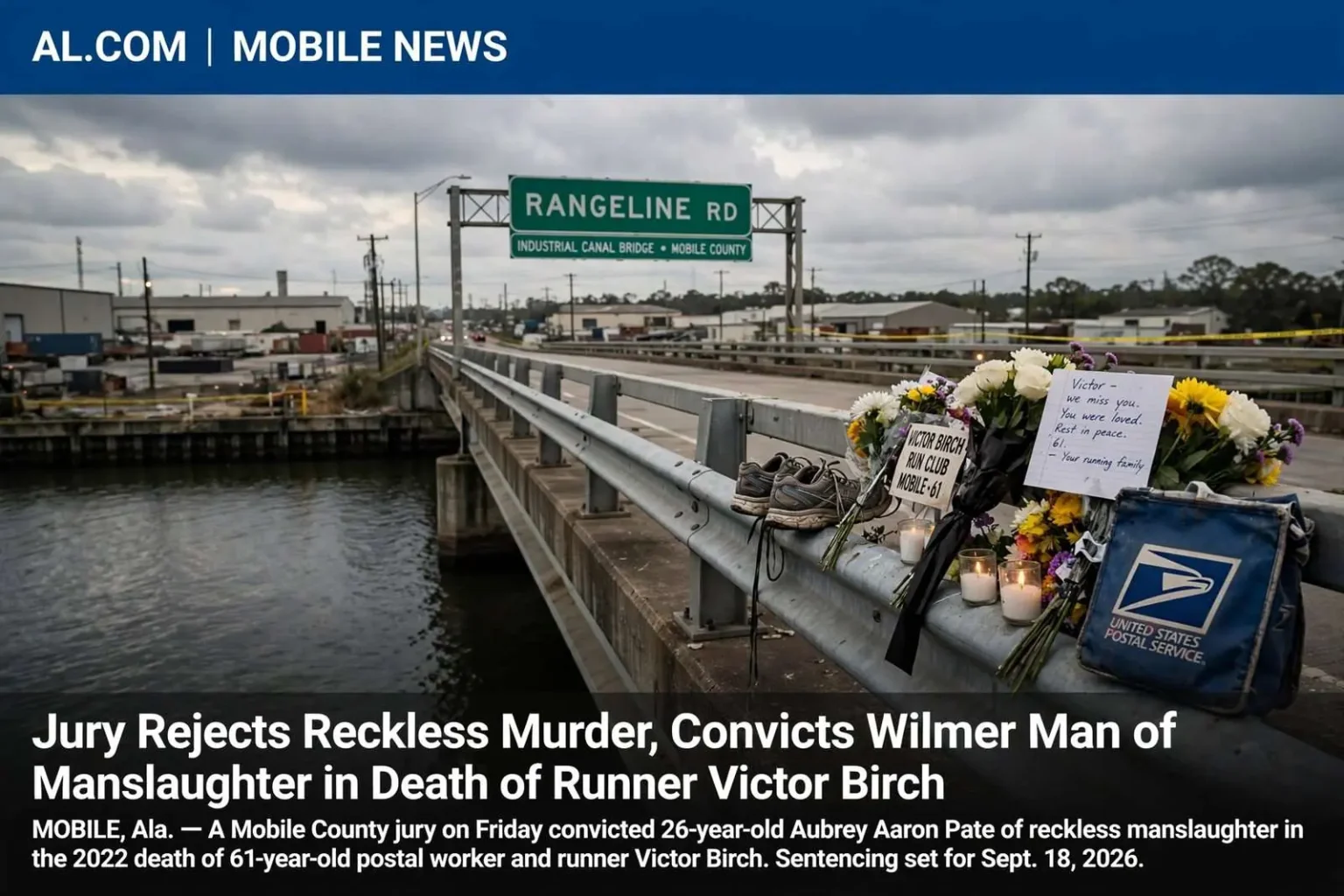
MOBILE, Ala. — A Mobile County jury has convicted a Wilmer man of reckless manslaughter in the 2022 death of Victor Birch, a well-known postal worker and runner, declining to convict him of the more serious reckless murder charge the state had brought.
Aubrey Aaron Pate, 26, was tried on a reckless murder count stemming from a head-on collision on the bridge over the Industrial Canal on Rangeline Road on Sept. 25, 2022. The jury returned its verdict Friday on the lesser included offense of reckless manslaughter. Sentencing is set for Sept. 18, 2026.
The crash killed Birch, 61, a U.S. Postal Service employee who was active in a local running group and widely known both on his carrier routes and among fellow runners. Pate was 23 at the time of the collision.
Mobile County District Attorney Keith Blackwood, who announced the verdict, framed the case as both a loss and a warning.
“This case is a devastating reminder that choosing to drive after consuming alcohol and drugs can have irreversible consequences,” Blackwood said. “Victor Birch did nothing wrong. He was simply driving down the road when his life was taken because of the reckless decisions of another person. A jury has held Aubrey Pate accountable for those decisions and for the life that was lost as a result.”
The crash on Rangeline Road
The Industrial Canal bridge carries Rangeline Road over the waterway that separates Prichard and the Chickasaw area from the industrial waterfront, and it is a corridor many commuters use daily between northwest Mobile County and the city. Head-on collisions on the narrow bridge span are among the most dangerous crashes that occur there — there is little margin, and the geometry of the bridge leaves no room for evasive maneuvers once two vehicles are closing on each other in the same lane.
Prosecutors said Pate’s pickup truck crossed into oncoming traffic and struck Birch’s car head-on.
Birch combined a career with the Postal Service with an active life in Mobile’s running community. Runners who log early miles around Mobile know the roads that way, and his death struck the local running group he was part of as a loss both personal and public, felt across the routes he regularly covered and the postal routes he served.
What the jury heard
Prosecutors told jurors the evidence would show a blood-alcohol content between .05 and .095, along with marijuana in Pate’s blood and urine, and argued that both substances were actively affecting his driving.
The state also called expert witnesses to testify about the combined effects of alcohol and marijuana on a person’s ability to operate a vehicle safely. Prosecutors argued that Pate’s decision to drive under those circumstances, followed by the fatal head-on collision, demonstrated the extreme indifference to human life that the reckless murder statute requires.
Expert witness Ronnie Redding testified that the pickup travelled between 77 and 81 mph and did not brake until roughly half a second before impact. “He did a lane change, with the pickup carrying into the northbound lane for 3.5 seconds, and then he swerved,” Redding said.
Pate testified in his own defense. He acknowledged sharing a joint with friends two days before the crash and drinking a beer the night before it, but maintained he was not impaired when he got behind the wheel. Defense attorney Jeff Deen characterised the collision as a tragedy that belonged in civil court rather than a criminal one, told jurors Pate had been the designated driver, and noted that both drivers were exceeding the speed limit.
The case was prosecuted by Assistant District Attorneys Ashley Rich and Megan Everett, with Trial Coordinator Carolyn Lambeth and Mobile County District Attorney’s Office Chief Investigator Don Boykin.
Reckless murder and reckless manslaughter are different offenses
Alabama is unusual in that it allows a death caused by impaired driving to be charged as murder rather than only as a form of manslaughter. The state’s reckless murder statute applies when a person causes a death by acting with extreme indifference to human life. It is a Class A felony, carrying a range of 10 to 99 years or life.
Reckless manslaughter, the offense the jury settled on, punishes a death caused recklessly — the defendant consciously disregarded a substantial and unjustifiable risk — without the extreme-indifference element the murder statute demands. It is a Class B felony in Alabama, carrying a range of two to 20 years.
The gap between those two offenses is precisely what the jury was asked to decide. By acknowledging alcohol and marijuana use before the crash while denying impairment at the time of it, Pate put the state to the task of proving not merely that the substances had been consumed but that they were still working on him at the wheel — and that his conduct rose to extreme indifference rather than ordinary recklessness. The verdict indicates the panel was satisfied on recklessness but not on the higher standard.
An unusually long path to trial
The case moved through a route to trial that even experienced local court watchers described as unusual. It went before three separate grand juries.
In March 2023, the first grand jury declined to indict, with prosecutors citing insufficient evidence at that stage. A no-bill means the case stalls at its first gate, and presenting the same facts again is not automatic; it requires new evidence, a renewed request from the prosecution, or a change in how the case is framed. In April 2023, after new evidence emerged, a second grand jury returned a manslaughter indictment. A third grand jury later elevated the charge to reckless murder, which is the count that went to trial.
Speaking after charges were finally brought, Birch’s eldest brother, Erich Birch, described the years of waiting. “The fact that he was not indicted and was not having to answer for what he did was very hard to take,” he said. He called the indictment “a huge sigh of relief that something is going to be done. But nothing done is going to bring Victor back.”
Trials arising from fatal crashes are among the most evidence-intensive cases a circuit court handles. Prosecutors must present the scene reconstruction — skid marks, vehicle damage, final resting positions — along with toxicology results, timeline records, and the testimony of everyone who saw the vehicles in the hours before impact. The defense tests every link in that chain. In a head-on collision case on a canal bridge, where both vehicles’ paths must be reconciled with the physics of the impact, that work took on added complexity that jurors saw laid out piece by piece.
Taking the stand
Defendants in murder trials are not required to testify, and most do not. Pate’s decision to take the stand made his account the centerpiece of the trial’s final phase, and it allowed prosecutors to confront him directly with the state’s toxicology and crash-reconstruction evidence.
Juries weigh those questions against the full picture — the reconstruction of the head-on impact on the canal bridge, the timeline of the evening, the science of how long each substance remains measurable and how long it remains active, and the credibility of the person in the witness box. The split verdict — guilty of the lesser offense, not the greater — is the answer that panel reached after hearing all of it.
What comes next
Pate is scheduled to be sentenced Sept. 18, 2026. As a Class B felony, reckless manslaughter carries a sentencing range of two to 20 years, and the judge will weigh Alabama’s sentencing guidelines along with arguments from both sides.
Sentencing hearings in cases of this kind typically include statements from the victim’s family. The defense also retains post-trial options — a motion for a new trial, and an appeal to the Alabama Court of Criminal Appeals — which are routine in cases of this gravity.
The wider toll of impairment-related crashes
Cases like this one are the reason Alabama prosecutors pursue impaired-driving deaths under the felony statutes rather than treating them solely as traffic matters. A head-on collision at speed leaves the occupants of the struck vehicle with almost no opportunity to protect themselves, and the bridge setting on Rangeline Road made the physics of the Sept. 25, 2022, crash unforgiving.
Enforcement and education campaigns across Mobile County continue to press the message the verdict underscores: impairment does not begin and end with a blood-alcohol number, and a driver who cannot account for what is still active in his system is gambling with the lives of everyone on the road.
For the running and postal communities that knew Victor Birch, the verdict marks the legal system’s finding on the crash that took him. It does not restore the early-morning miles, the routes he covered for the Postal Service, or the presence he carried in a local running group — but it does close the trial phase with a jury’s determination that his death was a crime, not an accident without fault.
Correction: An earlier version of this article stated that the jury convicted Pate of reckless murder and described the sentencing exposure as that of a Class A felony. The jury convicted him of the lesser included offense of reckless manslaughter, a Class B felony. The article has been corrected throughout.