Coy’s Rules: The Three Commandments a Mobile County Commissioner Left Behind
Former Commissioner Bay Haas recalled the three rules of political survival handed down by the late Coy Smith, a ballplayer, saloon keeper and commissioner whose career ended in a federal investigation.
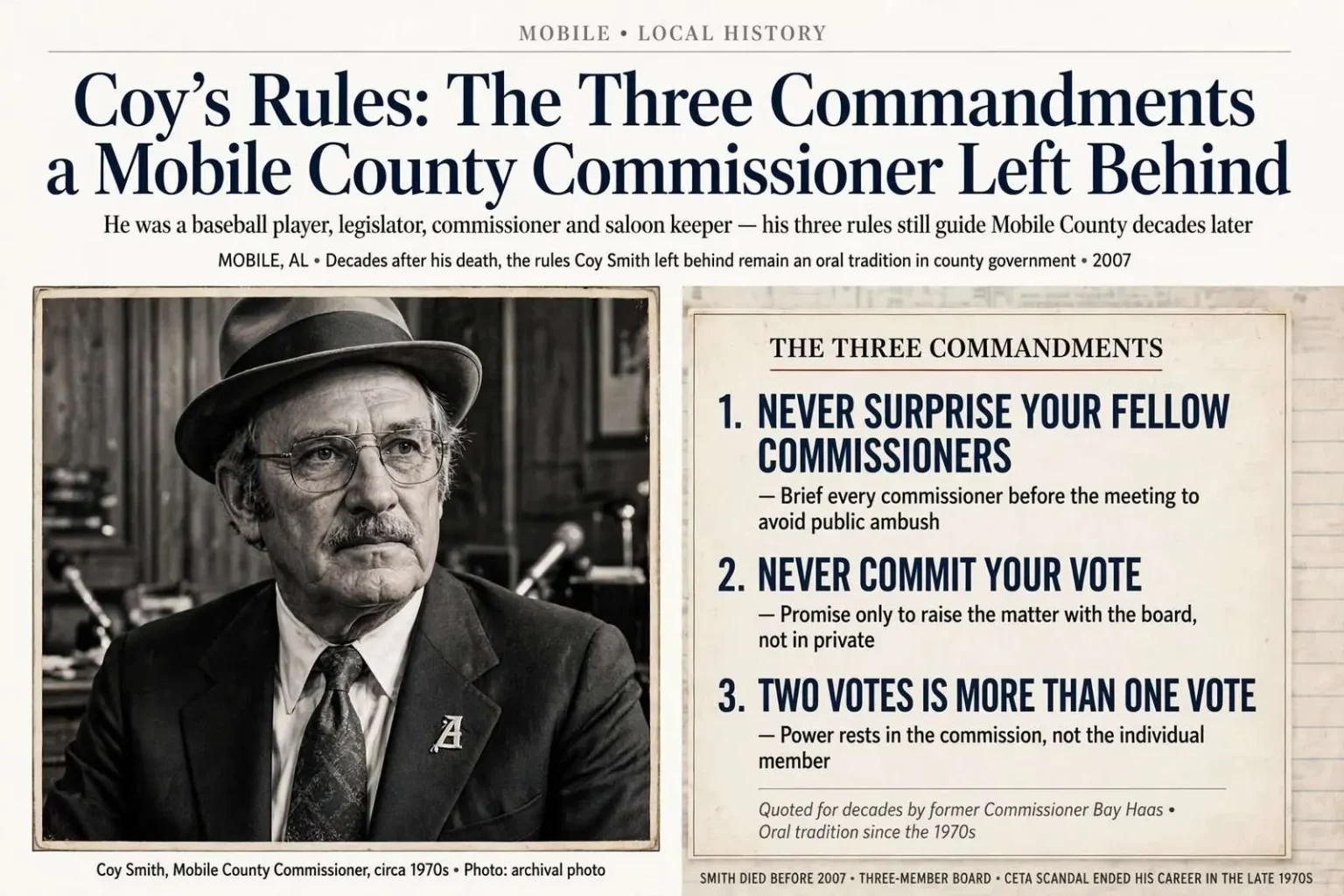
He was a professional baseball player, a Democratic state legislator, a Mobile County commissioner and a saloon keeper, and his political career ended in the wreckage of a federal investigation. But before it did, Coy Smith left behind three rules that a fellow commissioner still quoted decades later.
Smith, long dead by 2007, had been a popular and successful local politician of an earlier Mobile until he was tripped up in a federal investigation of the Comprehensive Employment and Training Act program, the federal jobs initiative of the 1970s that funneled public money through local governments and became, in more than one American city, a magnet for scandal.
Whatever his faults, said former County Commissioner Bay Haas, Smith understood how a small governing board actually works, and he was willing to explain it to anyone young enough to listen.
The resume itself explains why anyone listened. Professional baseball, the legislature, the county commission and the saloon business are four separate educations in how people behave when money and ambition are in the room, and Smith had all four. In an era when Mobile County government was run by courthouse regulars who learned their trade by apprenticeship rather than by handbook, Smith’s rules were the closest thing the institution had to a written manual — and they were passed along, deliberately, to the members who followed him.
Rule one: never surprise your fellow commissioners
“You have to discuss every single item you bring up in a meeting with every commissioner before the meeting,” Haas said. “This avoids intentional embarrassment of any member.”
On a three-member board, the ambush is the most tempting weapon available and the most corrosive. An item sprung without warning forces colleagues to vote in public without preparation, which is precisely why it is done.
Smith’s rule was a peace treaty: no member should ever have to learn about a proposal at the same moment as the audience.
The arithmetic of a three-member body gives the rule its force. With only two votes needed to pass anything, a commissioner who is surprised — or embarrassed — has exactly one natural response: find the third member and punish the ambusher by blocking his next item. An ambush, in other words, costs more than it gains, because on a board that small there is nowhere to hide afterward. The county commission districts divide Mobile County three ways, and members who represent overlapping constituencies must work with each other indefinitely; Smith’s rule kept those working relationships intact by removing the one behavior that poisons them.
Rule two: never commit your vote
“If someone asks you to support or oppose something, you never commit to support or oppose them,” Haas explained. “You may express favor or opposition, but the action you commit to is to take it up with your fellow commissioners. This encourages discussion and avoids isolating a member.”
The rule sounds like evasion and is actually its opposite. A commissioner who promises a vote in a private conversation has surrendered his judgment before hearing the arguments, and has cut his colleagues out of the decision. A commissioner who promises only to raise the matter with the board has preserved both.
The distinction also protects the requester. A citizen, contractor or lobbyist who extracts a private yes has gained nothing binding, and a public commitment extracted in private is the raw material of exactly the corruption investigations that later ended Smith’s own career. The rule’s discipline — speak to the board, not to the hallway — is the same discipline ethics laws would eventually impose from outside.
Rule three: two votes is more than one vote
“What he meant was that no individual commissioner has any authority,” said Haas, who was among the commission’s first Republican members. “All of the power rests in the commission and none in the individual member.”
This is the hardest lesson for anyone who has just won an election. Voters elect a commissioner to do things; the law empowers him to do almost nothing alone. Roads are paved, contracts are let and budgets are adopted by a majority of the body, which in a three-member commission means two people who agree.
For a new officeholder, the gap between the campaign and the office can be disorienting. A commissioner spends a campaign promising drainage projects, road work and jobs — and then arrives to discover that his signature moves nothing, that his district’s needs are met only when he can assemble a coalition with one other member, and that the committee chairmanships, agenda control and staff all belong to the body. Smith’s third rule compressed that discovery into a sentence: the commission is the office, not the commissioner.
Why the rules survived their author
“The rules are really about how any board must operate in order to function effectively,” Haas said. “Coy expressed them with a little more color, and it took me quite a while to fully understand them. While we disagreed more often than not, he was a master in the art of politics.”
The endorsement carried a certain weight because of who was giving it. Haas, a Republican who was preparing to retire in June as executive director of the Mobile Airport Authority, had spent much of his public life on the other side of the aisle from Smith. He had also lived long enough in Mobile County government to know the difference between a politician who wins elections and one who can actually pass something.
That difference is the rules’ real subject. Mobile County’s political history is full of officials who won election after election and left office having passed little, because they never learned that a small board runs on preparation, restraint and coalitions rather than on mandates. Smith — a Democrat whose career ended in disgrace — understood the mechanics better than many who never stumbled, and the fact that his rules survived him while his reputation did not is a measure of how good the advice was.
Haas’ own career made the tribute credible. As a commissioner he had been, by his account, Smith’s frequent opponent, and as the longtime head of the Mobile Airport Authority he had spent decades watching boards — the airport authority’s among them — function or fail on exactly the habits Smith described. Passing the rules along was not nostalgia for Coy Smith the man. It was an acknowledgment that the operating manual was correct even if its author was not.
A cautionary footnote
The CETA investigation that ended Smith’s career was a reminder that mastery of the art of politics is not the same as mastery of oneself. The program, created by Congress in 1973 to train and employ the jobless, put substantial discretion and federal cash in the hands of local officials, and federal prosecutors across the country eventually followed that money.
CETA’s design made it a scandal machine almost by construction. The act distributed training and public-employment funds through local government sponsors — counties, cities, community organizations — with few of the competitive bidding and oversight requirements that governed other federal spending. In city after city, the jobs flowed to friends, relatives and political workers, and by the late 1970s the program had generated enough federal indictments to become a national cautionary tale. Mobile County was one of the places the money and the trouble arrived together, and Smith, the consummate operator of his generation of Mobile politics, was caught in the net.
There is an irony in the fit between the scandal and the rules. The rules are all about transparency inside the board — brief everyone, commit nothing privately, respect the body — and CETA violations were typically the opposite: decisions made in private, favors committed off the record, public money treated as personal currency. Smith the board operator and Smith the CETA defendant practiced two different kinds of politics, and only one of them had rules.
What the rules are for
Still, the rules outlasted the scandal, passed along as an oral tradition among Mobile County officeholders:
Never surprise your fellow commissioners. Brief everyone before the meeting. Never commit your vote. Commit only to raising the matter with the board. Two votes is more than one vote. Power lives in the body, not the member.
They are not a bad summary of how any city council, school board or county commission in south Alabama still functions, or fails to.
Watch any governing board in the region and the rules explain most of what happens. The item that produces a surprising 4-1 vote in the city council chamber almost always traces back to a member who was surprised — rule one violated. The colleague who hedges every request until a meeting is not evading; he is following rule two. And the newly elected board member who campaigns against the majority and then accomplishes nothing for a term has rediscovered rule three, the hard way, at public expense.
Coy Smith’s career ended in the wreckage of a federal case, and his name survives, where it survives at all, in a saloon keeper’s legend. His rules survive better, because they were true before he learned them and will still be true after everyone who heard them secondhand has left office. Three sentences of courthouse wisdom from a disgraced Democrat, quoted approvingly decades later by a retiring Republican — in Mobile County, that is as close to an enduring institution as politics provides.