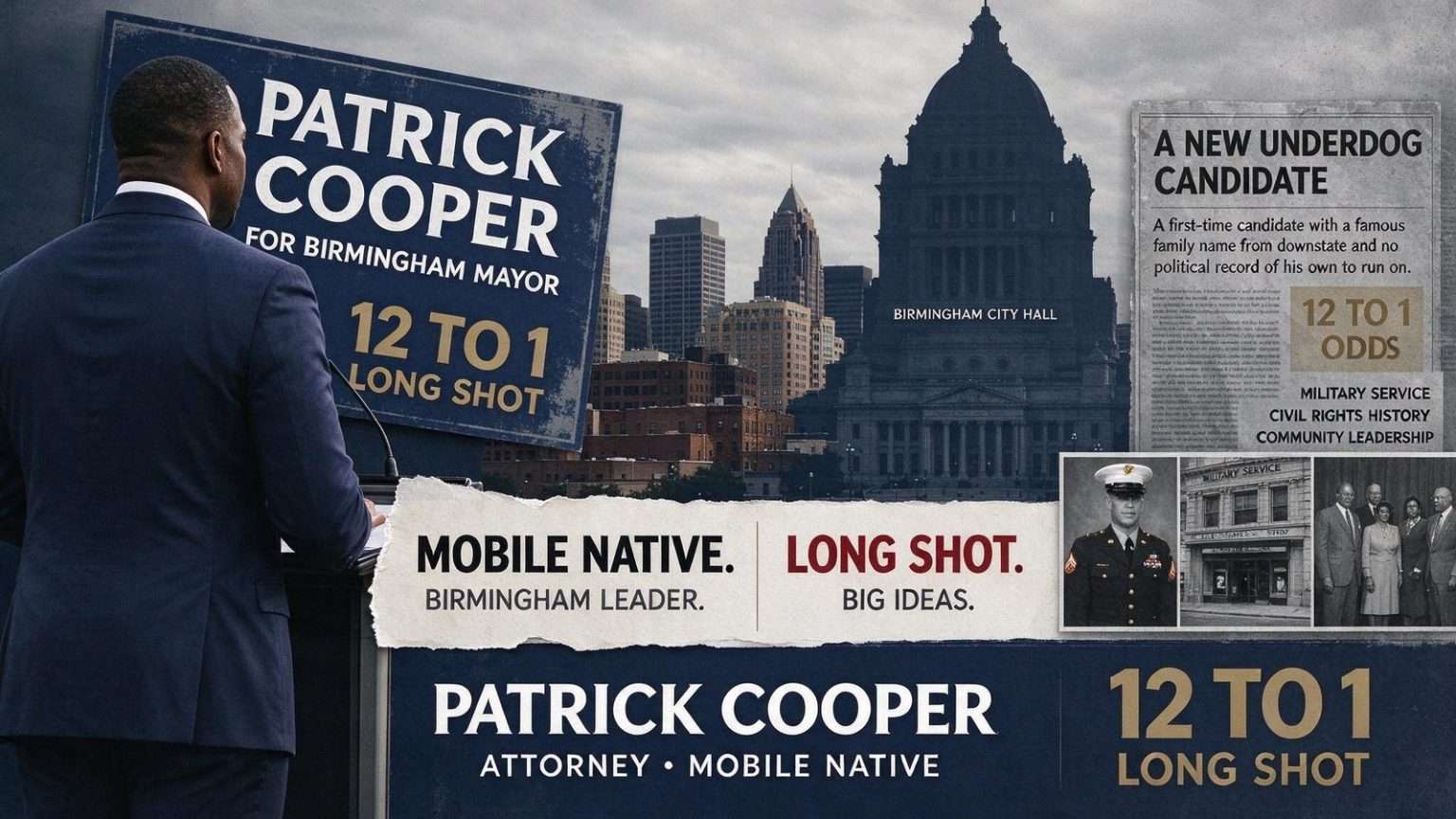
Birmingham’s mayoral election was drawing early handicapping from the city’s alternative press, and one name on the board belonged to a son of Mobile. Patrick Cooper, 48, a lawyer with the Birmingham firm of Maynard, Cooper & Gale, was rated a long shot at 12 to 1 by a Birmingham newsweekly’s early field guide to the race. In a race expected to feature better-known officeholders and perennial candidates, the newsmagazine treated Cooper as an intriguing unknown — a first-time candidate with a famous family name from downstate and no political record of his own to run on.
The write-up called him “a new underdog candidate” who had “expressed a desire to rid City Hall of its caretaker government and implement visionary progressive leadership.” It noted that he was actively raising money for the campaign, and that much of that money was coming from people who lived outside the city limits. That detail cut two ways in Birmingham politics. It suggested Cooper could tap a statewide and even national network of donors, but it also raised the familiar question of whether a candidate could claim momentum inside the city when the checks were arriving from suburban Jefferson County and beyond.
Some high-profile business interests, the piece said, considered him “the city’s best hope for something fresh and new.” That kind of early praise from the business community is a double-edged asset in a mayoral race, where candidates court both the boardroom and the neighborhood. The liabilities column was blunter: never elected to political office, no political experience, little or no name recognition. For a challenger, those are not minor marks against him. They are the difference between a campaign that writes its own narrative and one that must introduce itself to voters from scratch, block by block, in a city where municipal elections are decided by turnout far more than by party machinery.
Birmingham’s mayor and council run a strong-mayor form of government in which the occupant of the mayor’s office sets the agenda for a city that has spent decades wrestling with questions of image, development and division. A challenger promising “visionary progressive leadership” was, in effect, promising a different relationship between City Hall and the neighborhoods that felt bypassed by downtown’s growth. Whether Birmingham voters wanted that argument made by a newcomer was precisely what the early handicapping could not predict.
A Mobile pedigree
In Mobile, the surname needed no introduction. Cooper was the eldest child of Beverly and J. Gary Cooper, a former state senator, a retired U.S. Marine Corps major general, and the Clinton administration’s ambassador to Jamaica, who by then was heading Commonwealth National Bank in Mobile. It is a résumé few families can claim: a Marine general who came home to Alabama politics, served in the state Senate, represented his country abroad and then turned to community banking on Dr. Martin Luther King Jr. Avenue, in the heart of a neighborhood where access to credit has historically been scarce. The younger Cooper grew up with that example in the house — the discipline of the Corps, the obligations of public service and the realities of running a small bank all under one roof.
Patrick Cooper’s own path ran through some of the most demanding institutions in the country. He was a graduate of McGill — Mobile’s Catholic college preparatory school on Spring Hill, known to generations of local families simply as McGill — and took his undergraduate degree at Notre Dame before earning his law degree at Yale. A Mobile boy who made good in two of the most recognizable campus settings in American life, he then settled in Birmingham and built a corporate law practice at Maynard, Cooper & Gale, one of the large firms that anchors Alabama’s legal establishment. The trajectory is a familiar one in the South’s professional class, but rarely does it bend back toward a city hall race as a first campaign.
That mix — a polished corporate litigator’s résumé, a family name that opened doors in both Mobile and Montgomery, and a total absence of elected experience — made Cooper a hard candidate to type. He was not a product of Birmingham’s political clubs or its church-based activist networks, and he had no council record for opponents to attack. What he had was a story, and stories travel in Alabama, especially along the corridor that connects the state’s two largest cities.
An Alabama answer to Barack Obama
Mobile attorney Larry Hallett offered an assessment that mixed admiration with genuine puzzlement. “I like Patrick,” Hallett said. “He is handsome, bright, personable and charming. He will be able to raise a great deal of money for his campaign, and will obviously have the support of the big law firms and their clients, and their client’s money. He is Alabama’s answer to Barack Obama.”
Coming from a fellow Mobile lawyer, the comparison was a compliment of some weight. In the mid-2000s, Barack Obama was the fresh face of American politics — a young lawyer with an Ivy League degree, an unlikely name and a message that crossed old lines — and the analogy mapped neatly onto Cooper: a young Black lawyer with elite credentials, a corporate practice and a message of generational change, running in a Southern city whose politics had long been defined by older figures and older fights. The comparison set expectations Cooper could never fully control, but it also explained the early money. Donors who had watched the Obama phenomenon nationally could imagine the same energy translating to a Southern city hall, and they were willing to fund the experiment.
Then came the question. “Why in the world would Patrick want to be mayor of Birmingham?” Hallett asked. It was not a rhetorical flourish. A successful partner at a major Birmingham firm has status, income and influence without ever facing a voter; a mayor of Alabama’s largest city inherits its budget shortfalls, its crime numbers and its controversies the day after the election returns are counted. Hallett’s puzzlement was the puzzlement of a friend who could see the downside more clearly than the upside.
The uncle who broke a barrier in Prichard
The question had been asked in the family before. Patrick Cooper is the nephew of A.J. Cooper, the two-term mayor of Prichard who in 1972 became the first Black candidate elected mayor of a majority-white city in Mobile County, a landmark in a county still living with the machinery of segregation. Prichard, the industrial city wedged between Mobile and Chickasaw along the U.S. 43 corridor, had spent the twentieth century as a company town of shipbuilders and mill workers, and by the 1970s its schools, its housing and its city government were still carrying the weight of the old order. For a Black candidate to win the city’s top office in that environment, with a majority-white electorate, was the kind of result that made news well beyond Mobile County.
A.J. Cooper understood, then, exactly what his nephew was signing up for — and exactly what people would say about him. The former mayor said he had put the same question to his nephew that had once been put to him. “I asked my nephew Patrick the same question which had been put to me when I ran for Mayor of Prichard, ‘Why would you want to be Mayor of Prichard?'” the elder Cooper recalled. “His response was to the effect that Birmingham had been good to his children and to him and that Birmingham needed fresh energetic leadership not hidebound to the past.”
The answer, in its way, was the most revealing document of the young campaign: a statement of debt and obligation rather than ambition. Cooper had built his adult life in Birmingham — a career, a home, children in its schools — and the city that had given his family its prosperity was, in his telling, entitled to his service. That framing ran directly against the liability column in the newsweekly’s handicapping. The man with no political experience was presenting inexperience as independence: no debts to the political establishment, no favors to repay, no history to defend.
A cautionary word on councils
If the nephew took the job, his uncle suggested, he might look elsewhere for guidance on getting along with a city council. Relations between A.J. Cooper and the Prichard council of that era were, as he put it, tempestuous. “True enough, my relationship to my council (four white, one black) was tempestuous,” he said. It was an admission offered freely, and a warning delivered from experience: in the strong-council cities of Alabama, a mayor who cannot count to a majority on the council governs by press conference, and Birmingham’s nine-member council has historically been its own center of power, capable of frustrating a mayor’s agenda regardless of who holds the office.
Still, the elder Cooper counted the fights as worth having. “However between dragging Prichard into the 20th century of municipal management, having to fight Prichard’s history of segregation and the Klan to appoint the first black female judge, the first black female planning commission chair, the first black female housing authority chair etc. in Alabama made it worthwhile,” he said. The catalog of firsts was not decoration; it was a summary of what a barrier-breaking administration actually does — the appointments, the paperwork, the resistance, the slow conversion of an old-city government into one that looks like the people it serves.
He predicted his nephew’s leadership would “likewise position Birmingham to assume its rightful position as a leading city in the South and the nation.” That is the scale on which the Cooper family talks about municipal government — not potholes and rezonings, but a city’s standing in the region. Birmingham, a city that grew rich on steel and then spent half a century redefining itself around banking, medicine and universities, has heard that language of destiny from many candidates. What it had not heard before, in this cycle, was a candidate carrying both that ambition and a family history of delivering on it in a smaller, harder venue.
Why it mattered downstate
Mobile has always kept one eye on the Magic City, the larger, wealthier metropolis 250 miles up Interstate 65 whose politics set much of the state’s tone. Birmingham is where Alabama’s banks and its biggest law firms sit, where the state’s television news markets converge and where a mayor’s race is watched in Montgomery as a bellwether of where the state’s urban politics are heading. A Mobile-raised candidate with an Ivy League law degree, a corporate law practice and a family name associated with both military service and civil rights history was a story that traveled south along that highway almost as fast as it moved north through Birmingham’s neighborhoods.
Back home, the reaction blended pride with the same question Hallett had voiced. In the offices along Government Street and the courthouses of Mobile County, lawyers who knew the Cooper family from bar meetings and civic boards could recite the pedigree without notes: the father the general and ambassador, the uncle the trailblazing mayor, the eldest son the McGill, Notre Dame and Yale man. That a member of that family would leave the comfort of a partnership to chase City Hall in another city struck some as admirable and others as baffling.
The candidate: Patrick Cooper, 48, attorney, McGill and Notre Dame graduate, Yale law. The family: son of J. Gary Cooper; nephew of former Prichard Mayor A.J. Cooper. The early odds: 12 to 1, per a Birmingham alternative weekly’s handicapping. Those were the coordinates of the campaign as summer turned toward fall — an underdog’s numbers attached to an insider’s résumé, a challenger’s inexperience attached to an establishment’s donor list.
Whether Birmingham voters would reward an outsider with a fresh face and a famous name, or stick with the political establishment they knew, was a question for the fall. The 12-to-1 odds would either look foolish by Election Day or exactly right, and everyone from the alternative weeklies to the firm dining rooms to the family in Mobile understood that the answer belonged to the voters alone.