
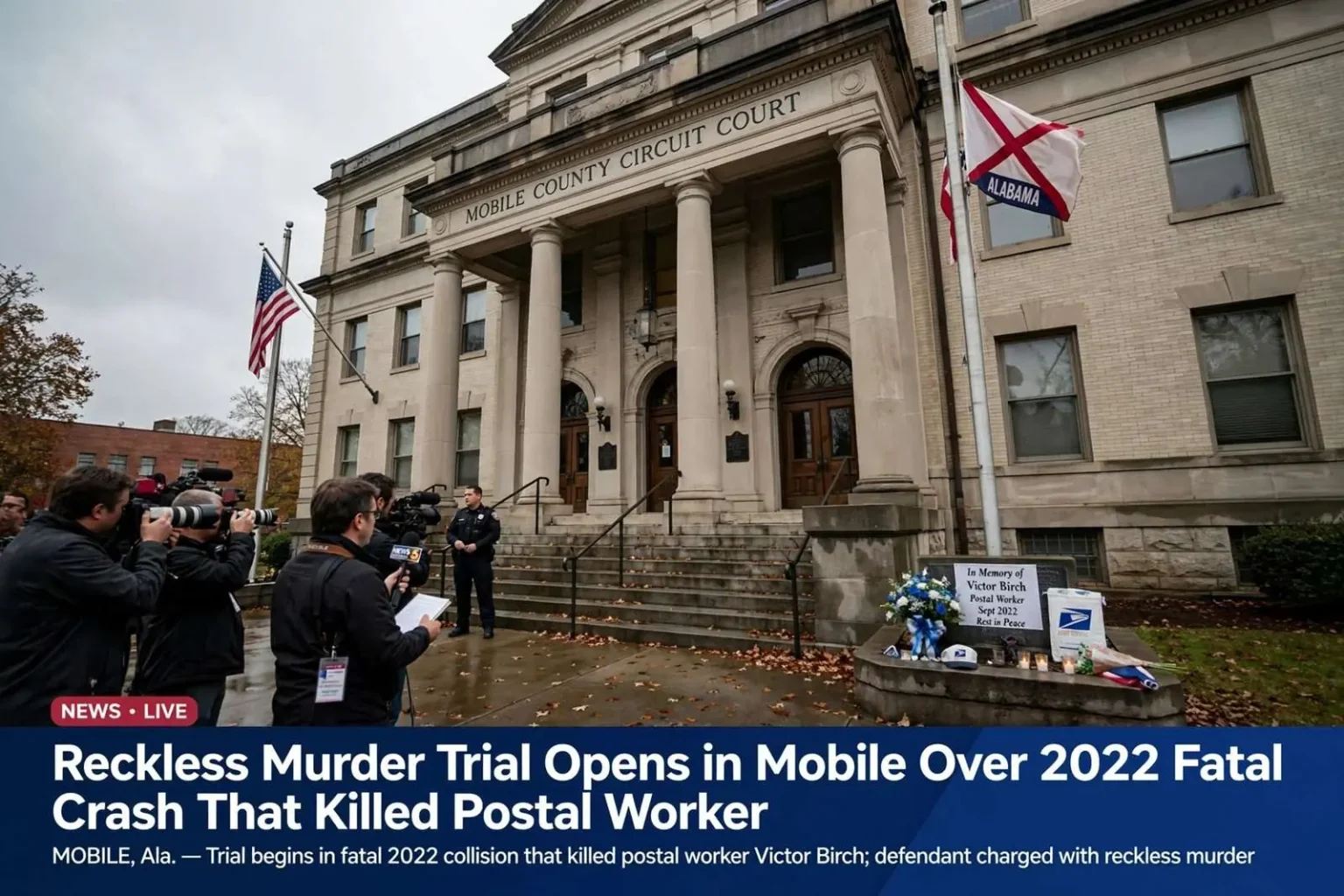
MOBILE, Ala. — A murder trial opened Monday in Mobile County Circuit Court in the case of a fatal head-on collision that killed a well-liked postal worker in September 2022. Victor Birch died in the crash near the Rangeline Road bridge over the Industrial Canal. Defendant Aubrey Aaron Pate, who was 23 at the time of the crash, faces a reckless murder charge in connection with Birch’s death.
The case has drawn attention both for the victim, who was known and liked across the routes he served, and for the unusual legal road it traveled to reach a courtroom. Reckless murder charges in Alabama are typically reserved for deaths caused by conduct showing an extreme indifference to human life, a standard that raises the stakes of a driving case far beyond ordinary traffic offenses. The trial in Mobile County Circuit Court will determine whether the evidence supports that level of culpability or something less.
Prosecution: Substances Were Affecting His Driving
In opening statements, prosecutor Ashley Rich presented evidence that Pate had both marijuana and alcohol in his system at the time of the crash, with a blood alcohol content estimated between .05 and .095. Rich argued that both substances were actively affecting Pate’s driving that night. The estimated range spans levels that fall below and above Alabama’s legal limit of .08, and prosecutors are expected to argue that in combination with marijuana, the impairment crossed the line into recklessness regardless of where the exact number fell.
The prosecution’s theory centers on the proposition that driving under the combined influence of alcohol and marijuana, at highway speed and on the wrong side of the road, constitutes conduct so dangerous that a reasonable person would recognize the risk. Witnesses to the crash scene and evidence recovered from the vehicles are expected to play a central role in establishing how the collision occurred near the Rangeline Road crossing of the Industrial Canal, a corridor that carries industrial and commuter traffic between downtown Mobile and the western shore communities.
Defense: A Designated Driver, Not a Criminal Case
The defense offered a different account. Attorney Jeff Deen described Pate as “the designated driver” who had consumed less than one beer, and argued that both drivers involved in the crash were speeding. Deen characterized the case as “a tragic matter. It’s a civil matter,” rather than a criminal one.
That framing sets up a battle over two questions at once. The first is factual: what Pate actually consumed and how it affected his ability to drive. The second is legal and philosophical: whether a fatal crash involving mutual high speed belongs in criminal court as murder, or belongs in a civil wrongful-death action where fault is apportioned and damages are paid without a prison sentence. Deen’s argument that both drivers were speeding suggests the defense will ask jurors to assign shared responsibility for the collision rather than placing it entirely on one vehicle.
The designation of Pate as a designated driver is a notable element of the defense strategy. It portrays a young man who took on the responsibility of keeping his companions safe, had little to drink by his own account, and was nonetheless involved in a catastrophe. Whether jurors accept that portrayal or reject it in the face of toxicology evidence will likely decide the case.
A Winding Path Through the Legal System
The case has taken a winding path through the legal system. An initial grand jury declined to indict Pate, but a subsequent grand jury returned a manslaughter indictment, which was later upgraded to reckless murder. That sequence is unusual. Grand juries meet in secret to decide whether probable cause exists to charge a defendant, and a refusal to indict typically ends a case unless prosecutors present new evidence to a later panel. Here, the second grand jury chose to charge, and the indictment was then amended upward to the more serious offense.
The progression from manslaughter to reckless murder matters enormously at trial. Manslaughter in Alabama involves recklessly causing a death, and carries a sentence of up to 20 years. Reckless murder, which applies to deaths caused under circumstances manifesting extreme indifference to human life, including certain driving-under-the-influence deaths, can carry a sentence of 20 years to life. The upgrade signals that prosecutors believe the evidence of impairment and driving behavior supports the highest charge available for a vehicular death.
Expert witnesses from both the prosecution and the Alabama Department of Forensic Sciences are expected to testify and dispute how the substances found in Pate’s system may have affected his driving. Toxicology battles of this kind frequently decide impaired-driving cases. The concentrations of alcohol and marijuana metabolites, the timing of the crash relative to consumption, and the degree to which each substance degrades reaction time, judgment and lane control are all matters on which qualified experts can honestly disagree. The Department of Forensic Sciences analyzed the evidence, and both sides will call experts to interpret the same underlying numbers.
Remembering Victor Birch
Victor Birch, the postal worker killed in the crash, was remembered by those who knew him as a well-liked figure in the community he served. Postal carriers occupy a familiar place in Mobile neighborhoods, and the death of a man struck down while performing his route or traveling the roads of the city resonated with residents who saw themselves and their own family members in the circumstances. The September 2022 crash near the Rangeline Road bridge over the Industrial Canal brought renewed attention to the stretch of roadway where it occurred, a corridor connecting Mobile’s industrial waterfront with growing residential areas.
The location itself is significant to the case. The Rangeline Road crossing over the Industrial Canal is a constrained route where traffic converges, and head-on collisions there leave little margin for error. Investigators work backward from the physical evidence — point of impact, vehicle damage, roadway marks — to reconstruct which vehicle crossed into the opposing lane and why. That reconstruction, combined with the toxicology evidence, will form the backbone of both sides’ arguments.
What the Jury Will Decide
As the trial proceeds in Mobile County Circuit Court, jurors will weigh competing narratives about a single night in September 2022. The prosecution asks them to see a driver under the influence of alcohol and marijuana who drove head-on into an oncoming vehicle and killed a working man. The defense asks them to see a designated driver involved in a tragedy caused substantially by the speed of both vehicles, a matter for civil court rather than a criminal conviction for murder.
The verdict will resolve the charge against Pate, but the case also illustrates broader questions about how Alabama’s courts treat fatal impaired-driving crashes. The distance between a declined indictment and a reckless murder charge, traversed by this case across two grand juries and an amended indictment, shows the range of outcomes available in the system and the discretion held by prosecutors and grand jurors alike. For the family of Victor Birch, the trial represents the legal system’s answer to their loss. For Pate, now several years past the crash, it determines whether the rest of his young adult life will be shaped by a conviction that can carry a sentence of 20 years to life.
Legal observers note that reckless murder prosecutions arising from traffic crashes occupy a narrow but consequential space in Alabama law. Because the statute requires proof of extreme indifference to human life, prosecutors generally rely on some combination of impairment evidence, extreme speed, and a pattern of dangerous driving to argue that the defendant knowingly gambled with other people’s lives. Defense attorneys counter that crashes, however tragic, are accidents in the ordinary sense unless the prosecution can prove that mental state beyond a reasonable doubt. The jury instructions the court gives on that distinction will shape how the panel weighs Deen’s argument that the case belongs in civil court.
The testimony of the forensic experts is likely to consume a substantial portion of the trial. Analysts from the Alabama Department of Forensic Sciences handle toxicology testing for much of the state, and their laboratory results form the factual foundation for both sides. The prosecution will seek to connect the measured levels of alcohol and marijuana to observable impairment, while the defense will probe the limits of what those numbers can prove about a person’s driving on a particular night. Questions about when Pate last consumed either substance, and how quickly each metabolizes, are expected to feature in that exchange.
Whatever the outcome, the trial’s progress from a declined indictment to a reckless murder charge is already a case study in the discretion Alabama law gives prosecutors. For now, the facts of a September night on Rangeline Road are in the hands of a Mobile County jury.
