Tattoos Seen on Security Footage Helped Investigators Identify Perdido Arson Suspect
Tattoos captured on security footage helped investigators identify Ronald Rex Johnson, 59, who is charged with arson in a Perdido tiny house fire.
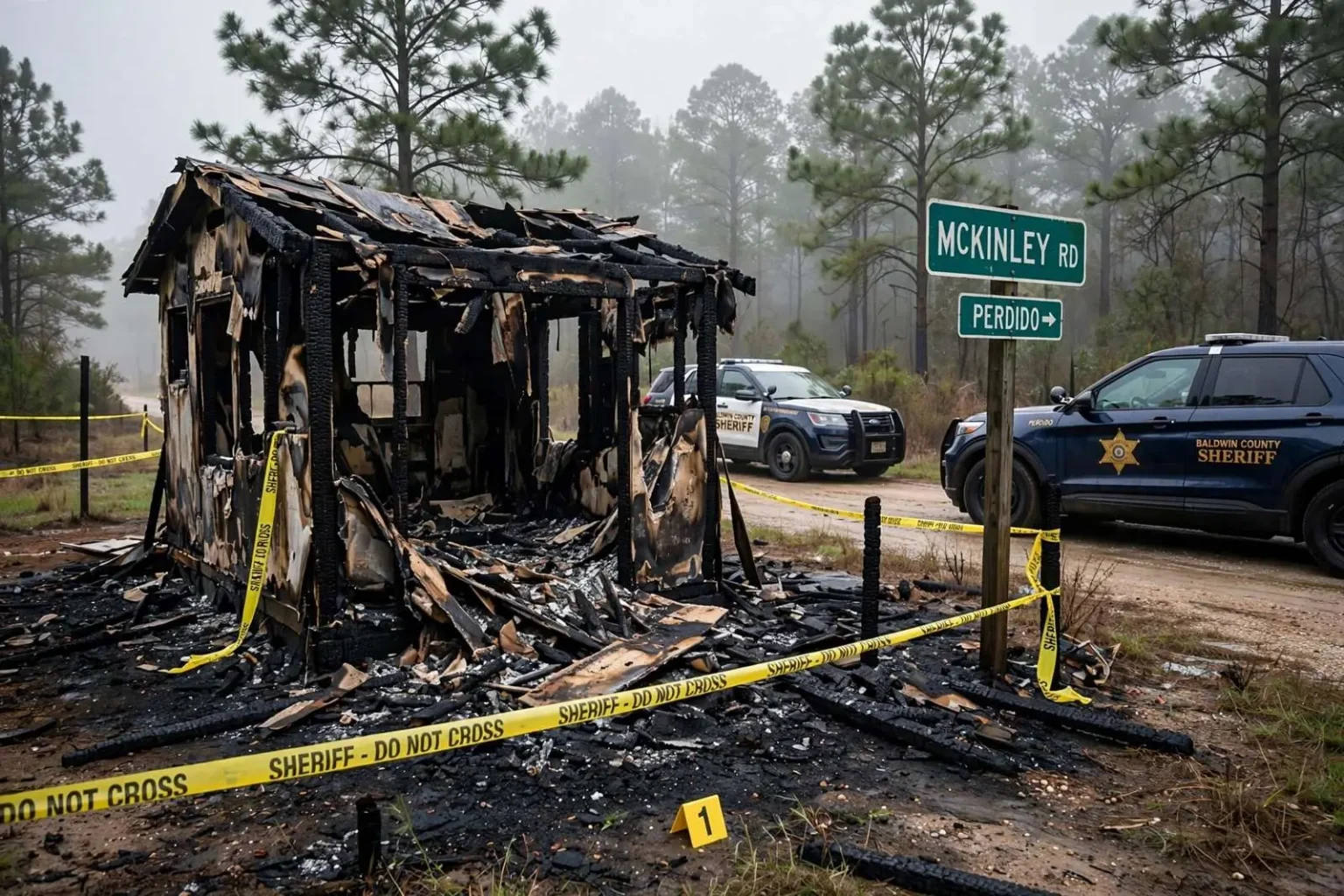
Investigators say distinctive tattoos captured on security camera footage helped identify the man accused of setting fire to a “tiny house” under construction off McKinley Road in Perdido. The case shows how even partial imagery from a home surveillance system can crack a case that might otherwise have gone unsolved, and it has drawn attention across rural northern Baldwin County, where residents have increasingly turned to cameras to watch over property far from town centers.
Ronald Rex Johnson, 59, was arrested Wednesday and charged with arson, according to authorities. He remains in the Baldwin County Jail, where he has been speaking with investigators, Baldwin County Sheriff’s Captain Justin Correa said. The arrest came after deputies pieced together footage from the scene with information gathered during the investigation, and the charge followed a review of the evidence with prosecutors.
“It sounds like Mr. Johnson made a series of bad decisions,” Correa said. “Apparently he was wondering, at some point, under the influence of something we don’t know exactly what, but some type of intoxicant, and had a torch with him and at some point decided he was going to set fire to this property.”
Investigators said security footage showed the suspect’s face and body covered, but two visible tattoos — a heart and crossbones bearing his name, and a spider web — helped lead them to Johnson. The markings, unusual enough to narrow the field of possible suspects, gave investigators the break they needed after the fire, and Correa said the images became central to the identification.
“We all saw how his face was covered, and his body was covered, but those tattoos on his arm really gave him away,” Correa said. The captain’s account described a suspect who had prepared to conceal his identity but failed to account for the distinctive marks on his arm, which the camera captured despite the covering.
The fire and the loss
Property owner Dana Ledkins said she and her husband, Michael, had almost finished building and furnishing the tiny house when it was destroyed. The structure represented months of planning and labor, the kind of project families on rural acreage undertake to add living space, house relatives or create a retreat on their own land.
“To hurt innocent people that you don’t know is just ridiculous,” Ledkins said. Her account of the loss described a family watching months of investment burn for no reason they could understand, with no connection between them and the man accused of setting the fire.
She said she felt relief upon learning of the arrest but also anger. “I felt a little bit of relief but a little bit of anger too, especially when he said he was just walking around the woods at 1:30 in the morning high with a torch in his hand.” The explanation she described — an aimless late-night walk through the woods while intoxicated, ending at her family’s property — deepened her frustration that the destruction appeared to be random.
Ledkins said she remains anxious about the possibility of Johnson’s release. “I have to tell you I am scared of him getting out.” Her concern reflects a fear familiar to families in rural communities, where homes sit far from neighbors and law enforcement response times are measured in miles of two-lane road.
Johnson was scheduled to make his first court appearance Friday for a bond hearing. The hearing would determine whether he remains jailed while the case proceeds, and the arson charge he faced carries consequences that grow with the circumstances of the fire and the value of the property involved.
Perdido, the community where the fire occurred, sits in the rural northern reaches of Baldwin County, an area of farms, timberland and scattered homes that stretches toward the county’s border with Monroe and Escambia counties. Life there unfolds at a distance from the county’s fast-growing beach communities to the south, and residents rely on volunteer fire departments and deputies patrolling wide circuits to respond when trouble arrives.
The Baldwin County Sheriff’s Office covers that territory with a department responsible for one of Alabama’s largest counties by area. Baldwin County has ranked among the state’s fastest-growing for years, and its law enforcement agencies have worked to keep pace with growth that has pushed new development deeper into formerly remote areas. The sheriff’s office investigates crimes across the unincorporated county, from the coastal communities to the agricultural north, and arson cases fall within its general investigative duties alongside the fire services that respond to the scenes themselves.
Arson investigations typically combine the work of fire personnel, who read a scene for signs of how and where a blaze started, with the work of deputies and investigators, who pursue the question of who was present and why. In rural fires, the absence of witnesses makes physical evidence and any available camera footage disproportionately important, which is why the security images in the Perdido case carried so much weight.
How the footage cracked the case
Home security cameras have proliferated across the Gulf Coast in recent years, driven by falling prices and systems that record continuously or trigger on motion. In subdivisions, doorbell cameras have become common enough that investigators routinely canvass neighborhoods for footage after a crime. In rural areas like Perdido, where houses sit on acreage rather than lots, property owners have increasingly installed cameras facing driveways, outbuildings and approaches to the home, precisely the kind of coverage that recorded the suspect in this case.
Investigators in Baldwin County and across the state have adapted to that reality, treating private camera footage as one of the first things to collect after a major crime. The footage in this case showed a suspect whose face and body were covered — a deliberate precaution that would have defeated identification in years past — but the tattoos on his arm offered a signature as individual as a fingerprint for anyone who knew what to look for.
Tattoos have long played a role in criminal identification, and investigators maintain the habit of noting distinctive markings when developing leads. A design as specific as a heart and crossbones bearing a person’s name functions nearly like a signature written on the evidence, and matching such markings to a known individual is far faster than other investigative paths.
The arrest in the case came together quickly by the standards of arson investigations, which can drag on for months when a suspect is unknown. Investigators here benefited from footage that captured the suspect’s body despite his covering, from the cooperation of the property owners, and from what authorities described as conversations Johnson had with them after he was jailed.
The charge of arson in Alabama carries serious penalties, with the severity of the offense graded by the circumstances of the fire, including whether people were inside the structure and whether the property was occupied or under construction. A conviction can bring a prison sentence measured in years, and prosecutors weigh the evidence gathered by investigators when deciding how to present the charge in court.
The tiny house at the center of the case also reflects a building trend that has spread across the Gulf Coast in recent years. Small structures on family land have become popular as housing costs have risen, serving everything from guest quarters to starter homes, and Baldwin County property owners have joined the movement as they add space for grown children, aging parents or rental income.
For families undertaking such projects, the loss of a nearly finished structure is measured in more than money. The materials, the labor and the planning represent months of weekends and evenings, and insurance coverage for buildings under construction can complicate recovery. The Ledkins family’s account of the loss captured that mixture of financial and personal damage that follows a fire no one can explain.
Random destruction of property poses particular challenges for rural communities. When a fire or burglary connects to a dispute, neighbors at least understand the motive; when investigators conclude the act was senseless, the sense of vulnerability can be harder to shake. The Ledkins family’s description of their reaction — relief at the arrest, anger at the apparent randomness, fear about release — traces the emotional arc many victims describe in the weeks after such a crime.
The bond hearing scheduled for Friday serves as the first public step in that process. At a first appearance, a defendant hears the charges, and a judge considers whether to set bond, at what amount, and under what conditions. For the accused, it is the first chance to appear before a court; for the victims, it is the first glimpse of the legal process that will determine whether the man charged in the fire remains in custody as the case moves forward.
Prosecutors and defense attorneys will now take up the evidence assembled in the investigation. The security footage, the tattoos that led to the identification, the statements attributed to the defendant and the findings at the fire scene will shape how the case proceeds through the Baldwin County court system, which handles the full range of felony matters arising in the county’s rural and coastal districts alike.
For deputies and investigators, the case offers a clear illustration of why they encourage residents to install and maintain cameras. Law enforcement agencies across Alabama have promoted private surveillance as a force multiplier, asking property owners to register systems or simply to preserve footage after incidents nearby. The Perdido case shows the payoff: a suspect who covered his face still could not hide the tattoos the camera recorded.
It also offers a reminder to residents of rural Baldwin County about the value of documenting their property. Photographs of buildings under construction, receipts for materials and images of a project’s progress help establish value and support both insurance claims and prosecution when destruction occurs, as the Ledkins family’s loss demonstrated.
As the case moves toward its hearing and beyond, the outcome will rest on the evidence investigators assembled in the days after the fire — evidence that began with two visible tattoos caught on a security camera by a family that had nearly finished building its dream.