

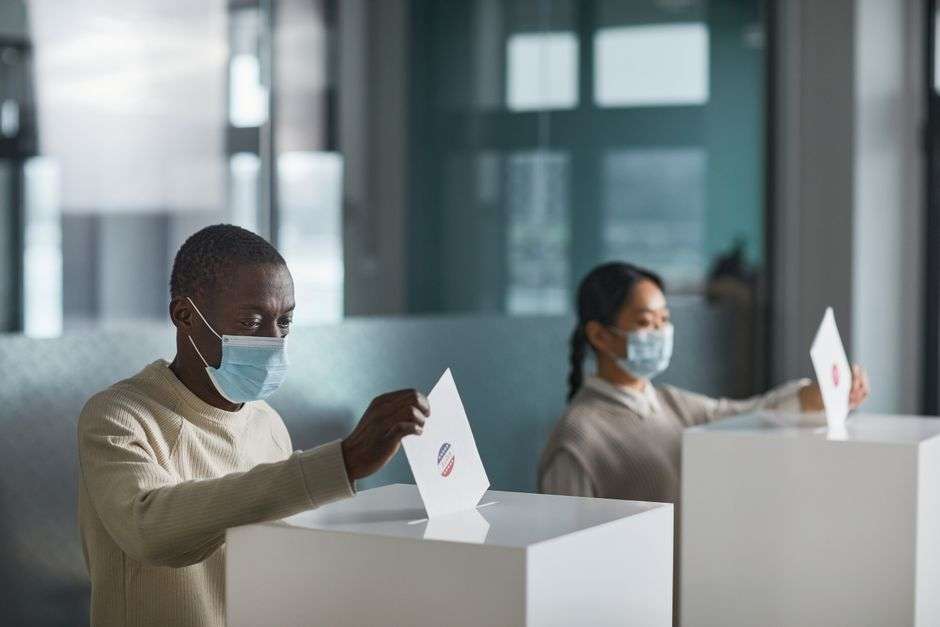
A dispute between the city of Mobile and Mobile County election officials over face coverings at the polls was settled this week after the Alabama Attorney General’s office made clear that no voter can be turned away for refusing to wear a mask, even at polling places located inside city-owned buildings.
The disagreement surfaced days before the July 14 runoff election, when Mobile Parks and Recreation Director Shonnda Smith notified election officials that, because of the city’s public mask ordinance, voters would be required to wear face coverings to enter any city-owned facility being used as a polling precinct. Eight locations were affected, including the Connie Hudson Senior Center, the Mobile Museum of Art, the Mobile Civic Center, Hank Aaron Stadium and the Robert Hope, Joseph Dotch, Michael Figures and Thomas Sullivan community centers.
Though Smith’s message did not explicitly say voters would be barred from casting ballots without a mask, the practical effect at those eight sites would have amounted to exactly that. Mobile County Probate Judge Don Davis, the county’s chief elections officer, quickly pushed back, telling Smith that Secretary of State John Merrill’s office had already advised election officials statewide that no COVID-19 safety measure could be allowed to hinder or prevent a voter from entering a polling place, regardless of whether that voter appeared to be ill.
City attorney Ricardo Woods responded that Mobile had no intention of preventing anyone from voting, and was instead trying to reconcile the city’s own ordinance with the need to keep poll workers and voters safe. Turning voters away over a mask, he warned, risked creating chaos or the appearance of voter suppression. Woods noted enforcement of the ordinance had already been relaxed citywide, with police officers and employees handing out face coverings rather than issuing citations, and that residents with a medical or mental health reason for not wearing a mask were exempt under the ordinance’s own terms.
Woods said the city’s preference was for compliance rather than punishment, and suggested handing out masks to voters who arrived without one or setting up separate voting areas for people who were sick or unwilling to wear a face covering. That second option had also been floated by Merrill’s office in guidance sent to election officials on June 15, but Davis said it was far less practical than it sounded.
Davis said his office had already purchased extra masks and trained poll workers to offer them to any voter who showed up without one. Still, given how politically charged the mask debate had become, he acknowledged some voters would likely refuse, and poll workers had no authority to turn them away as a result.
Setting up separate voting areas for maskless voters, Davis said, would have been logistically and legally fraught just days before the election. Alabama voters are assigned to a specific precinct based on where they live, and most polling locations simply do not have the physical space to create a second, parallel voting area. Extending the idea to only a handful of precincts wasn’t an option either, Davis said, since state law would require the county to offer the same accommodation at every polling place, and the county lacked the poll workers, equipment and voting machines to do that on short notice.
There were also ballot security concerns. Under normal Election Day procedure, a voter marks their own ballot and feeds it into the voting machine without assistance. A separate-area setup for maskless voters could have required poll workers to handle ballots on a voter’s behalf for at least part of the process, opening the door to disputes over ballot integrity.
Davis said his office referred the matter to Attorney General Steve Marshall for a formal answer, and the response left little room for interpretation: a voter cannot be required to wear a mask at a polling place in order to cast a ballot, even in a city or county that otherwise mandates masks in public, and even inside a building that would normally require one for entry.
“We all want voters to wear a mask, and we’re encouraging them to do so, but we cannot mandate that they wear a mask in order to vote. Constitutional rights and state law trump city ordinances,” Davis said, adding that his office had asked the city to instruct its community center directors to stand down from the earlier directive. The Mobile County Commission, he said, had already spent close to $500,000 on protective equipment and sanitation measures ahead of the runoff.
After the attorney general’s guidance came down, Woods said the city welcomed the clarification and reiterated that Mobile never intended to turn anyone away at the polls. He said voters without a mask would still be offered one, and those who declined for medical, mental health or personal reasons would still be allowed to vote, though they would not be permitted to move freely through the rest of the city facility. Woods added that critics were focusing on a worst-case scenario rather than the underlying purpose of the ordinance, which the Mobile City Council passed to encourage compliance and slow the spread of COVID-19, not to override state election law.
The confusion wasn’t limited to Mobile. Madison County, Jefferson County, and cities including Tuscaloosa, Birmingham, Selma and Montgomery had adopted similar mask ordinances, and Mobile County has its own order covering unincorporated areas. In some of those jurisdictions, officials had publicly suggested their local mandates would apply at polling places on Election Day, prompting Merrill and Marshall to issue a joint statement declaring any such enforcement illegal.
“If you want to cast a ballot in this state, you must be at least eighteen, a United States citizen, a resident of Alabama, you cannot have been convicted of a disqualifying felony and you must have a valid photo ID,” Merrill said in the statement. “If you meet those five standards, you can cast the ballot for the candidate of your choice. State law doesn’t say anything about having to wear a mask in order to vote.”
Merrill said he understood the need for COVID-19 precautions at the polls, but urged any Alabama voter who felt they were prevented from voting or unduly burdened by health restrictions at their precinct to file a complaint with his office at (334) 242-7200 or through the Secretary of State’s website. Alabama Republican Party Chairman Terry Lathan also thanked Merrill and Marshall publicly for clarifying voters’ rights ahead of the runoff, saying she hoped residents would still choose to follow CDC guidance even though they could not be denied a ballot for going without a mask.
Mask requirements at polling places have been a subject of debate across the country since the COVID-19 pandemic began. In some jurisdictions, election officials imposed mask requirements as a public-health measure, while in other jurisdictions, state law prohibited such requirements.
The Alabama Secretary of State’s office, which oversees election administration across the state, has issued guidance to local officials about the authority to impose mask requirements at polling places. That guidance has been the subject of correspondence with city officials in some jurisdictions.
The exchange between state and local officials over mask requirements at polling places reflects the broader tension between public-health authorities and election administrators over how to manage the intersection of pandemic-era safety measures and traditional polling place operations.
Local governments and community partners are working through the implications of the situation, and several follow-up meetings have been scheduled for the coming weeks. Members of the public who want to weigh in on the matter can find the meeting dates on city and county websites, and written comments can be submitted through the standard channels used by the relevant agencies. Local news outlets will continue to cover the story as it develops.
Across south Alabama, similar issues are being addressed in other communities, and the lessons learned here are likely to inform how those communities approach their own challenges. Local officials have indicated they are in regular contact with counterparts in neighboring cities and counties, and they expect to share best practices as the situation continues to evolve.
The agencies involved in the matter have committed to keeping the public informed as the work progresses, and residents who want to receive updates directly can sign up for email or text alerts through the relevant city or county websites. Local community organizations have also agreed to share information as it becomes available, and several have scheduled public forums in the coming weeks to give residents a chance to ask questions of the officials involved.
For background, readers can consult the official websites of the relevant agencies, the local newspapers that have covered the story, and the public-meeting archives that document the prior deliberations on related topics. The combination of those resources should give residents a thorough understanding of how the current situation developed and how the agencies and elected officials are approaching the decisions that remain.