Mobile County Relocates 21 Polling Places Ahead of Elections to Aid COVID-19 Social Distancing
The Mobile County Commission approved relocating 21 polling places for upcoming elections, citing the need for larger spaces to allow social distancing during the COVID-19 pandemic.
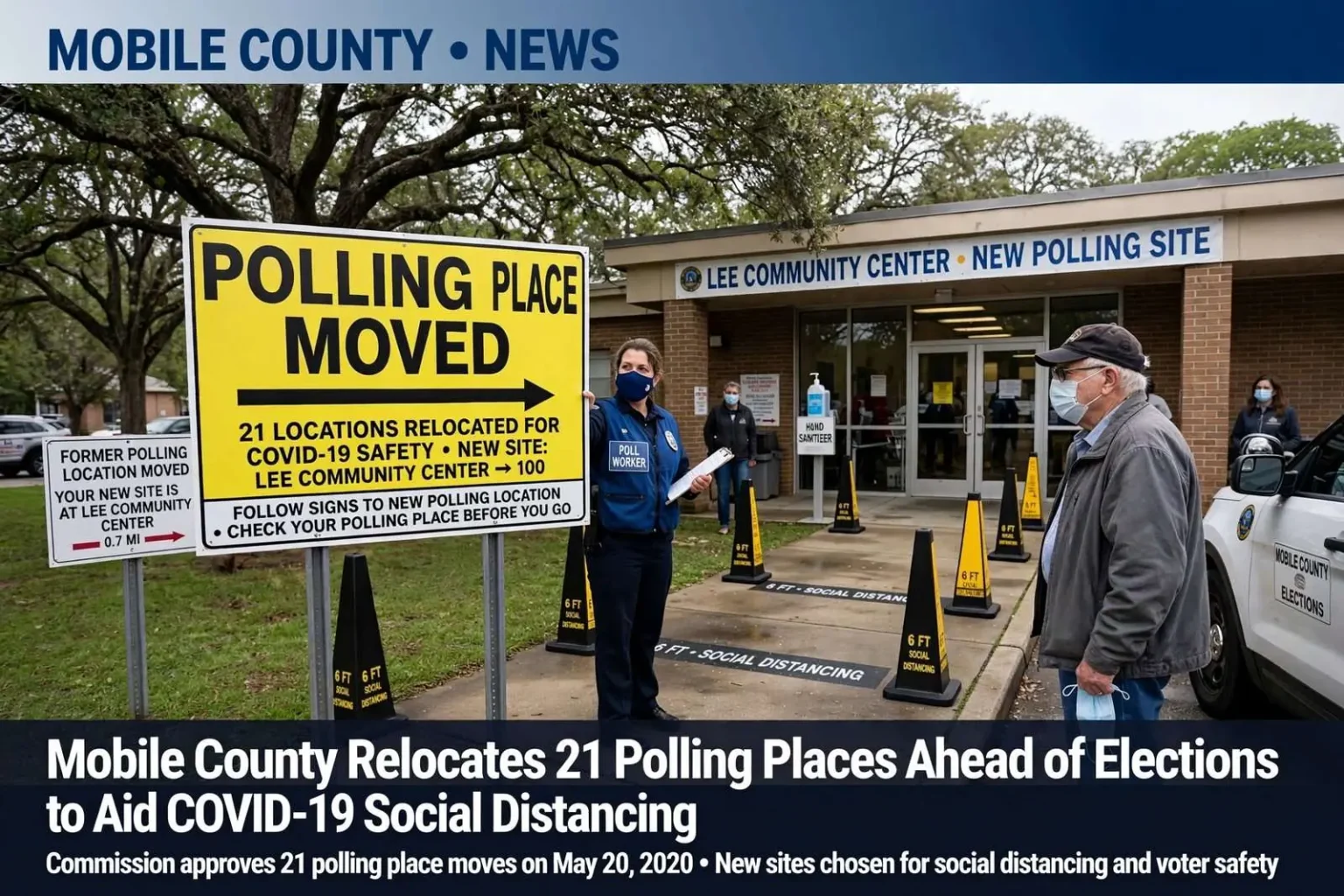
The Mobile County Commission approved the relocation of 21 polling places for the county’s upcoming elections during its meeting on May 20, 2020. The move, one of the largest single adjustments to the county’s voting map in recent memory, reshaped where thousands of residents would cast ballots in an election year upended by the coronavirus pandemic.
Commissioner Merceria Ludgood said all 21 locations were moved in response to the COVID-19 pandemic, with new sites chosen to give poll workers and voters additional space to observe social distancing guidelines on Election Day. The goal, she indicated, was to protect both the people who staff the polls and the voters who come through them, particularly older poll workers and voters at higher risk from the virus.
Commission President Jerry Carl said the county needed to make sure voters were aware of the changes well ahead of time. ‘We want to make sure we mark the polling places that have been moved,’ Carl said. ‘It would be great if we had some large, but not expensive signs when we move the polling place.’
Carl’s emphasis on signage reflected a practical worry shared by election officials across the country: a voter who shows up at the old location and finds nothing there may simply go home, and every voter who gives up is a voice lost from the election. Visible, inexpensive signs at former sites pointing to new ones became a common tool as governments adjusted their polling maps in 2020.
The logistics of moving a fifth of the county’s polls
Relocating polling places in the middle of a pandemic presented logistical challenges for county election officials, who had to balance public health guidance with the need to keep voting accessible and familiar to residents. Moving a fifth of the county’s polling locations on relatively short notice meant coordinating new signage, notifying voters and ensuring poll workers were briefed on the new sites before ballots were cast.
Each relocated polling place touches a web of moving parts. Voting machines and ballot supplies must be delivered to the new site; poll workers must know where to report; the building must be inspected for accessibility, parking and power; and notices must reach the affected voters through mailings, media coverage and online lookups. Doing that for 21 precincts at once, while the pandemic disrupted normal operations everywhere, strained the Probate Office and county staff who run Mobile County’s elections.
Notifying voters was the piece officials worried about most. Alabama law requires notice of polling place changes, and counties supplement the legal minimum with news releases and online precinct finders. In 2020, with mail delays and shifting health guidance, officials encouraged voters to double-check their assigned location before heading out rather than relying on memory from past elections.
The timing mattered as well. The commission acted on the relocations weeks ahead of the elections to give residents time to learn their new voting locations, a cushion that also gave election staff room to correct problems — a sign posted late, a voter confused about a new site — before they could suppress turnout.
A statewide and national pattern
The change reflected a broader trend across Alabama and the country in 2020, as local election officials sought larger venues, such as civic centers, churches and school gymnasiums, to replace traditional polling sites too small to allow safe distancing between voters standing in line.
Across Alabama, county commissions and probate judges spent the spring of 2020 doing the same arithmetic Mobile County did: how many voters could safely queue inside a room, and which buildings in each precinct had the square footage to allow six feet between people in line. Nursing homes, small community centers and cramped clubhouses — long staples of the polling place map — gave way to school gyms and civic halls wherever they could.
The pandemic also forced changes beyond the rooms themselves. Election officials scaled up cleaning protocols, separated machines, marked floors for distancing, and supplied poll workers with masks, gloves and sanitizer. Some counties consolidated precincts outright; Mobile County’s approach of relocating rather than consolidating kept the number of voting locations stable, preserving convenience while upgrading the space.
The Mobile County Commission’s role
The county commission holds legal authority over polling place locations in Mobile County, acting on recommendations from election officials. The three-member body, which includes the commission president and commissioners representing districts across the county, approves each change, making the May 20 vote the formal step that locked in the new map.
Commissioner Ludgood, whose district includes portions of Mobile’s downtown and western neighborhoods, spoke to the public-health rationale behind the relocations. The commission’s discussion reflected the balancing act every election board faced in 2020: honor the habits of voters who have gone to the same school or church to vote for decades, while acknowledging that those familiar rooms might be too small to be safe during a pandemic.
Commission President Carl’s comments about signs captured the county’s communication strategy — simple, visible notices at old locations, combined with advance publicity, to catch voters who missed the mailings. The cost-conscious framing was typical of a commission also weighing pandemic expenses against an already-approved budget.
What voters needed to know
For Mobile County voters, the practical message was straightforward: check your polling place before you go. Precinct assignments in the affected 21 locations changed, and a voter’s old site could no longer be assumed. County officials directed voters to look up their precinct online or call the Probate Office’s election staff to confirm where their ballots would be waiting.
Election officials also urged voters to consider alternatives that reduced Election Day crowding. Absentee voting, already available to Alabamians who met statutory qualifications, drew increased attention in 2020 as residents weighed in-person lines against health guidance. Applications for absentee ballots surged in many Alabama counties as the pandemic stretched on.
The relocations did not change what was on the ballot or who could vote — only where. Precinct boundaries remained the same, meaning a voter’s new polling place was chosen to serve the same set of households as the old one, typically as close by as a suitable larger building allowed.
Election Day under pandemic rules
When the elections arrived, the 21 relocated sites operated under procedures that would have been unimaginable a year earlier. Poll workers wiped down surfaces between voters, masks were encouraged, and lines were spaced to keep people apart. Workers and voters alike adapted to a version of Election Day that looked little like the crowded, hand-shaking rituals of past cycles.
The experience of moving 21 polling places in a few weeks became part of the county’s pandemic record — an example of local government improvising under pressure to keep a fundamental civic process running. For the election officials who pulled it off, the credit lay in unglamorous details: the signs, the mailings, the briefings and the maps that got voters to the right room on the right day.
Polling places as public health infrastructure
The 2020 experience changed how officials think about polling sites. A location that had served a precinct for years could no longer be evaluated only on familiarity, parking and accessibility ramps; square footage, ventilation and the ability to separate people in line became part of the calculation. Sites with wide halls, multiple entrances and large rooms suddenly looked different to election planners than they had before the virus arrived.
Churches, civic centers and school gymnasiums became the venues of choice across Alabama precisely because they offered that space. Most had hosted elections before or had the layout to accommodate them, and their operators were largely willing to help — a quiet civic contribution that few voters ever notice. Where such buildings were unavailable, counties had to weigh consolidation, a step many tried to avoid because longer drives and longer lines fall hardest on voters without cars or flexible schedules.
Mobile County’s decision to relocate rather than consolidate preserved access for the affected precincts. Keeping every precinct open, even in a new building, meant no voter had to travel farther than necessary or share a crowded site with thousands of neighbors from other neighborhoods.
The people who run the polls
Any discussion of 2020’s election changes eventually comes back to poll workers. The inspectors, clerks and sheriffs who staff Alabama’s polling places are often retired residents — the very demographic the pandemic put most at risk. Counties across the state recruited younger substitutes that year, and those who served worked long days under new rules, sanitizing booths and managing lines while answering an endless stream of “where do I vote now?” questions.
Briefing those workers on the relocations was part of the logistical lift the county faced after the May 20 vote. Every poll worker assigned to a moved precinct needed to know the new address, the new layout, the equipment drop schedule and the health protocols — training delivered while the usual in-person classes were themselves constrained by distancing rules.
A record worth keeping
Looking back, the relocation of 21 Mobile County polling places in May 2020 stands as a snapshot of local government responding to an emergency without stopping the machinery of democracy. The commission’s vote, Carl’s signage plan and Ludgood’s public-health rationale together documented how one of Alabama’s largest counties adapted its elections to the pandemic.
For residents, the episode left a practical legacy: a reminder that polling places are not permanent fixtures, and that a few minutes spent confirming an assigned location before any election can save a wasted trip. In a county that stretches from downtown Mobile to the Washington County line, where precincts serve everyone from urban neighborhoods to rural crossroads, that habit of checking — learned the hard way in 2020 — remains good advice in every election year.
The May 20, 2020 approval of the 21 relocations preserved the county’s voting access through an election cycle unlike any other, keeping ballots available in every precinct while giving voters and poll workers the space to stay safe. It was, by the standards of a chaotic year, a quiet administrative achievement — one sign, one mailing and one relocated precinct at a time.