Walter Knight Sues Prichard, Says He Never Resigned and Wants His Pay Back
The former Prichard police chief filed suit Tuesday in Mobile County Circuit Court, disputing the city's account that he resigned in July and asking a judge to order Prichard to resume paying him while the case proceeds.
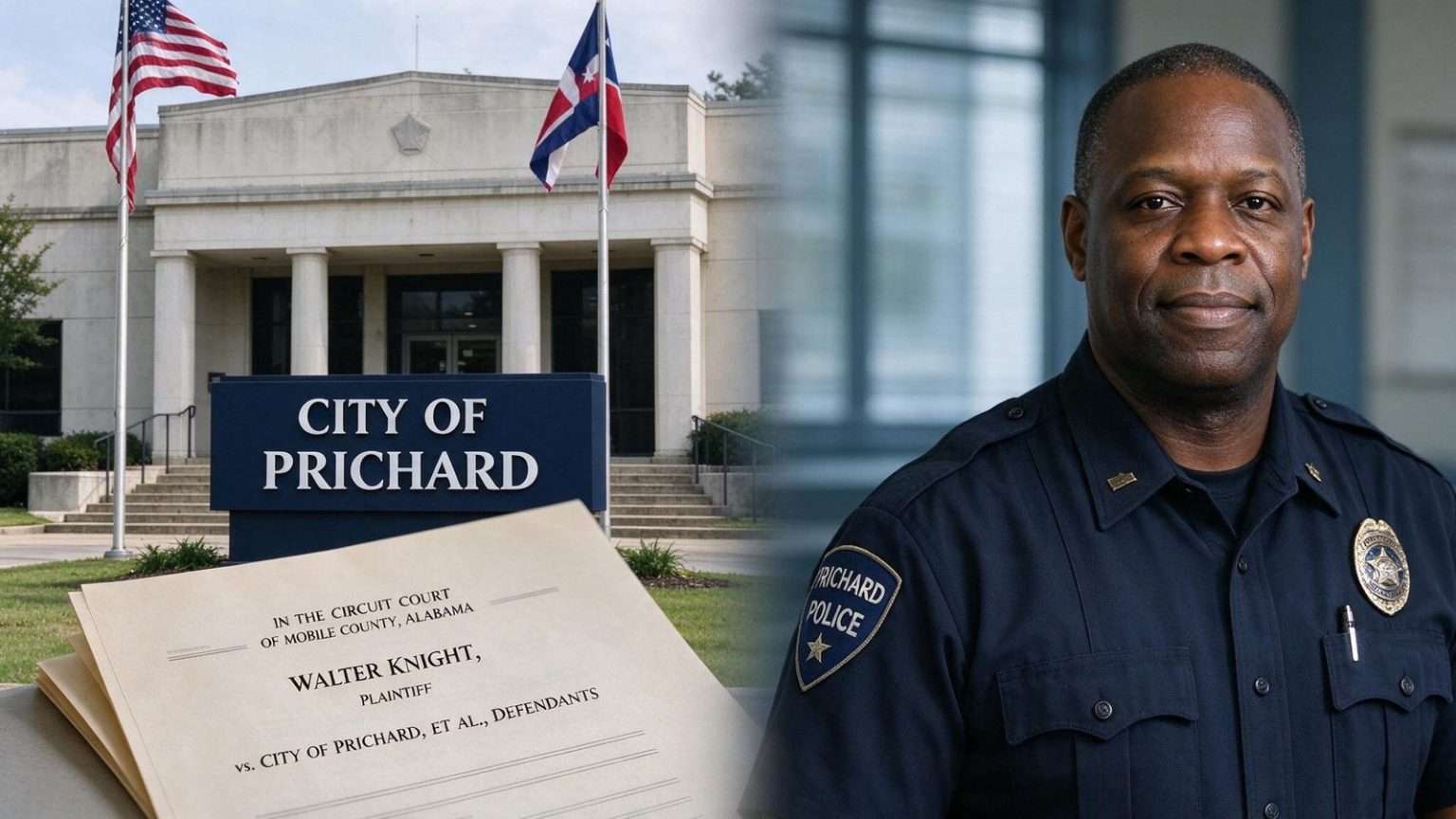
PRICHARD, Ala. — For six weeks, the City of Prichard has operated on a simple premise: Walter Knight resigned as police chief in July, and the matter of his employment was settled.
On Tuesday afternoon, Knight filed a lawsuit in Mobile County Circuit Court asserting that none of that is true.
Knight says he never submitted a written resignation and never otherwise communicated that he intended to leave the job. He says the city stopped paying his salary and providing family health insurance on or about Aug. 21 — a unilateral act, in his telling, taken against an employment agreement that remains in effect.
He is asking a judge to order Prichard to resume paying him while the case is pending, and to award damages for unpaid salary, benefits, accumulated leave, interest and court costs. The suit accuses the city of breaching his contract and of wrongfully terminating him.
Knight said he remains “ready, willing, and able to be chief.”
Two Irreconcilable Accounts
The dispute at the center of this case is unusually clean. There is no dispute that Knight was arrested. There is no dispute about when his pay stopped. There is no dispute that a written contract exists. There is a dispute about a single document.
Two days after Knight’s July 22 arrest, Mayor Carletta Davis said she had requested and accepted his resignation as police chief. That statement has been the city’s operating position ever since.
Knight’s complaint says he did not resign, directly contradicting the mayor. As of publication, the city has not produced a copy of a resignation letter.
That gap matters more than it might appear. If Knight resigned, the employment relationship ended by his own act, the city owes him nothing beyond what had already accrued, and stopping his pay was routine administration. If he did not resign, then what occurred was a separation the city initiated — and a separation the employer initiates is measured against whatever the contract says about how and when the employer may do that.
It is worth stating plainly what a complaint is at this stage. A lawsuit is one side’s account, written by that side’s lawyer, and filing it establishes nothing. Prichard has not yet filed an answer. Every allegation described here is Knight’s allegation, and the city will have the opportunity to admit, deny or contest each of them on the record.
The Contract
According to the complaint, Knight signed a written employment agreement in June 2023. The contract ran alongside the mayor’s term of office and was subject to renewal by both sides.
The complaint says the contract paid $70,000 annually. Davis said Tuesday that the chief made $62,000 a year.
An $8,000 discrepancy in a public employee’s stated salary is not a small thing. It is the kind of factual dispute normally settled by producing a signed document and a payroll record, and the fact that the two sides are describing different numbers suggests that those records will be an early focus once the case moves into discovery — the phase in which each side must hand over relevant documents to the other.
The structure Knight describes — a written agreement tied to the mayor’s term and renewable by mutual consent — is a common arrangement for a municipal department head. Its practical significance is that it displaces the default. Absent a contract, an employment relationship is generally terminable by either party without a stated reason. A written agreement replaces that default with terms, and the question a court then asks is not whether the city had good reasons but whether it followed the terms it agreed to.
That framing is what makes the missing resignation letter the hinge of the case rather than a documentary curiosity. A resignation is the employee’s decision, and it ends the analysis. A termination is the employer’s decision, and it opens one.
The Criminal Case Behind It
Knight was arrested July 22 by the Mobile County Sheriff’s Office and charged with using his office for personal gain and second-degree theft. Authorities allege that he earned money from funeral processions and used city resources while on duty.
The arrest came amid a widening investigation into the Prichard Police Department that followed a June raid at police headquarters and led to multiple arrests of department employees. Federal prosecutors charged former Officer Emanuel Naman Dotch II with corruption offenses. Since the raid, five officers have been arrested.
Those are allegations. Knight has not been convicted of anything, and he is presumed innocent unless and until proven guilty.
It is worth being precise about how the criminal and civil matters relate, because they are easily conflated. Knight’s lawsuit does not ask a court to decide whether he committed the offenses he is charged with. It asks whether the city honored its contract when it stopped paying him. Those are separate proceedings, in front of different judges, under different rules and different standards of proof. A criminal case asks the state to prove guilt beyond a reasonable doubt. A civil contract claim asks whether it is more likely than not that an agreement was breached. The same person can lose one and win the other, and nothing about the outcome of one automatically determines the other.
Nor does a criminal charge, by itself, dissolve a written employment agreement. Employers commonly do have grounds to suspend or separate an employee facing serious charges — but those grounds generally have to be invoked, in the manner the agreement specifies, and the record of doing so is what a court later examines. The city’s public position has not been that it removed Knight for cause. Its position has been that he quit.
What Prichard Is Saying
City Attorney Josh Briskman declined to comment. A city spokesperson said Prichard is aware of the lawsuit but is not commenting at this time. The mayor and the city attorney had not responded to requests for comment as of Tuesday night.
That silence is ordinary practice for a municipality served with a complaint, and it should not be read as agreement or concession. Cities routinely decline comment until they have filed an answer, in part because a public statement about a disputed fact becomes an exhibit.
The Timing
Knight’s filing landed on the same day Davis held a news conference laying out the city’s plan to rebuild the police department: a $100,000 salary for the next chief, an outside search firm the city is paying up to $50,000, a proposal to raise starting officer pay from $36,000 to about $40,000, and a rebuild she estimated would take 18 months to two years after a chief is hired.
Davis also said Tuesday that the city’s 14 remaining officers will be placed on leave, likely in phases, once Prichard reaches a law enforcement services agreement with Mobile County, and that the search firm will review those officers against new standards as the department works toward accreditation.
The juxtaposition is awkward for Prichard in a practical way, not merely an optical one. The city is trying to recruit a police executive to run a turnaround at a salary well above what it previously paid. Candidates evaluating that job will look at how the city handled the exit of its last chief — not because they expect to be arrested, but because the enforceability of a written agreement with a municipality is exactly the kind of thing a senior hire examines before relocating a family. An unresolved contract fight with a predecessor is a data point in that evaluation regardless of who is ultimately right about it.
What Comes Next
The immediate question before the court is Knight’s request for an order requiring Prichard to resume his pay while the case is litigated. A request for that kind of interim relief is typically decided early and separately from the merits, and courts weighing one generally look at how likely the party asking is to succeed in the end, and whether the harm from waiting is the sort that money can later repair. It is a preliminary judgment, not a verdict, and it can cut against the eventual outcome in either direction.
Beyond that, the case proceeds on an ordinary civil schedule. The city files an answer, admitting or denying the allegations. The parties exchange documents. And the disputed resignation — whether it exists, and if so in what form — gets resolved on the record rather than in competing press statements.
Three things are worth watching from here.
Whether a resignation document surfaces. The city has said Knight resigned; Knight says he never submitted a written resignation. If a signed letter exists, producing it is the shortest path to ending the case. If the city’s position rests on something other than a written resignation, that will become apparent quickly.
The salary figure. The complaint says $70,000; the mayor said $62,000. Payroll records and the signed 2023 agreement should settle a question that is currently being litigated in public through two different numbers.
The interaction with the criminal calendar. Knight remains charged, and defendants in parallel proceedings frequently face decisions about what to say in a civil case while a criminal one is pending. That dynamic often affects the pace of civil litigation even when it changes none of the underlying facts.
Knight remains charged in the criminal case and is presumed innocent unless and until proven guilty. The city has not yet responded to his allegations in court.
The Contract, the Indictment and the Reaction Around It
Court records and public comment since the filing fill in more of the background to Walter Knight’s breach-of-contract claim against the City of Prichard.
Knight began working with the Prichard Police Department in 2000 and became its administrative head in 2016. Under the 2023 employment agreement he signed with former mayor Jimmie Gardner, he was paid a salary of $70,000 a year plus insurance benefits for himself and his family. The eight-page complaint, filed in Mobile County Circuit Court by Daphne attorney Christ Coumanis, states that he has not received a paycheck since Friday, Aug. 21.
“Prichard has alleged that Chief Knight resigned his position as chief of police. Chief Knight denies that he resigned his position,” the complaint reads. “Chief Knight did not voluntarily terminate the employment agreement. Chief Knight did not submit a written resignation to Prichard or otherwise communicate an intention to resign his position. Prichard has failed and refused to pay Chief Knight the compensation due to him under the employment agreement.”
The filing also asserts that Knight met the terms of the job while he held it.
“Chief Knight satisfactorily completed all responsibilities assigned to him as chief of police, including but not limited to overseeing department operations, managing personnel, attending council meetings, and serving as the administrative head of the police department,” the complaint reads. “Unless Prichard is enjoined from continuing its wrongful conduct, Chief Knight will suffer immediate and irreparable injury, loss and damage for which there is no adequate remedy at law.”
The lawsuit states that Knight is “ready, willing and able” to continue serving as Prichard’s chief of police.
The Charges Behind the Dispute
Knight was arrested Wednesday, July 22, on allegations that he used public time and Prichard police equipment while working private funeral processions. He is charged with use of official position or office for personal gain and theft by deception. A charge is an accusation; a defendant is presumed innocent unless and until proven guilty.
Public Criticism of the Case
The prosecution has drawn public skepticism from at least one state lawmaker. State Rep. Napoleon Bracy, D-Saraland, wrote on his personal Facebook profile on Sunday, July 26, that he had expected more from the investigation launched by a special Mobile County grand jury.
“Charging the chief of police with felonies under these circumstances, as though he was using his office for significant personal gain, raises serious questions,” Bracy wrote. “These charges appear excessive, and what began as an investigation is beginning to look more like a witch hunt.”
At an August community meeting, Bracy said he had been “looking for the smoking gun” when he read the indictment, adding that he had expected to see “some cocaine, some guns, some bodies.”
The Family’s Account
Knight’s wife, Ramona, posted a video response on social media after Mayor Carletta Davis announced the resignation, saying her husband had not left the job. The video has since been removed from her personal Facebook profile.
“If you want him out, fire him. How hard is that? Fire him,” Ramona Knight said. “Don’t put no lies out and say he resigned because you don’t want the blood on your hands. No, baby. Do what you got to do.”
The Night the Council Could Not Act
The immediate aftermath played out at a City Council meeting the day after the arrests, when a crowd of residents filled City Hall and listened in somber silence as council attorney Moshae Donald read every word of the grand jury’s recommendation letter aloud — a letter that called on city leaders to remove Knight, abolish the police department and rebuild it. The reading was interrupted only by murmurs of dismay from the audience.
The council could not vote. Donald explained that only the mayor has the legal authority to fire a chief or move to reorganize the department, and Davis had made no recommendation on either question. Her seat on the dais was empty: instead of attending, Davis appeared at a voting-awareness and back-to-school rally at Bishop State Community College’s Baker-Gaines Central campus, where a poster listed her as a host alongside State Rep. Barbara Drummond, D-Mobile.
The split on the dais spilled into the open. Council President Traci Hale said she agreed with the grand jury’s recommendations but conceded the council’s hands were tied, and she railed against the department’s record — questioning how many rape kits had gone unexamined, how many crimes had gone unsolved, and noting that two of her own relatives were murdered years ago without anyone being held accountable. “At some point, we have to stand up and say we need help,” Hale said.
District 4 Councilwoman Teresa Fox Bettis pushed back, arguing the city should keep its department intact with significant changes rather than abolish it. Abolishing a police department “is a dangerous thing,” she warned, and would signal “the beginning of the end of our city.” She criticized the Sheriff’s Office’s footprint in the city — when one MCSO patrol car stops a motorist, two or three more respond, she said — drawing a shout from the audience that deputies were working like “slave catchers.” District 1 Councilwoman Annie Williams corrected the record: the Sheriff’s Office, she said, would leave once the city stood up a new department of its own. “They are only here until we can call consultants and get our police department up and running,” she said. When one man in the audience demanded to know where the mayor was, Hale’s reply — “Good question” — drew the night’s biggest reaction.
Davis, in a statement issued after District Attorney Keith Blackwood’s press conference, called the recommendations “understandably difficult for our city” and promised to review them and “take every lawful step necessary” to ensure residents receive professional public safety services.
The meeting also laid bare the mayor-council feud running underneath the public safety crisis. In June, Davis had sued the council, accusing it of overstepping its authority by investigating city finances, and Circuit Judge Jill Phillips ordered both sides into mediation — a move Davis suggested and the council resisted, writing in a court filing that it had no confidence the talks would produce a path forward.
The Friday Announcement: Tucker Out, a Captain In
More than 24 hours after the stalled meeting, Davis broke the logjam on her own terms. In a Facebook post, she announced she had directed Knight to resign as chief and had placed Maj. Aaron Tucker on unpaid administrative leave. With the department’s leadership gutted, she said Capt. Maxine Mark would oversee law enforcement in Prichard while her office developed a transition plan.
Davis said the city was “currently exploring all possible options” for the department’s future. “The city of Prichard is facing one of the most difficult moments in the history of our police department,” she wrote. “As mayor, my foremost responsibility is to protect the safety of our residents while ensuring that the city government operates with integrity and accountability.” By then the Mobile County Sheriff’s Office had already been running law enforcement operations in the city since June, leaving the department Davis was reorganizing largely sidelined.