Prichard Will Introduce Its PoliHire Search Lead for the Next Police Chief on Tuesday
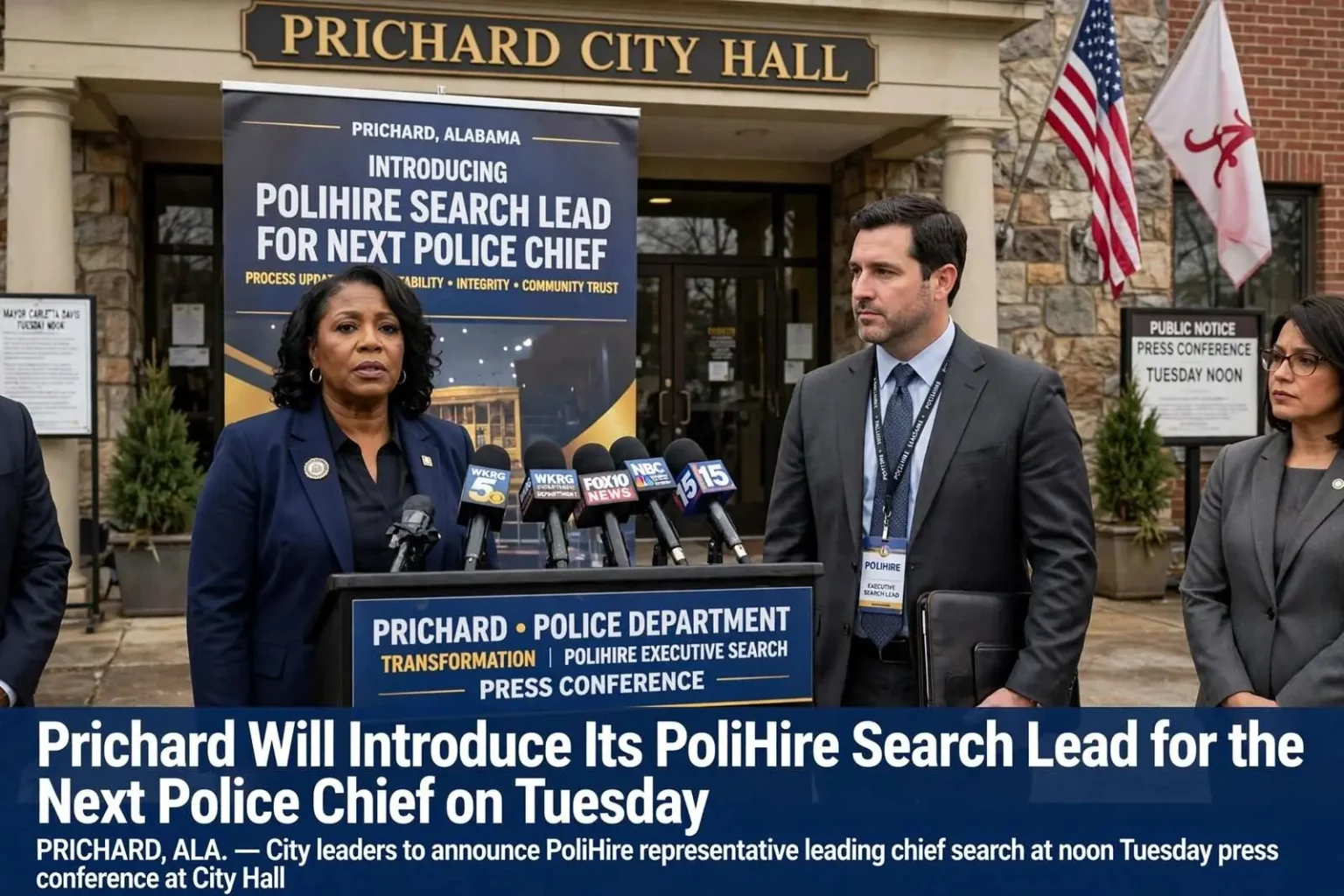
Mayor Carletta Davis and the Prichard City Council will hold a noon press conference Tuesday at City Hall to introduce the PoliHire representative leading the executive search for the city's next police chief.
PRICHARD, Ala. — Prichard city leaders will provide an update next week on efforts to rebuild the Prichard Police Department, including the formal start of the search for the city’s next police chief.
Mayor Carletta Davis, joined by members of the Prichard City Council, will hold a press conference Tuesday at noon at Prichard City Hall.
During the press conference, Davis will announce and introduce the PoliHire representative who will lead the executive search process.
The city has partnered with PoliHire to find an experienced law enforcement executive to lead what officials describe as the transformation and rebuilding of the department. City leaders said they are looking for a transformational leader committed to accountability, integrity, professional policing, effective public safety and rebuilding community trust.
Why a Search Firm
Hiring a police chief through an outside executive search firm is a deliberate choice, and it says something about how a city is approaching the job.
The alternative — promoting from within, or running the recruitment through a city’s own human resources department — is faster and cheaper. It also draws from a smaller pool. A municipality the size of Prichard, advertising on its own, is largely limited to candidates who already know the city or who happen to see the posting.
A search firm specializing in law enforcement executives does several things a city cannot easily do for itself. It maintains a standing network of command-level officers across the country, many of whom are not actively job-hunting and would never respond to a public advertisement but will take a phone call. It conducts confidential outreach, which matters enormously to a sitting chief or deputy chief who cannot be seen applying elsewhere without destabilizing their current department. It handles background investigation and vetting to a standard most small-city HR departments are not equipped to apply to a chief-level hire. And it structures a process — position profile, stakeholder interviews, candidate assessment, panel interviews — that gives the hiring authority a defensible record if the choice is later questioned.
The trade-off is cost and time. Executive searches for police chiefs commonly run three to six months from engagement to appointment.
What a Search Process Usually Looks Like
The consultant’s first job is generally not recruiting at all. It is listening.
A typical process opens with stakeholder engagement: interviews or listening sessions with elected officials, department personnel at multiple ranks, community organizations, clergy, business owners and residents. The output is a position profile — a document describing the community, the department’s condition, the challenges the next chief will inherit and the qualities the city is seeking.
That document is more consequential than it sounds. It is what gets sent to prospective candidates, and it is where a city either tells the truth about its situation or does not. A profile that understates the difficulty of a job attracts candidates who leave within two years.
From there the firm recruits, screens and presents a slate. Finalists typically go through panel interviews — often including a community panel — along with background investigation, credential verification and reference checks that reach past the names a candidate supplies. The appointment itself remains the city’s decision. A search firm produces candidates; it does not choose.
The Qualities Prichard Named
The city’s stated criteria are worth reading closely, because the specific words a municipality chooses in a chief search tend to describe the problems it is trying to solve.
Accountability and integrity point at internal discipline and conduct standards — how complaints are handled, whether policy is enforced consistently up and down the ranks.
Professional policing is a term of art. It generally signals an interest in written policy, documented training, supervision structures and the kind of operational discipline that accreditation bodies measure.
Effective public safety is the outcome measure — response times, case clearance, crime trends.
Rebuilding community trust is the one that cannot be achieved by administrative reform alone, and it is the hardest to deliver. It is also the phrase most often used when a department’s relationship with the people it serves has been strained.
The city’s use of “transformation and rebuilding” rather than “leadership” or “continuity” is itself a statement of where officials believe the department stands.
Context in Prichard
Prichard is a city of roughly 20,000 people bordering Mobile to the north, with its own municipal government, school-attendance geography and police department. Its finances and public services have been the subject of sustained local coverage for years.
Policing in the city has been part of that conversation. This newsroom reported in recent days that the Mobile County Sheriff’s Office will continue patrolling in Prichard after a letter of intent halted a planned Friday cutoff of that arrangement — an indication of how much the city has been relying on outside law enforcement support while it works on its own department.
A chief search running in parallel with an arrangement like that raises a practical question the next chief will have to answer: what the department’s staffing target is, how it gets there, and what the transition looks like as outside coverage winds down. Recruitment and retention of patrol officers is the central operational challenge for most small departments in the current labor market, and it is typically harder for a department that is simultaneously rebuilding its reputation.
What Tuesday Will and Will Not Tell You
Tuesday’s press conference is a process announcement rather than a hiring announcement. What can reasonably be expected:
- The identity of the PoliHire representative leading the search.
- Some description of the process and its stages.
- Potentially a timeline, or at least a target window.
- Possibly information about how residents can participate — community input sessions, surveys or public panels.
What is unlikely to be announced is a candidate. At the point a firm is being introduced, recruitment has not begun.
For residents, the input phase is the part worth showing up for. Once the position profile is written and the slate is assembled, the community’s role narrows considerably. The window in which a city’s residents can shape what kind of chief is being sought is early, and it is short.
If You Want to Attend
The press conference is scheduled for noon Tuesday at Prichard City Hall. Mayor Carletta Davis will be joined by members of the Prichard City Council.
What the Next Chief Inherits
Whoever takes the job in Prichard will arrive facing a set of problems common to small municipal departments and a few specific to this one.
Staffing. Police recruitment nationally has been difficult for several years running. Applications are down, retirements have accelerated, and small departments compete for the same candidates as larger agencies that can pay more and offer more specialized career paths. A department in the middle of a rebuilding effort competes at a further disadvantage, because candidates weigh institutional stability heavily.
Retention. Recruiting is only half the equation. Small departments frequently function as training grounds, absorbing the cost of putting an officer through the academy and field training only to lose them to a larger agency two years later. Closing that gap generally requires pay scale adjustments, career path development or both — and both cost money a small city may not have.
Policy and accountability infrastructure. The written framework that governs a modern department — use of force policy, complaint intake, internal affairs process, body camera policy, early intervention systems, training documentation — is substantial, and building or rebuilding it takes sustained administrative effort that competes with day-to-day operations.
Community relationships. The item the city listed last and the one that takes longest. Trust is rebuilt through consistency over years, not through an initiative.
What Residents Can Ask For
Cities that run a chief search well tend to build in structured public input. Residents who want to influence the outcome have a narrow window and a few useful levers.
- Attend the input sessions if they are held. The position profile is written from what the consultant hears. Turnout shapes it.
- Ask about the timeline and the finalist process. Whether finalists will be named publicly, and whether a community panel will interview them, are decisions the city makes and residents can weigh in on.
- Ask what the department’s authorized strength is and what its actual strength is. The gap between those two numbers is the single most useful figure for understanding a department’s condition.
- Ask what happens to the sheriff’s office arrangement. Any credible rebuilding plan has to describe how outside coverage winds down and what replaces it.
Why the Choice of Firm Matters
Executive search firms in this space are not interchangeable, and the identity of the individual leading a search matters more than the firm’s name on the letterhead. The consultant’s own network is the asset being purchased, and consultants who came out of policing themselves — former chiefs and command staff — typically bring a different rolodex than consultants who came out of general municipal recruitment.
That is one reason Tuesday’s announcement is being framed around introducing a specific representative rather than simply naming the firm. Residents attending should expect to learn who that person is, what their background is, and how they intend to run the process.
The Details
The press conference is scheduled for noon Tuesday at Prichard City Hall, with Mayor Carletta Davis joined by members of the Prichard City Council. This newsroom will report on what is announced.