Shattered Dreams: The B.C. Rain High School Shooting and the Long Road to Justice
On April 24, 1997, seven shots in a B.C. Rain High School breezeway wounded Mobile's reigning Player of the Year, Kendrick Cleveland, and classmate Arthur Johnson. Prosecutors said the shooter aimed at Cleveland's legs to end his basketball career. Cleveland crossed the graduation stage on crutches weeks later.
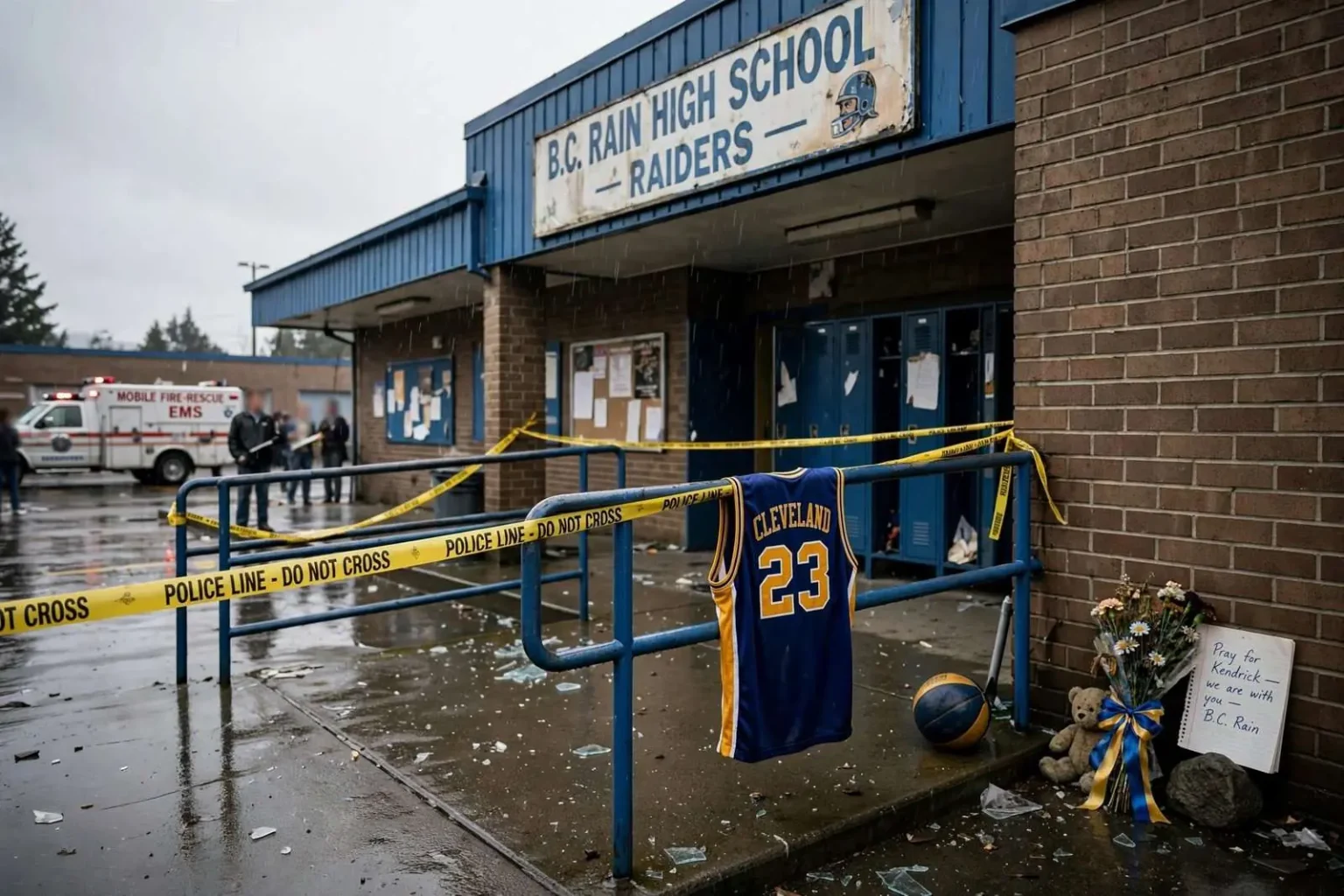
The shooting of B.C. Rain basketball star Kendrick Cleveland changed the trajectory of a promising young athlete, shook a Mobile community and set in motion a nearly yearlong journey through the criminal justice system.
The morning of April 24, 1997, began like any other spring Thursday at B.C. Rain High School.
Students crowded the breezeways, laughter and the slamming of locker doors echoing through the corridors as teenagers counted down the days to spring break.
By 7:55 a.m., that ordinary rhythm had been shattered by gunfire — seven shots that would leave one of Alabama’s brightest young basketball stars fighting for his future and a community confronting the reality that violence had reached its schoolhouse doors.
When the smoke cleared, two students lay wounded: Kendrick Cleveland, 18, the city’s reigning Player of the Year and the engine behind Rain’s state championship run, and Arthur Johnson, also 18, who had been struck by a bullet that penetrated his chest.
The shooter was Jermaine Demetrius Billups, an 18-year-old classmate who, police would later say, had deliberately aimed at Cleveland’s legs in a calculated attempt to end his athletic career and settle a grudge that had been simmering for months.
What unfolded over the next ten months — from the breezeway to the hospital ward, from the grand jury room to the courtroom — would test the resilience of a family, the resolve of a prosecutor and the conscience of a community that had believed such things happened elsewhere.
The Shooting
R.L. Watson, an assistant principal at B.C. Rain, was on hall duty when he heard the first loud pop.
He thought it was firecrackers, perhaps smuggled into the school for spring break celebrations.
Then came the second, and the third, followed by the screams of students fleeing for their lives.
“I heard the first pop and I thought, ‘Somebody’s playing with firecrackers.’ Then I heard the second one and I knew it wasn’t firecrackers.”
Watson later told the Press-Register that he immediately realized something was seriously wrong.
In the crowded breezeway, Billups had drawn a handgun and opened fire on Cleveland at close range.
Witnesses described a scene of chaos — students diving behind lockers, pressing themselves against walls and scrambling for exits.
Cleveland was hit seven times: three bullets in his left leg, one in his right thigh and one in his hand. The thigh wound alone would require four separate surgical procedures.
Johnson, caught in the crossfire, was struck in the chest.
Billups fled the building but was apprehended shortly afterward. The weapon, a .25-caliber handgun, was recovered.
School officials noted with grim resignation that it was one of dozens of firearms confiscated from Mobile County students each year.
Thursday’s incident marked the fifth school shooting in the district in five years, although remarkably, no student had been killed in any of them.
The Victims
Kendrick Cleveland was more than a basketball player.
He was the face of B.C. Rain athletics, a 6-foot-4 guard who had led the Raiders to a Class 6A state championship just weeks earlier.
He had been named Mobile Register Player of the Year, had drawn interest from college programs and had recently told head coach Rick Pietri that he wanted to play basketball in college — and eventually return to coaching.
“That’s all on hold now,” Pietri said in the immediate aftermath.
Cleveland was rushed to USA Medical Center, where surgeons began the painstaking work of repairing shattered bone and severed vessels.
The thigh wound proved especially stubborn, requiring four operations over six weeks.
He would not leave the hospital until June 13 — nearly two months after the shooting.
Even then, he needed crutches to walk, and doctors warned that a return to competitive basketball was, at best, a remote possibility.
Arthur Johnson’s injuries, while serious, did not require the same prolonged hospitalization.
His mother, interviewed by the Press-Register days after the shooting, said she was not afraid for her son to return to B.C. Rain.
“He wants to go back,” she said. “And I’m going to let him.”
The Motive
The question that haunted investigators, classmates and the Cleveland family was simple:
Why?
According to police and prosecutors, the answer lay in a feud that had been building since winter.
Cleveland told reporters in July that he barely knew Billups and had never had a conversation with him. But two incidents had apparently lit the fuse.
The first occurred at a bowling alley, where a friend of Cleveland’s had an altercation with Billups.
The second, more direct confrontation took place in the school parking lot weeks before the shooting, when Billups reportedly confronted Cleveland and threatened him.
“The word around school was he didn’t like me,” Cleveland said in a July interview from his hospital bed. “He told me he was going to get me.”
Police said Billups admitted after his arrest that he had deliberately aimed at Cleveland’s legs — not to kill him, but to destroy the one thing that defined him: his game.
Assistant District Attorney John Cherry would later tell the grand jury that Billups had aimed at the star athlete’s legs in an attempt to end his basketball career and settle what prosecutors described as a long-brewing feud.
It was a chillingly specific motive: not simply rage or random violence, but an alleged calculation to erase a future.
A Community Responds
The shooting sent shockwaves through Mobile.
At B.C. Rain, administrators worried openly about the school’s reputation.
“We’re going to get a black eye from this,” one principal told the Press-Register. “People are going to think this is a violent school, and it’s not.”
Parents flooded the switchboard.
Local television stations scrambled to cover the story, but WKRG-TV5 drew sharp criticism for a hastily written “teaser” spot that unnecessarily frightened parents who had not yet learned that their children were safe.
Media reporter Mike Brantley wrote that the station’s promotional spot had “unnecessarily frightened some parents,” while viewers “phoned in their beef with TV5.”
Letters to the editor poured in.
One writer, referencing a recent series on troubled youth at the Strickland Youth Center, asked:
“How do concerned parents protect their children from this bunch when they are forced to attend the same schools?”
School spokesman Tom Salter tried to put the shooting in context.
“No students have been killed in acts of violence” in Mobile County schools, he said.
But the statistic rang hollow to parents who had just watched ambulances carry two teenagers from a school breezeway.
The Legal Process
The machinery of justice moved with deliberate speed.
On May 21, a Mobile County grand jury received the case against Billups, who was being held at Mobile County Metro Jail on $50,000 bond per assault count.
By July 15, the grand jury had returned indictments: two counts of first-degree assault and one count of possessing a deadly weapon on school premises.
Each assault count carried a potential sentence of two to 20 years. The weapons charge carried a potential sentence of one to 10 years.
Billups remained in custody.
His attorneys, recognizing the weight of the evidence — including Billups’ own admission to police — began exploring a mental-health defense.
On Jan. 22, 1998, Billups, now 20, entered a dual plea: not guilty and not guilty by reason of mental disease or defect.
Court documents indicated that he had told police he purposely tried to ruin Cleveland’s career because Cleveland had insulted him.
The case was set for trial in Mobile County Circuit Court. Jury selection was scheduled to begin Feb. 11, 1998.
But that morning, just as the venire was being assembled, the trajectory changed.
Billups withdrew his mental-health plea and pleaded guilty to the assault charges.
The weapons charge was dismissed as part of the agreement.
The plea came as a surprise to many in the courtroom, including members of the Cleveland family who had prepared to testify.
Sentencing was set for a later date.
Billups faced up to 40 years in prison.
The Aftermath
For Kendrick Cleveland, the legal resolution was only a footnote to a longer, more personal battle.
He missed his senior prom.
He missed the final games of his high school career.
He watched his teammates play from a hospital bed, then from a wheelchair and finally on crutches.
The mounting medical bills — surgeries, rehabilitation and ongoing care — became a second crisis for his family.
Yet in May 1997, just a month after the shooting, Cleveland appeared at B.C. Rain’s graduation ceremony.
He walked across the stage on crutches, diploma in hand, to a standing ovation.
The Press-Register called him “the star of graduation.”
Columnist Buster Kantrow captured the moment in writing:
“A burst of bullets may have stolen his final month at B.C. Rain High, separated him from his senior prom, perhaps torn the basketball forever from the hands of the best player in the city. But it didn’t take away Cleveland’s power to shine from a wheelchair.”
In July, Cleveland gave his most extensive interview since the shooting.
He spoke calmly about the bowling alley incident, the parking lot confrontation and the morning in the breezeway.
He spoke about the seven bullets, the surgeries and the uncertainty of ever playing again.
And he spoke about the future.
“I’m going to play again,” he said. “I don’t know when. I don’t know where. But I’m going to play.”