Mobile County Probate Court Holding About $154,000 in Unclaimed Funds
Mobile County Probate Court is holding about $154,000 in unclaimed funds belonging to roughly 30 Mobile residents.
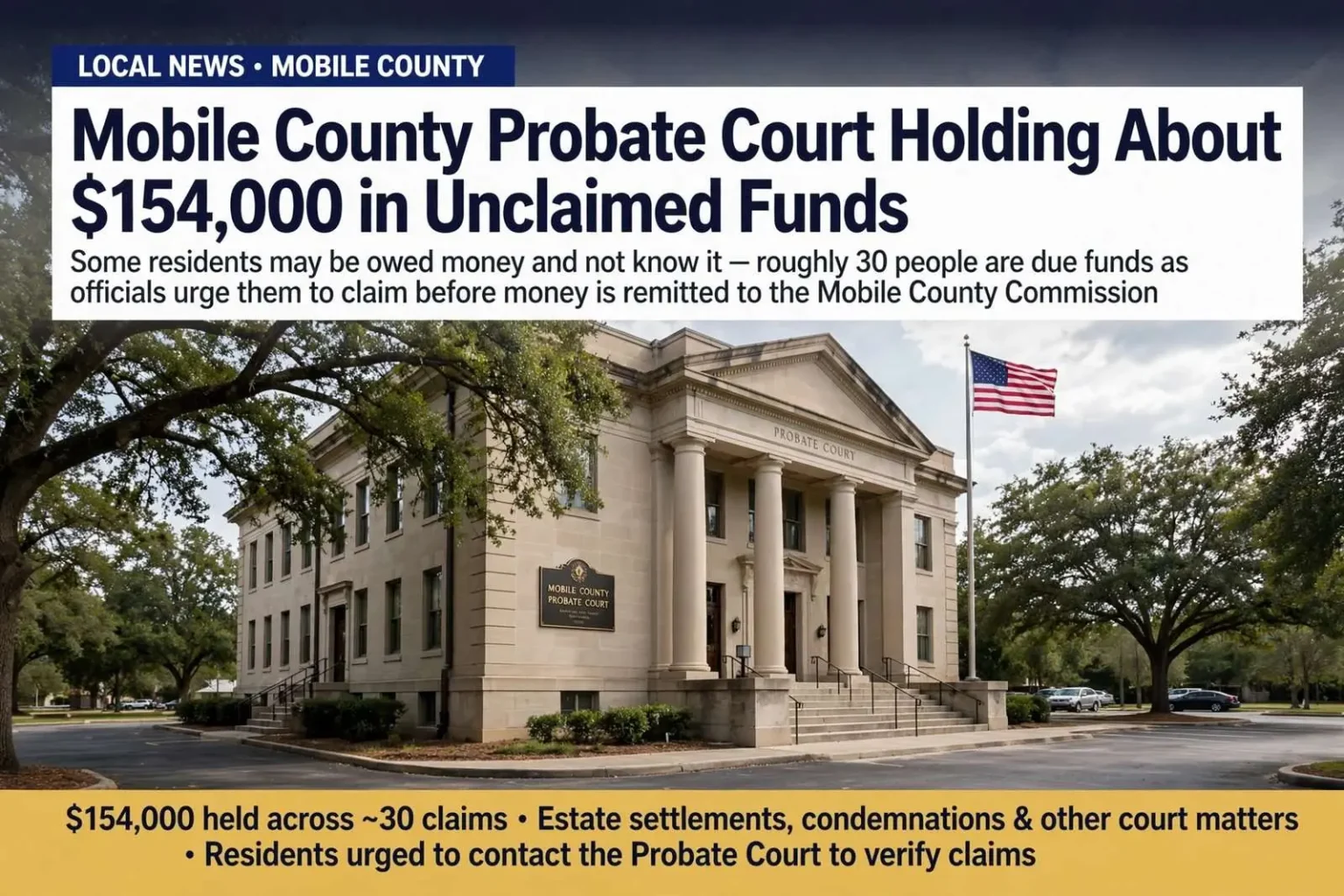
Some Mobile County residents may be owed money and not know it. The Mobile County Probate Court is holding approximately $154,000 in unclaimed funds that belong to about 30 people, according to county officials, and the clock is quietly ticking on those balances. The money is slated to be remitted to the Mobile County Commission’s court if it remains unclaimed, meaning that residents who fail to come forward could eventually have to pursue their money through a longer and less convenient process.
The holdings cover a range of court matters. People who have done business with the Probate Court — through estate settlements, condemnations, or other proceedings — may want to check whether funds from those matters were never collected. In many cases the person entitled to the money is unaware a payment was ever deposited on their behalf, particularly when the underlying case closed years ago.
What the Funds Represent
Court registries in probate matters routinely receive deposits connected to the cases that move through the courthouse. An estate settlement may generate a distribution for an heir whose address was never updated, or a condemnation proceeding tied to a road or utility project may leave a payment waiting for a property owner who has since moved. Deposits can also sit in escrow when conditions attached to a payment were never satisfied or when the paperwork needed to release the money was never completed.
When those loose ends are never tied off, the balances remain on the court’s books as unclaimed funds. Officials with the Mobile County Probate Court note that the roughly $154,000 now being held is spread across approximately 30 separate claims, which means the individual amounts vary. Some claimants may be owed a few hundred dollars, while others could be due significantly more depending on the size of the original proceeding.
Why Unclaimed Funds Pile Up in Probate Work
Unclaimed court funds are a common byproduct of probate work, and Mobile County is far from unique in holding them. Probate matters often unfold over months or years, and the people entitled to money at the end of a case are not always easy to reach. When heirs move away, businesses close, or paperwork goes stale, money awarded or held in escrow can sit untouched for years.
The problem is compounded by simple turnover in daily life. Families may not know that a deceased relative’s estate produced a distribution for them. A small business named in a condemnation case may have dissolved before the payment cleared. Checks are mailed to old addresses, are never cashed, and are eventually returned to the court, where the balance is reclassified as unclaimed rather than lost.
Because probate courts in Alabama handle an unusually broad docket — estate administrations, will probates, guardianships and conservatorships, adoptions, condemnations, and other filings — the potential sources of stray funds are numerous. Each category can generate deposits that outlast the attention of the parties involved, and each year the balances that go uncollected are rolled forward on the court’s registry until someone claims them or they are remitted.
How the Claims Process Works
Counties typically publish lists of unclaimed funds and allow claimants to come forward with proof of identity and entitlement before the balances are turned over. The purpose of the publication step is to give potential claimants a final, visible notice that money is waiting, and to give the court a documented effort to locate the owners before the funds leave its control.
For someone who believes they may be on the list, the first step is to contact the Mobile County Probate Court for more information about the claims process. Court staff can confirm whether a balance is being held under a person’s name or under a case number, and they can explain what documentation will be required. Claimants should be prepared to identify the underlying matter — an estate case, a condemnation filing, or another proceeding — along with their own connection to it.
Proof of entitlement is the heart of any claim. For an heir, that may mean a certified copy of a death certificate and evidence of the family relationship, or a copy of a court order distributing estate assets. For a property owner in a condemnation matter, it may mean proof of ownership at the time of the taking. For a business, records showing the company’s existence and authority of the person signing the claim can be required. Presenting clean documentation up front is the fastest way to move a claim from the registry to an actual payment.
What Happens If the Money Goes Unclaimed
If no one comes forward, the money is slated to be remitted to the Mobile County Commission’s court. Remittance does not erase the obligation — the funds are not simply absorbed as revenue with no recourse — but it does change where a claimant must go to pursue the money. Instead of walking into the Probate Court and working with the registry staff who know the case, a late-claiming owner generally faces the more formal process of seeking the funds from the county after the transfer has occurred.
That shift is why officials want the roughly 30 people connected to these balances to check their records now rather than later. A claim made while the money is still in the court’s registry is typically straightforward: the court verifies identity and entitlement and releases the payment. A claim made after remittance can involve additional steps, longer waits, and more documentation to trace a payment that has already left the court’s books.
Alabama’s Broader Unclaimed Property Picture
The balances in the Probate Court’s registry are part of a much larger category of forgotten money across Alabama. Under state law, businesses and institutions are generally required to report and turn over property — bank accounts, refunds, payroll checks, insurance proceeds, and similar assets — that has gone unclaimed for a set period, and the state treasurer operates an unclaimed property program that lets residents search for and reclaim those assets at no charge. Court-held funds are handled separately through the county, but the underlying principle is the same: the money belongs to its owner, not to the government holding it, and owners retain the right to claim it.
For residents, that means it pays to search in more than one place. Someone who finds their name associated with a probate matter may also want to check the state’s unclaimed property database for other forgotten assets, particularly if a relative’s estate was handled years ago and involved multiple accounts. Claims through both channels are free, and the documentation requirements overlap enough that gathering records once can serve both purposes.
What Residents Should Do Now
Anyone who dealt with the Mobile County Probate Court — as an heir, a property owner, a business, or a party to another proceeding — should consider whether a payment from that matter was ever actually received. Estate settlements, condemnations, and other proceedings are the most common sources of the funds now being held, but staff can search the registry even when a claimant only has a rough recollection of the case.
When contacting the court, claimants should have as much identifying information as possible: the full name of the person or business involved, approximate dates, and any case numbers from old paperwork. Heirs claiming on behalf of a deceased relative should bring documentation of the family relationship and any estate filings they have. The clearer the paper trail, the faster the claim can be verified.
Residents should also be wary of third parties who offer to locate unclaimed money for a percentage fee. The court’s claims process does not require a paid intermediary, and the same information is available directly from the Probate Court at no cost. Anyone receiving a solicitation about these funds can simply call the court and confirm the claim on their own.
With approximately $154,000 belonging to about 30 people still sitting in the registry, officials are encouraging anyone with a possible connection to come forward before the balances are remitted to the Mobile County Commission’s court. For the people on that list, a short phone call and a few documents could convert a forgotten file into a real payment.
Checking Other Places Money May Be Waiting
Beyond the Probate Court registry, Mobile County residents with long-forgotten assets have several free avenues to search. Old utility deposits, dormant bank accounts, uncashed payroll checks, and insurance proceeds eventually move into the state’s unclaimed property system, which can be searched online in seconds using nothing more than a last name. Claiming from that system, like claiming from the county, costs nothing beyond the documentation needed to prove identity and entitlement.
Financial experts recommend that families searching for a deceased relative’s funds work outward from the estate file. The probate case itself lists the assets that were administered, which gives searchers a map of where money might have gone afterward: the banks named in the inventory, the insurers that paid policy proceeds, and the court registry that received any deposits during administration. A name on an unclaimed funds list is often attached to exactly one of those threads, and following the whole thread sometimes turns up more than the original balance.
For the roughly 30 people connected to the balances now held by the Mobile County Probate Court, the message from county officials is straightforward: check now, while the money is still on the court’s books. Once the approximately $154,000 is remitted to the Mobile County Commission’s court, reclaiming it will still be possible, but the process shifts away from the registry staff who can match a claimant to a case in minutes. A few minutes of record-gathering today is the difference between a routine claim and a lingering one.