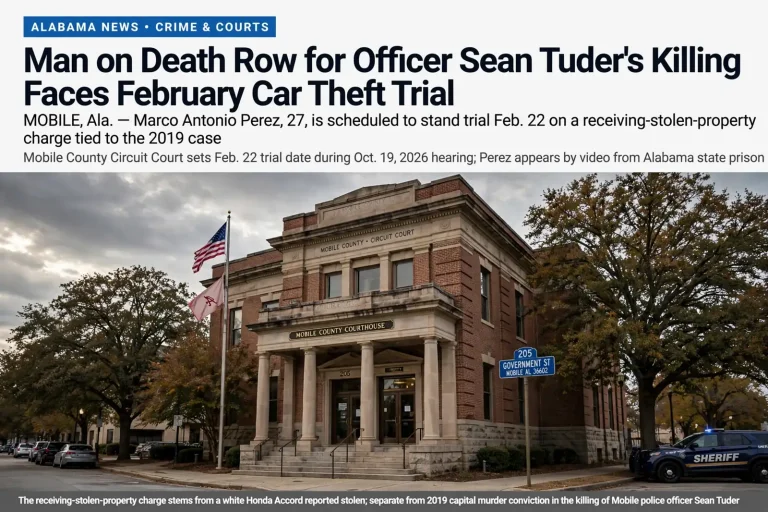
Mobile Neurosurgeon Shawn Clark Pleads Not Guilty to 10 Child Pornography Counts
Dr. Shawn Clark appeared in handcuffs and a jail jumpsuit Tuesday after spending Labor Day weekend in Mobile Metro Jail. He faces four additional charges in Baldwin County, and prosecutors say the case involves both real and AI-generated images.
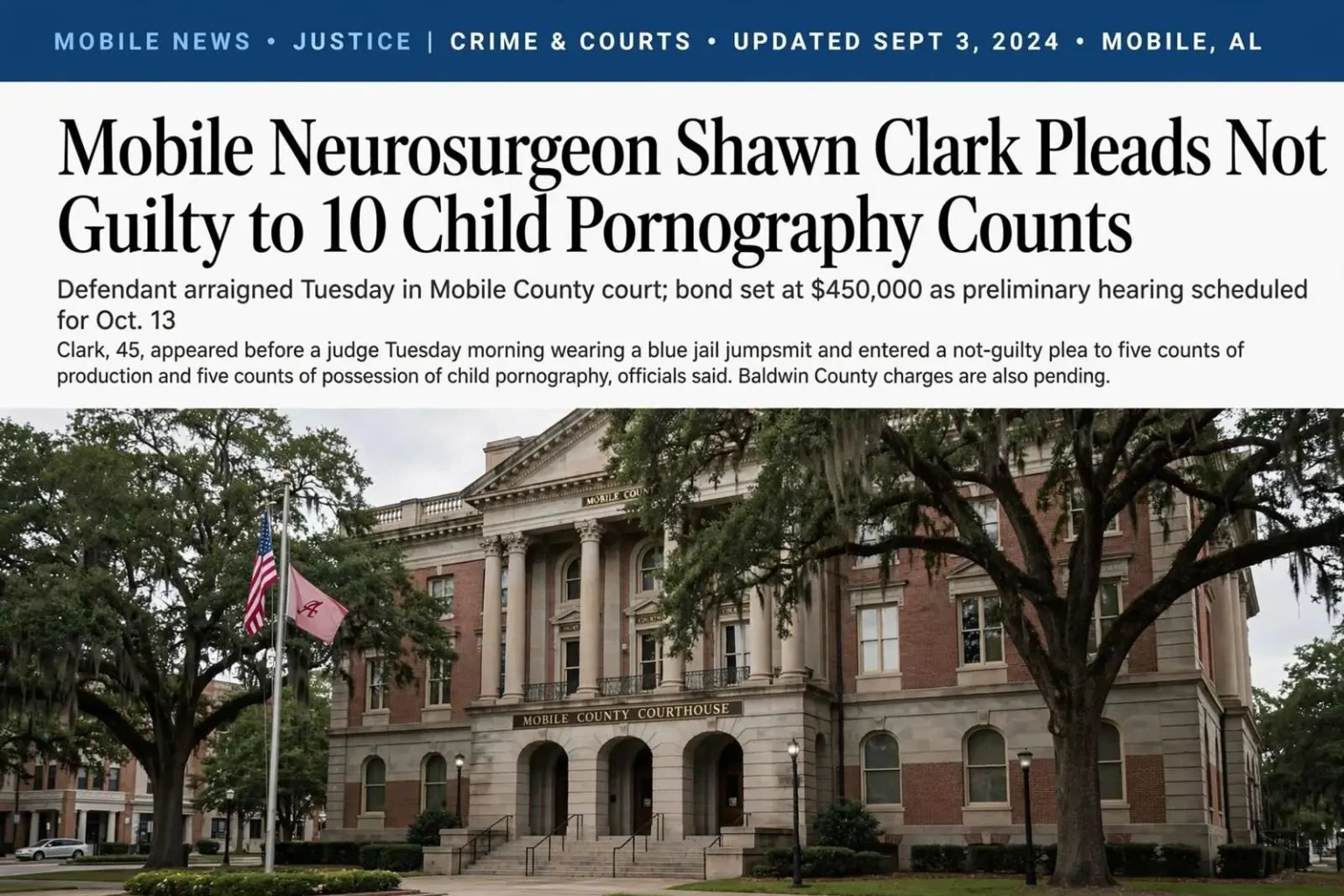
MOBILE, Ala. — Dr. Shawn Clark spent Labor Day weekend in Mobile Metro Jail, and on Tuesday morning he was transported from there to a courtroom, where he appeared before a judge in handcuffs and a blue jail jumpsuit and pleaded not guilty to 10 charges.
Five of those charges allege the production of child pornography. Five allege possession. A judge set his bond at $450,000 last week; Clark did not post it over the holiday weekend.
He also arrived without a lawyer of his own.
An Arraignment Is Not a Trial
Tuesday’s hearing was an arraignment, and it is worth being clear about what that proceeding does, because it is routinely mistaken for something larger.
An arraignment is the point at which a defendant is formally told what he is charged with and enters a plea. No evidence is weighed. No witness testifies. The judge makes no finding about whether the allegations are true. A not-guilty plea at this stage is close to universal — it is the procedural step that preserves every defense available later, and reading it as a substantive claim about the facts misunderstands the mechanics. The remaining business of an arraignment is administrative: counsel, bond, conditions of release, and the date of the next hearing.
All four of those came up Tuesday.
A Lawyer Who Has Not Yet Taken the Case
Clark had not retained defense counsel before the hearing. Attorney Bucky Thomas stepped in for the arraignment and told the court he would file notice if Clark retains him. Thomas said he was still working to finalize an agreement before formally taking on the case.
“We’re trying to make arrangements at this point,” Thomas said. “Once those are satisfied, like I said, I’ll get involved.”
That arrangement is not unusual in the first weeks of a serious case, particularly one with exposure in more than one county. An attorney who appears for a single hearing without filing a formal appearance allows the defendant to be arraigned with counsel present, without committing the lawyer to represent him through the life of the case. Until a notice of appearance is filed, the representation is provisional.
Thomas also raised a possibility that hangs over the case: federal charges.
“Anytime you deal with the internet, you know, computer transaction stuff like that, obviously that possibility is always there,” Thomas said. “But we just don’t know at this point.”
No federal charges have been announced. Thomas was describing a category of risk that defense lawyers routinely flag in cases involving digital evidence, not reporting a development.
Clark’s preliminary hearing is set for Oct. 13, a date that reflects the defense request for additional time to address the Baldwin County matters.
The Charges Span Two Counties
Clark was arrested Sept. 3. The Mobile County charges stem from images investigators say were found on devices in his Fairhope home and his Mobile medical office. Authorities searched both last week.
The Baldwin County Sheriff’s Office says Clark faces four additional charges there for possession of child sexual abuse material, filed after deputies assisted Mobile County investigators with the search of the Fairhope residence. Baldwin County Sheriff Anthony Lowery has said more charges could be forthcoming.
The split is a function of geography rather than duplication. Fairhope is in Baldwin County; Clark’s medical office is in Mobile. Alabama prosecutions are brought by the district attorney for the county where the offense is alleged to have occurred, which is why a single investigation involving two locations produces two sets of charges, two case numbers and two court calendars. The Mobile County case is the one that was arraigned Tuesday. The Baldwin County charges proceed on their own track, and the defense’s request for more time at the Oct. 13 setting was tied directly to that parallel exposure.
Investigators say the material at issue includes a mix of images depicting actual children and AI-generated images.
Why the AI Allegation Matters Legally
The reference to AI-generated material is not incidental. It points to a specific and relatively recent piece of Alabama law.
The 2024 Alabama Child Protection Act makes it illegal to create or share AI-generated sexual depictions of children. That statute exists because synthetic imagery had been a genuinely unsettled area. Child pornography laws in the United States have historically rested on the premise that a real child was harmed in the making of the material, and courts have treated that premise as the constitutional justification for prohibiting the images. Depictions produced without a real child did not fit that framework cleanly, and legislatures in a number of states responded by writing statutes aimed squarely at the newer technology.
Alabama’s 2024 law is one of those responses. Its practical effect in a case like this one is that the state has a statutory basis for charging conduct involving generated material, rather than having to fit every allegation into a framework built around images of identifiable real children.
What the available record does not establish is how the counts break down. Neither the charging documents’ contents nor a count-by-count description of which allegations involve which category of material has been made public. That distinction matters — the production counts and the possession counts are different allegations carrying different weight — and it is one of the things a preliminary hearing can begin to clarify.
Bond, and the Conditions Attached to It
Clark’s bond totals $450,000. He has not posted it, which is why he was brought to court from jail rather than appearing from home.
Bond is not a fine or a penalty. It is the security a court requires to release a defendant before trial, on the expectation that he will return for future proceedings. Alongside the money, the court imposed conditions that apply only if Clark is released: house arrest, electronic monitoring, no contact with minors, no recreational internet use and surrender of his passport.
Conditions of that kind are enforcement mechanisms rather than findings. They exist to manage risk while the case is pending, and violating one is generally grounds for revoking release and returning the defendant to custody. They are also, in a case like this one, the terms that determine whether release is practically usable at all.
The judge has allowed Clark to continue working. The no-contact order, however, prohibits him from being around minor patients — a restriction that substantially narrows what a practicing physician can do, and one that the court alone does not fully control.
“Whether or not an employer or a hospital will give him sort of working privileges is up to those individual entities,” said Chief Assistant District Attorney Jennifer Susman. “We can’t speak to that.”
That is an important line, and Susman drew it carefully. A judge’s order permitting someone to work is not the same as an employer’s decision to let him. Clinical privileges are granted and withdrawn by hospitals and employers under their own processes, which run independently of a criminal docket and on their own timelines.
The Question Clark Asked in Court
Clark asked the court how he could be placed on house arrest and simultaneously ordered to have no contact with minors when his daughter lives in the home.
“My understanding is that the no-contact order includes being with any minors, and so long as his daughter is a minor, it will also include his daughter,” Susman said.
A representative of the Department of Human Resources told the court that Clark’s wife may have removed the girl from the home, and that as long as the daughter is not there, he can stay at his home in Fairhope.
That resolution is a living arrangement, not a resolution of anything larger. Decisions about the placement and welfare of a child are handled through a separate process, with its own standards and its own confidentiality, and that process runs on its own schedule regardless of what happens on the criminal docket.
What Happens Between Now and Oct. 13
The Oct. 13 preliminary hearing is the next scheduled event, and like the arraignment, it is a narrower proceeding than its prominence suggests.
A preliminary hearing tests whether there is probable cause — whether the state can show enough to believe an offense occurred and that this defendant committed it. That is a substantially lower bar than the proof beyond a reasonable doubt required for a conviction. The judge does not decide guilt. If the state meets the standard, the case is bound over to a grand jury, meaning it moves to the body that decides whether to return an indictment and formally charge the defendant. If the state does not, the charges can be dismissed at that stage — which does not always end a matter, since a grand jury can consider a case independently.
Preliminary hearings are often the first public airing of what investigators actually found, because the state must put on some evidence rather than simply reciting allegations. They are also frequently waived by defendants who would rather not preview the state’s case or create a transcript of testimony. That is one reason the Oct. 13 setting may or may not proceed as scheduled.
Several threads remain open. Baldwin County’s four possession charges are pending separately, with the sheriff signaling that more may come. Thomas raised the prospect of federal charges, but no federal action has been announced. And whether Clark retains Thomas or another attorney will shape the pace of everything that follows.
Clark has pleaded not guilty. Everything alleged against him remains an allegation, and he is presumed innocent unless and until proven guilty.