Port City Classic Funding Restored as Council Presses for a Uniform Yardstick
Mobile's proposed fiscal 2027 budget eliminates the Port City Classic's $400,000 appropriation even as it raises funding for the organization that stages the game. Councilman Cory Penn and NAACP chapter president Robert Clopton want the city to evaluate every taxpayer-funded event by the same standard before any are cut. Mayor Spiro Cheriogotis says he is open to the conversation.
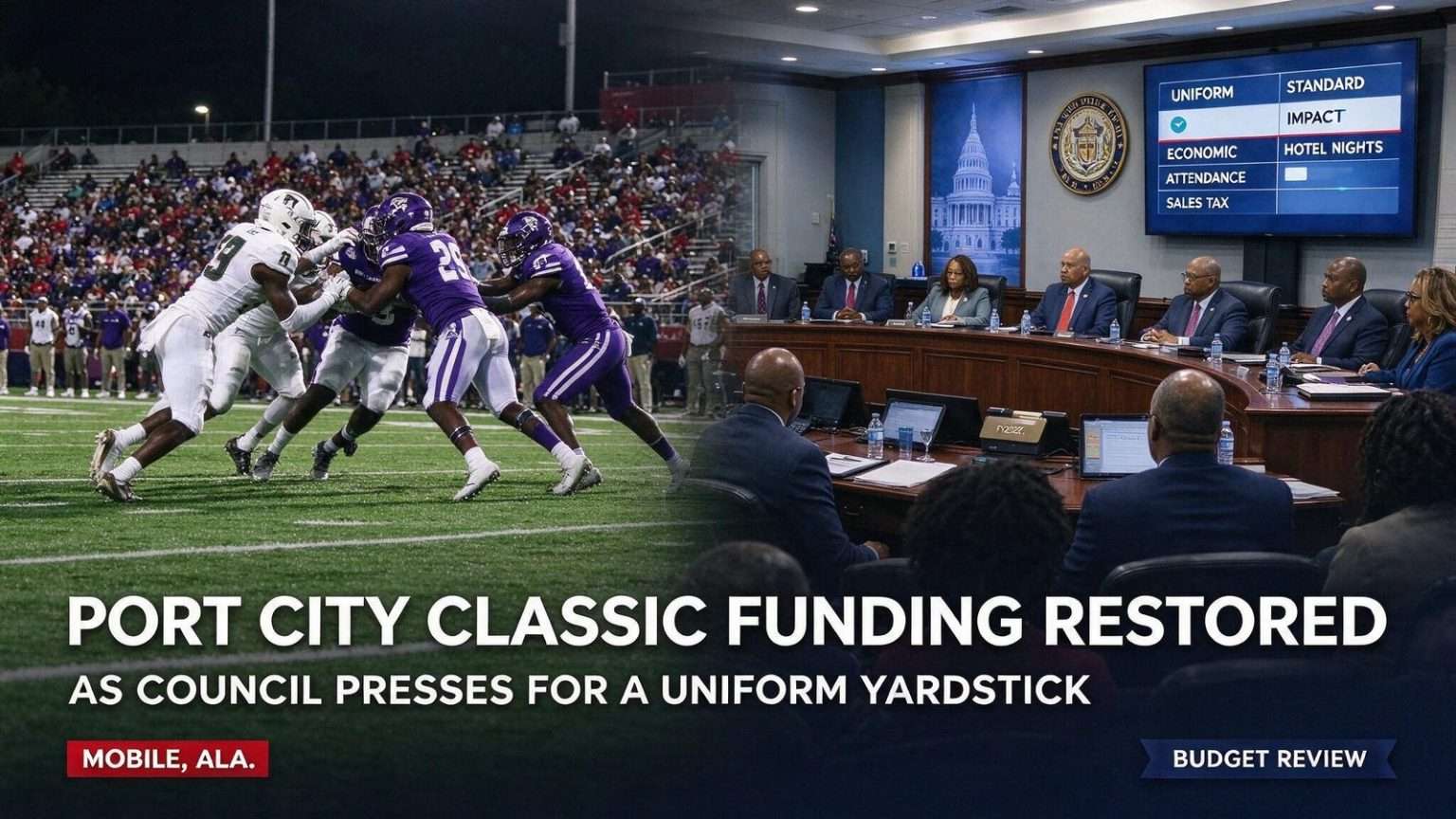
MOBILE, Ala. — Two days after Tuskegee University edged Fort Valley State University 24-23 at Ladd-Peebles Stadium, the game they played — and whether Mobile taxpayers should keep paying for it — became the first significant flashpoint in the City Council’s review of Mayor Spiro Cheriogotis’s proposed budget.
Cheriogotis said Tuesday he is open to discussions that could lead to the Port City Classic continuing next year, even as his fiscal year 2027 spending plan eliminates the game’s dedicated funding. At the same time, he argued that his budget actually increases the city’s support for the organization that stages the event.
Both claims can be true at once, and understanding why requires looking at how Mobile budgets for events in the first place.
What a performance contract is
The money at issue moves through a line in the city budget known as “performance contracts.” These are annual appropriations the city makes to a range of events and nonprofit organizations, and together they account for more than $8.7 million in the city’s budget.
The structure is common in municipal government. Rather than running festivals, tournaments and cultural programs itself, a city contracts with outside organizations to deliver them, on the theory that the resulting visitor spending, hotel stays and sales tax collections return value to the public that exceeds the appropriation. The word “performance” in the name refers to the contracted party performing services under an agreement — but it also invites the obvious question of whether those services are performing in the economic sense, which is exactly the question now being pressed at City Hall.
Because these are annual appropriations rather than long-term obligations, each budget cycle is a fresh decision. An event funded in one year has no automatic claim on the next year’s money. That is what makes the annual budget the moment when a line like the Port City Classic’s is most vulnerable, and it is why the debate has surfaced now.
The numbers behind the disagreement
The proposed FY2027 performance contracts include $600,000 for Brothers Working Together, the organization that sponsors three events involving historically Black colleges and universities: the Port City Classic, the Gulf Coast Challenge in early October, and the Bridge Builders Classic basketball game in January.
Cheriogotis said that appropriation is $100,000 more than last year’s $500,000 — a 20% increase to the organization.
But the 2027 proposal also eliminates funding for the Port City Classic, which received $400,000 in last year’s budget. The Bridge Builders Classic, which received $100,000 last year, is likewise set to be eliminated.
Put the figures side by side and the picture clarifies. The organization’s own line grows by $100,000. Two separate event lines totaling $500,000 disappear. The mayor’s statement about increased funding for the sponsoring organization and the objection that the city is cutting HBCU event support are describing different rows in the same document.
The city’s other football commitments provide the comparison that council members have begun to draw. Mobile provides $500,000 annually to the Senior Bowl and $500,000 annually to the 68 Ventures Bowl, as listed in the city’s budget. Those are the figures against which the treatment of the HBCU games is now being measured.
The call for a standard that applies to everything
The most substantive proposal to emerge Tuesday was not about restoring one line item. It was about creating a common yardstick.
Robert Clopton, president of the Mobile chapter of the NAACP, told the council that the mayor’s staff should establish a “performance standard” for every event that uses taxpayer money.
“We need to apply it to every major event,” Clopton said during the council meeting, pushing back against proposals that would eliminate the Port City Classic next September.
“If an event is not performing, fix it, review it, or reconsider the investment or eliminate it,” Clopton said. “It’s not about politics. It’s about transparency.”
That formulation is notable because it does not defend the Port City Classic on the grounds that it should be exempt from scrutiny. It accepts elimination as a legitimate outcome — provided the same test is applied to everything else the city funds. The argument is procedural: whatever the standard is, it should be written down and used uniformly.
Councilman Cory Penn made a parallel case, urging the mayor’s office to find a way to evaluate every football game the city supports through the performance contracts line.
“I think we need to have an evaluation of all the games before we cut any of the games to make sure we understand the economic impact,” Penn said. “We are working on that process. Until then, let’s restore (the Port City Classic’s funding). If we don’t meet the (expectations), then we have to move on.”
Penn’s position amounts to a sequencing argument: measure first, cut second. He said he would like to work with the mayor’s administration to restore funding for the Port City Classic while the city conducts what he called a “performance review for all the football games we have.”
The dispute over economic return
Last month, Cheriogotis said he did not believe the game’s attendance, hotel-room nights, and sales tax generation justified the city’s annual investment. Those three metrics are the standard currency of event-funding arguments in tourism-dependent cities, because they map onto the revenue streams a municipality actually collects.
Attendance is the rawest measure and the least directly tied to city revenue: a full stadium of local residents generates ticket sales for the promoter but comparatively little new municipal money. Hotel-room nights are the metric closest to what cities care about, because visitors staying overnight generate lodging tax and spend on meals, fuel and retail across several days rather than a few hours. Sales tax generation attempts to capture that broader spending.
The mayor’s remarks prompted the game’s CEO, Kevin Ball, to counter that the Port City Classic provides a healthy economic return for Mobile. Cheriogotis said he has since met with Ball. Ball could not be reached for comment.
Clopton argued that the Port City Classic is just as viable as other events the city funds, particularly from an economic development standpoint. He said the HBCU games generate “millions of dollars in economic activity” for the city through hotel room nights and spending by visiting teams and their fan bases.
What the public record does not yet contain is a common set of figures. The reported exchange includes the mayor’s judgment that the metrics do not justify the investment, and the assertions from Ball and Clopton that the return is strong. It does not include a published analysis applying the same methodology to the Port City Classic, the Senior Bowl, the 68 Ventures Bowl and the Gulf Coast Challenge. That absence is precisely what Penn and Clopton are asking the administration to fill.
Why economic impact figures are hard
The difficulty in resolving this kind of dispute is not usually a shortage of numbers. It is that different methods produce different numbers, all of them defensible on their own terms.
The central methodological question in any event impact study is what counts as new money. Spending by someone who traveled to Mobile specifically for a game, stayed in a hotel and would not otherwise have visited is new economic activity. Spending by a local resident who bought a ticket instead of spending the same evening at a restaurant is largely money that would have circulated in the local economy anyway. Studies that count all spending at an event produce far larger totals than studies that count only spending attributable to visitors who came because of it.
A second question is what the city compares the appropriation to. Total economic activity is one figure; the tax revenue the city itself collects from that activity is a much smaller one. An event can generate millions in local spending while returning a fraction of its appropriation to the municipal treasury in direct tax receipts, and reasonable people disagree about which figure should govern the funding decision.
None of this is unique to Mobile or to these particular games. It is the standard difficulty in every city that funds events, and it is the reason a written, uniformly applied standard — the thing both Clopton and Penn asked for — would change the terms of the argument regardless of which events ultimately survive the review.
Where the process stands
Tuesday’s session was the first meeting of the City Council’s finance committee on the mayor’s proposed spending plan, which is set to take effect Oct. 1. That timing gives the council a limited window: the budget must be settled before the new fiscal year begins.
Cheriogotis said during the finance committee meeting that he is willing to have a broader conversation about performance contracts. That is a meaningful opening, though it is short of a commitment to restore any specific line, and it leaves open whether such a conversation would happen in time to affect the FY2027 budget or in the year that follows.
This year’s Port City Classic has already been played. Tuskegee’s one-point win over Fort Valley State on Saturday at Ladd-Peebles Stadium was decided under the current funding arrangement. The proposals at issue concern next September’s game.
What to watch next
Several questions will determine how this resolves.
- Whether an evaluation framework is actually created. Both Penn and Clopton asked for a standard applied to all city-funded events. Whether the administration produces one, and whether it covers the Senior Bowl and 68 Ventures Bowl alongside the HBCU games, is the test of whether this becomes policy or stays rhetoric.
- Whether the Port City Classic’s $400,000 is restored. Penn wants it restored pending a review. The budget as proposed eliminates it.
- What happens to the Bridge Builders Classic. Its $100,000 is also set to be eliminated, and it has drawn less attention than the football game.
- How Brothers Working Together allocates its $600,000. With the organization’s own appropriation rising while two event lines are cut, how the organization deploys the larger sum across the Gulf Coast Challenge and any surviving events becomes consequential.
- The Oct. 1 deadline. The budget takes effect at the start of the fiscal year, which constrains how long the council can leave these items unsettled.
The larger question raised Tuesday is not really about one football game. It is whether a city that distributes more than $8.7 million a year through performance contracts has a consistent, transparent method for deciding which contracts to keep — and whether that method will be written before the next round of cuts, or after.
The Numbers Behind the Debate
Mayor Spiro Cheriogotis’s $404 million Fiscal Year 2027 budget includes no taxpayer funding for the Port City Classic, the game conceived in 2023 to promote Historically Black Colleges and Universities. The budget proposal shows the event has received roughly $1.55 million from the city since it began — $350,000 in Fiscal Year 2023, then $400,000 in each of fiscal years 2024, 2025 and 2026.
Attendance Has Fallen Every Year
Official box scores show the Port City Classic has struggled to fill Ladd-Peebles Stadium. The inaugural game between Alabama State University and Grambling State University drew 8,601 people to the 40,000-seat field in Midtown Mobile. That figure fell to 7,831 in 2024 and 6,123 in 2025. Saturday’s game between Tuskegee University and Fort Valley State University drew 6,061 — the lowest total in the contest’s history.
Where the Money Would Move
The proposal would eliminate $400,000 for the Port City Classic and $100,000 for the Bridge Builder Classic basketball game, which has received $100,000 from the city every year since Fiscal Year 2024. At the same time, it would increase funding for the Gulf Coast Challenge, the annual football game between Jackson State University and Alabama A&M University, from $500,000 to $600,000. That event received $250,000 in Fiscal Year 2022 and $350,000 in Fiscal Year 2023 before reaching $500,000 for fiscal years 2024 through 2026.
All three events are organized by Brothers Working Together LLC. Cheriogotis noted that when the city assembled the budget proposal, the company had submitted an application seeking $500,000 in city funds for all three events combined.
The NAACP Asks for a Single Yardstick
Mobile NAACP President Robert Clopton used the public comment portion of Tuesday’s council meeting to ask city leaders to look again before voting to end the funding. Clopton pointed to figures compiled by the Mobile Sports Authority showing both games generated millions in economic impact in 2024 — $6.29 million for the Gulf Coast Challenge and $4.55 million for the Port City Classic.
“If an event isn’t performing, let’s fix it, review it, reconsider the investment, or eliminate it,” Clopton said. “I respectfully ask the City Council to reconsider eliminating the Port City Classic’s funding. Instead, make Fiscal Year 2027 a performance year for re-examining things.”
He framed the request as a question of method rather than favoritism.
“This should not be about one event versus another. It is not about politics. It’s only about fairness, transparency and measurable results,” Clopton said.
A Council Member Presses the Point
District 1 Councilman Cory Penn, who expressed support for the Port City Classic in a Facebook post last month, did not respond to Clopton during the regular meeting but took up the subject at a committee meeting later that afternoon.
“I have a lot of questions regarding performance contracts. One in particular I would like to work with the administration and this council on is restoring the Port City Classic before we can do a performance review for all the football games we have,” Penn said. “I would like to work with the administration before we start trying to move money around.”
Cheriogotis’s answer left the outcome open.
“We understand there is still some need there and are certainly willing to talk through that,” he said.
The council is expected to continue reviewing the proposed budget before a final vote. If approved, the Fiscal Year 2027 budget would take effect Oct. 1.
Update: Port City Classic funding restored in final budget (Sept. 22, 2026)
The Port City Classic’s $400,000 is back. Before unanimously approving the fiscal year 2027 budget on Tuesday, Sept. 22, the Mobile City Council voted 6-1 to adopt an amendment from Councilman Cory Penn sending $400,000 to Brothers Working Together LLC for the game, the same amount it has received each year since fiscal 2024. Councilman Ben Reynolds cast the lone vote against it.
The money came from about $1.5 million set aside for Regions Arena operations that the city will not need next year. Reynolds argued the city should “sit this one out,” pointing to $400,000 in state funds recently sent to the Mobile Sports Authority, part of which may support the game.
Mayor Spiro Cheriogotis called the amendment “perfectly palatable” but said he is not sure the game has yet delivered the economic impact the city expects. “It takes time to establish these games,” he said. Penn said the restored money gives the city time to evaluate the performance contracts for the Port City Classic, the Gulf Coast Challenge, the 68 Ventures Bowl and the Senior Bowl, and council members said all performance contracts will face a harder look next year.
For full details on the approved budget, see our updated budget story.