City seeks extra $1.95 million for Oaklawn-area homes after voucher breakdown
Mobile officials say the Mobile Housing Authority pursued the wrong type of federal voucher for Taylor Landing, a 70-home development next to the Oaklawn public housing complex, leaving the city to cover rent subsidies itself. The City Council is weighing $1.95 million on top of $11.5 million already approved. The Housing Authority says it was pressured to rush a process requiring public notice.
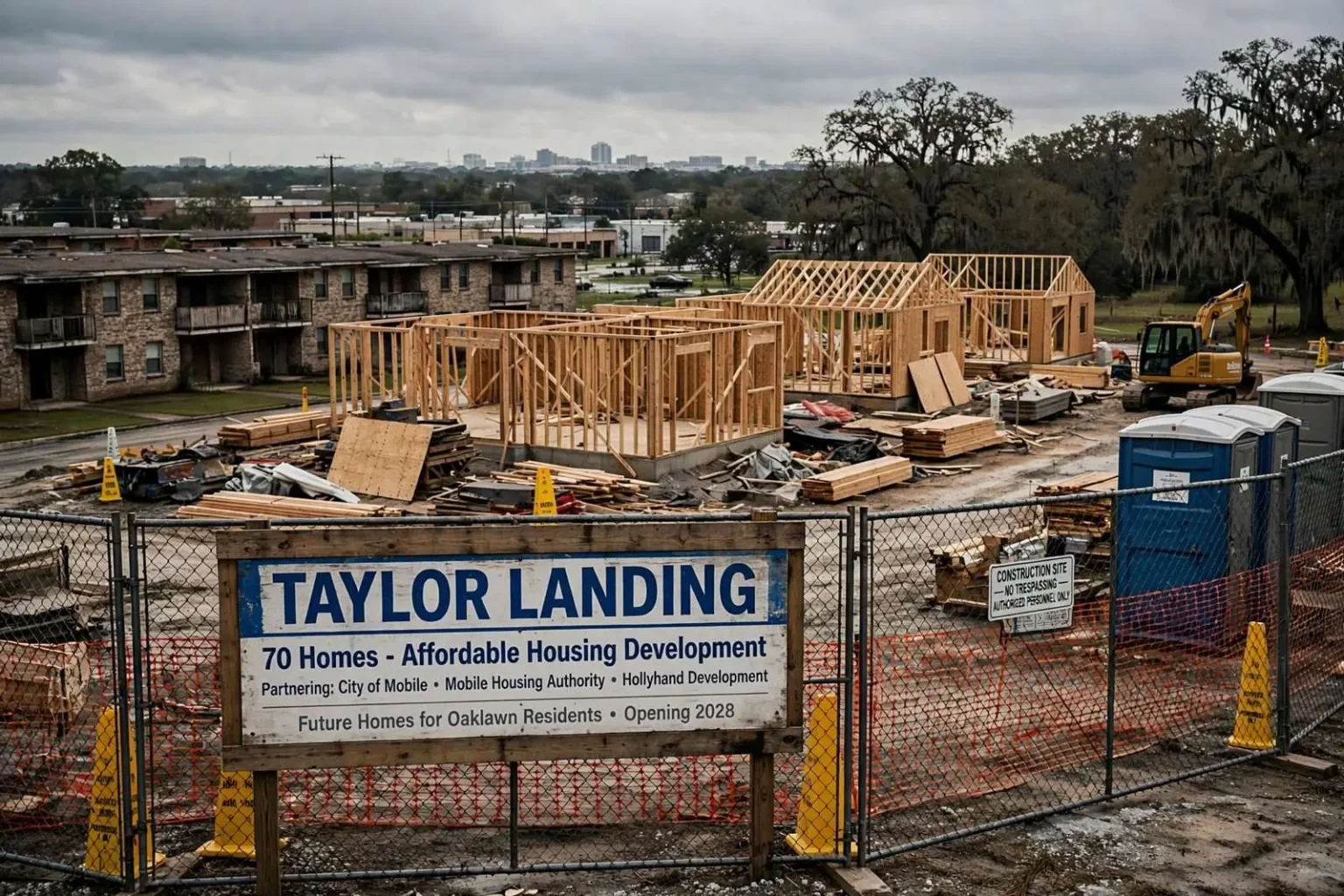
MOBILE, Ala. — A disagreement over which federal rental subsidy should have been attached to a new affordable housing development next to the Oaklawn public housing complex has opened a public rift between the city of Mobile and the Mobile Housing Authority, and it has landed on the City Council in the form of a request for nearly $2 million in additional taxpayer money.
The council took up a resolution Tuesday to shift $1.95 million to the project, known as Taylor Landing. That request comes on top of $11.5 million the city approved for the development last year, bringing the city’s committed contribution to well over $13 million if the new appropriation is approved.
At the center of the dispute is a question that sounds technical but determines what residents will pay every month: which type of federal housing voucher the Housing Authority was supposed to secure for the project, and whether the process that produces one was ever formally completed.
What Taylor Landing is
Taylor Landing is planned for a site adjacent to Oaklawn, one of Mobile’s public housing complexes. The development is to include 70 homes, 69 of which are earmarked for current Oaklawn residents. That ratio matters: this is not a project designed primarily to add units to the general rental market, but one built around rehousing people who already live in the neighborhood’s public housing.
It was presented as a partnership. The city would put in money; the Mobile Housing Authority would bring federal vouchers to subsidize rents in the new units. Redevelopments of aging public housing are commonly structured this way, with a local government, a housing authority and a private developer each supplying a different piece — land, capital, subsidy and construction expertise — because no single party typically has all four.
The developer is Hollyhand Development, whose president, Win Yerby, told council members during their pre-meeting conference that his company has completed roughly $300 million worth of public housing redevelopment across Alabama and has gone through the voucher process about a half-dozen times.
Why the voucher type matters
The city’s position is that the Housing Authority pursued the wrong kind of voucher, and that the mistake is what created the need for an additional $1.95 million in municipal money. City officials said the funds would subsidize the rents of low-income tenants who would otherwise have been covered by vouchers issued through the U.S. Department of Housing and Urban Development.
Jamey Roberts, the city’s senior director of neighborhood development, framed the stakes in terms of what residents pay.
“The voucher piece is very important to the city,” he said.
Roberts said the vouchers were the mechanism ensuring that Oaklawn residents moving into the new units would not have to pay more than 30 percent of their incomes in rent.
That 30 percent figure is the long-standing federal benchmark for housing affordability, and it is the operating principle behind rental assistance programs generally: a household pays a set share of its income toward rent, and a subsidy covers the difference between that amount and what the unit actually costs. Without a subsidy filling the gap, either the tenant pays more or someone else absorbs the difference. In this case, the city is proposing to be that someone.
It is worth being precise about what has and has not been established publicly. The city says the wrong voucher type was used. The reported account does not specify which voucher types are involved or lay out the technical distinction between them. What is clear from the officials’ own descriptions is the practical consequence: absent the expected federal subsidy, the city says it must supply the money itself to hold rents at the intended level.
The developer’s account
Yerby’s remarks to the council split the difference in a way that is worth reading closely. He did not say the voucher approach was unworkable. He said it required following a defined sequence to completion.
“It is doable, but you have to follow the process throughout. And our understanding … is that the Housing Authority did intend to do that but until the board actually acts formally on it, it’s not done,” he told council members during the pre-meeting conference.
That statement identifies the specific point of failure the city is alleging: not that the Housing Authority refused to pursue vouchers, but that a governing board vote — the formal act that converts intent into a binding commitment — had not occurred.
The distinction between intent and formal action is fundamental to how public agencies operate. Staff can negotiate, plan and prepare, but a public body generally speaks through recorded votes taken in noticed meetings. Until a board acts, staff-level agreement is not an obligation the agency can be held to. That is a feature of open government law rather than a loophole, but it also means that timelines built on expected board action carry risk whenever the vote has not yet happened.
The Housing Authority pushes back
The Mobile Housing Authority rejected the characterization. The agency said the city had demanded it “rush a process that requires public notice” along with feedback from residents and others.
That defense rests on the same procedural ground the developer described, viewed from the other side. Processes involving federal housing subsidy and public housing residents typically carry notice and comment requirements precisely so that the people most affected — in this case, Oaklawn residents whose housing is at stake — have a chance to be heard before decisions are locked in. Those requirements take calendar time, and they cannot generally be compressed to fit a development schedule or a municipal budget cycle.
The agency’s statement went further, objecting to how the disagreement is being described publicly.
“It is unfortunate that a narrative is being spun to make the Mobile Housing Authority appear unwilling to serve as a catalyst for change in the Oaklawn community, when in reality, it has already gone above and beyond,” the agency said in a statement.
It added: “Until the truth is told publicly, it only makes sense for the Mobile Housing Authority and its affiliate entity to discontinue partnership attempts with parties that will mischaracterize what has transpired.”
That second sentence is the most consequential line in the exchange. It signals a willingness to step back from partnership attempts — a significant posture for an agency whose cooperation the project’s original financing structure assumed.
The money, and how it might come back
The $1.95 million the council is being asked to approve is not being presented as a permanent write-off. Roberts said the city hopes HUD vouchers may still be applied to the project. If that happens, the vouchers would allow rent increases, and that money would be funneled back to Mobile to reimburse the city for the $1.95 million.
The mechanics there are worth unpacking. If federal vouchers ultimately attach to the units, the subsidy would cover a larger share of each unit’s rent than the tenant pays directly. The property’s rental income would rise without tenants paying more out of pocket, and the additional revenue could be used to repay the city’s bridge contribution. In effect, the city would be fronting the subsidy and waiting for the federal program to catch up.
That is a plausible structure, but it is contingent. It depends on vouchers actually being secured later, on the terms permitting reimbursement, and on the two public agencies now trading public statements finding a way to work together. None of those things has happened yet.
The timeline
The council considered the resolution Tuesday but did not finalize it. If the council approves the measure next week, the money would become available in October, with construction beginning shortly afterward. Construction is expected to take about 18 months.
That schedule places the practical pressure on the council. A delay in approving the appropriation is not merely a delay in spending; it is a delay in a construction start that governs when 69 Oaklawn households can move into new units. An 18-month build begun in late 2026 would deliver homes sometime in 2028.
At the same time, approving the money resolves the immediate schedule problem without resolving the underlying question. The additional $1.95 million substitutes local dollars for federal ones. It does not itself produce the vouchers, repair the relationship between the city and the Housing Authority, or establish which account of events is accurate.
What the dispute does and does not establish
Several things are clear from the public record as reported. The city is asking for $1.95 million beyond the $11.5 million already approved. The project involves 70 homes with 69 reserved for current Oaklawn residents. The city attributes the funding request to the wrong voucher type having been pursued. The Housing Authority says it was pressured to compress a process carrying public notice requirements and objects to how it is being portrayed. The developer says the voucher route is workable but was not formally completed by a board vote.
Several things are not established. The reported account does not resolve whether the Housing Authority was in fact asked to move faster than its own procedural obligations allowed, nor does it establish when the city first learned of the voucher issue or whether an alternative existed that would have avoided the additional local expense. Nor does it indicate what happens to the reimbursement hope if the two agencies stop cooperating entirely.
What to watch next
The most immediate item is the council vote expected next week. Approval would release the money in October and clear the way for construction; rejection or deferral would leave the project’s rent structure unresolved.
Beyond that, the questions worth following are whether HUD vouchers are ultimately obtained for Taylor Landing, whether the reimbursement Roberts described materializes, and whether the Housing Authority’s stated intention to discontinue partnership attempts extends to future projects in Mobile. Public housing redevelopment generally depends on the local housing authority’s participation, and a durable breach between the city and the authority would have consequences reaching well past one 70-unit development.
For the residents of Oaklawn, the practical question is simpler and more pressing: whether the units they have been promised get built on schedule, and whether the rent they pay when they move in stays at the level the project was designed around.