Victim Identified in Deadly Bellingrath Road Shooting in Theodore
Police identified William Burton, 35, as the man killed in a shooting on Bellingrath Road in Theodore; the homicide investigation continues.
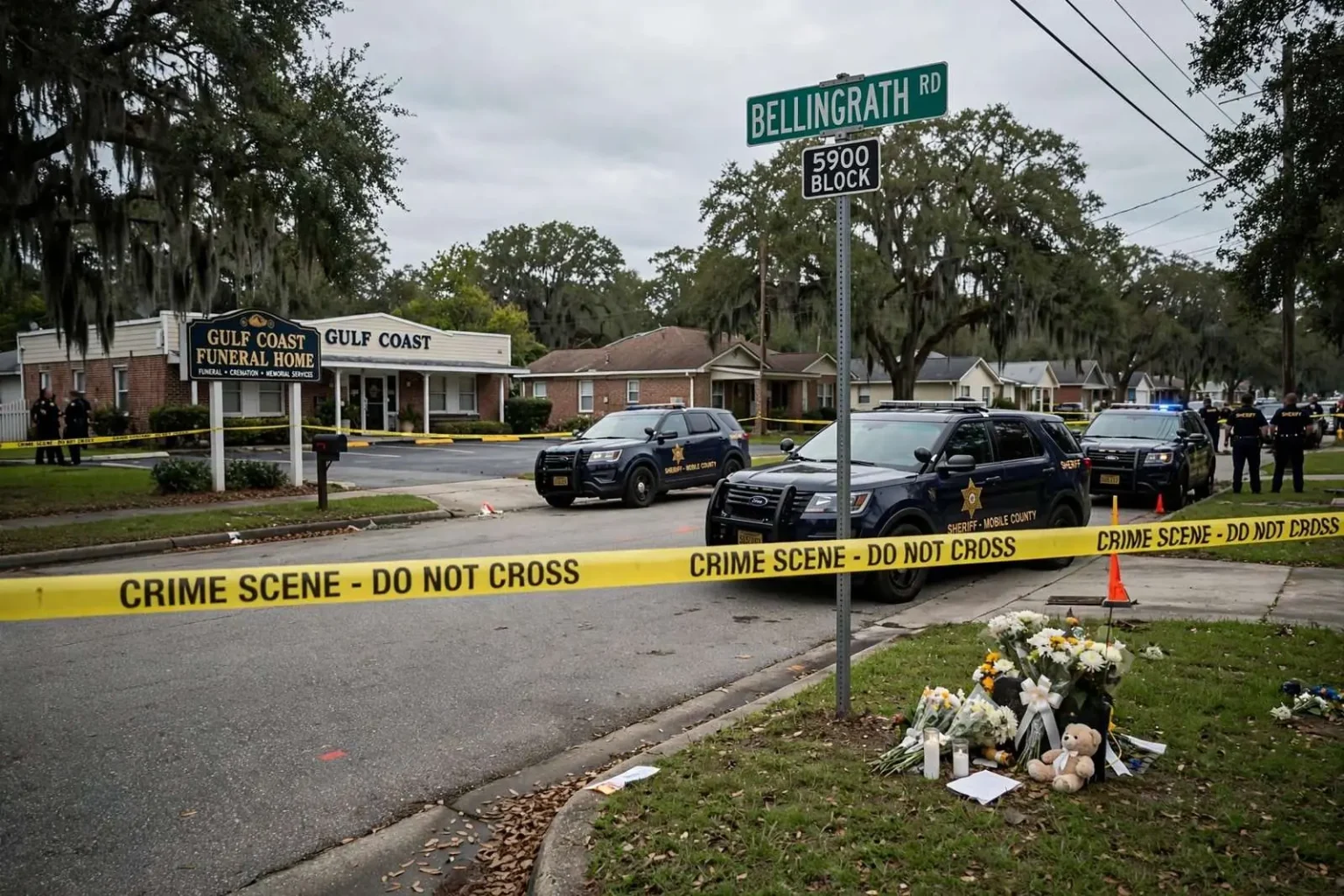
The man shot and killed at a Theodore home has been identified as 35-year-old William Burton, known to loved ones as Willie. The identification, confirmed days after the gunfire, turned an anonymous crime scene into a specific loss: a father of five, remembered by his stepfather as well-respected and someone who never caused problems, gone from a residential street in one of Mobile County’s longest-settled communities.
Mobile police confirmed a 35-year-old man died in the shooting at a home on the 5900 block of Bellingrath Road, near Gulf Coast Funeral Home, and said they are investigating the case as a homicide. Bellingrath Road runs through the heart of Theodore, linking neighborhoods, churches, and small businesses along a corridor that carries everyday life rather than through traffic. A fatal shooting on that street, in view of the community, landed hard in a part of the county where residents are unaccustomed to homicide on their own block.
A witness told reporters another man walked up to the victim, shot him multiple times, and ran away. The description — an approach on foot, multiple shots, and a flight from the scene — gave investigators a starting picture of the encounter and gave the neighborhood an unwelcome image to carry. The shooter’s path, on foot, suggests the attack was not random in its method, and detectives spent the early days of the investigation working to establish who the victim was with and why.
A family’s grief at the scene
Burton’s stepfather, Charles Carter, said he got the call while at work — that Willie had been shot and was down. By the time he reached the scene, paramedics were still working on him, but Burton did not survive. The account is the kind no family prepares for: an ordinary shift interrupted, a drive across the county, and the arrival to find medics fighting for a life already slipping away, with the tape of a homicide investigation drawing closer around the people gathered at the edge of it.
Carter described his stepson as well-respected and someone who never caused problems. He was a father of five children. That is the portrait the family offered publicly — not of a life defined by the street where it ended, but of a working father whose death leaves five children without him. In the days after the shooting, relatives gathered and grieved while detectives did the work that families in that position cannot: establishing the sequence of events, identifying the shooter, and building a case.
According to Carter, Burton had been visiting a female friend at the home off Bellingrath Road when he was shot. That detail placed the victim at the residence as a guest rather than a resident, and it became one of the central facts of the early investigation — who else was at or near the home, what drew the shooter there, and whether the visit had been observed by anyone in the quiet residential stretch where the house sits.
The investigation in its early days
Police have not announced any arrests in the case, and the investigation remains ongoing. Homicide work in its first days moves on several fronts at once: canvassing the neighborhood for anyone who saw a man on foot before or after the shooting, collecting physical evidence from the scene, reviewing any camera footage from homes and businesses along the corridor, and piecing together the victim’s final hours through the people who knew his movements. Each thread matters, and the earliest ones — the witness account and the family’s knowledge of his plans that day — usually shape the rest.
The geography of the case matters to that work. The 5900 block of Bellingrath Road sits in a settled part of Theodore, near the funeral home that gives the stretch a familiar landmark, and residential streets like it hold witnesses: neighbors working in yards, drivers passing at the right moment, security cameras covering driveways and porches. Investigators count on the area’s residents to help close the gap between what the witness saw — a man walking up, firing, running — and the identity of the man who did it.
The region’s law enforcement structure also shapes how the case proceeds. Mobile County’s unincorporated communities like Theodore are patrolled by the county sheriff, while major-crime investigations draw on the resources of the region’s forensic and prosecution systems. A case like Burton’s moves from the scene to the medical examiner, from interviews to warrants, at a pace set by evidence rather than urgency. For the family, that pace is its own trial: the investigation continues while the household Burton supported learns to carry on without him.
Gun violence and the communities left behind
Every homicide leaves two landscapes behind it. The first is the crime scene itself — the block, the tape, the patrol cars that mark the street for a day or two before the routine returns. The second is slower and harder to see: five children without a father, a stepfather who replays the phone call that interrupted his workday, and a neighborhood where residents now look differently at the house on their street. Those are the costs that never appear in an arrest report, and they are the ones the Bellingrath Road community is carrying as the case waits for its break.
Mobile County sees dozens of homicides in a typical year, spread across the city and the county’s outlying communities, and each one follows the same hard arithmetic: a small number of cases are solved quickly, most yield to sustained investigative work over months, and a few go cold while families wait. Advocates for victims’ families often note that the waiting is hardest in the communities with the fewest resources to press for answers — which is why public attention to cases like this one, and tips from residents who know something, matter as much as they do.
Who Willie Burton was
The details of a victim’s life are what make a case worth solving, and the picture that emerged of William Burton was plain and human. Thirty-five years old. A father of five. Known to everyone who loved him as Willie, not William. Described by the stepfather who raised alongside him as well-respected, the kind of man who never caused problems. Those details came not from officialdom but from a grieving family willing to talk about who they lost, and they are the details neighbors on Bellingrath Road will remember when they think of the shooting on their street.
Thirty-five is the middle of a working life, the age at which fathers are deep in the raising of children rather than finished with it. Five children now face the years ahead with the loss at the center of their family’s story, and the community response to homicides in Mobile County — vigils, fundraisers, the quiet networks of churches and neighbors — exists precisely for households in that position. Whatever the investigation produces, the family’s work of the coming years is already defined.
How the case can move forward
For an investigation in its early stage, the paths forward are the classic ones. A witness comes forward with a name. A camera on the corridor yields an image worth distributing. A person close to the shooter hears something and makes the call detectives ask for. The testimony of the witness who saw the attack — a man walking up, shooting multiple times, running — provides the frame, but frames need filling: a face, a direction of travel, a motive, a moment when someone saw the shooter before or after the few seconds that ended William Burton’s life.
The first hours after a fatal shooting set the course of everything that follows. Detectives secure and process the scene while evidence is fresh, interview the witnesses who are immediately available, and issue the early identification that lets the public know who was lost. Then the work slows into rhythm: follow-up interviews, forensic results that take days or weeks, and the steady accumulation of small facts that eventually allows investigators to say publicly who they believe pulled the trigger and why.
Residents of the Bellingrath Road corridor and anyone with knowledge of the case have a direct role in that work. Investigators routinely stress that tips, even partial ones — a sighting of a man on foot, a familiar face near the home that afternoon — can be the thread that unravels a case. In communities like Theodore, where people notice who belongs and who does not, that knowledge is usually held by ordinary residents, and the decision to share it is the hinge on which cases like this one most often turn.
Until an arrest comes, the 5900 block of Bellingrath Road remains the place where a well-respected father of five was killed in broad public view, and the case remains open — worked by investigators, watched by a family, and remembered by a community that would like nothing more than for Willie Burton’s killer to be identified, arrested, and held to account.