Local Government Mobile County
Mobile County schools float $919.6 million spending plan for FY2027
The Mobile County Public School System is proposing a $919.6 million budget for fiscal year 2027, a 3.7% increase that would draw more than $68 million from reserves and other fund balances. State revenue is projected to jump 21%, while debt service would climb more than 61%. Two public hearings were scheduled before the board takes final action.
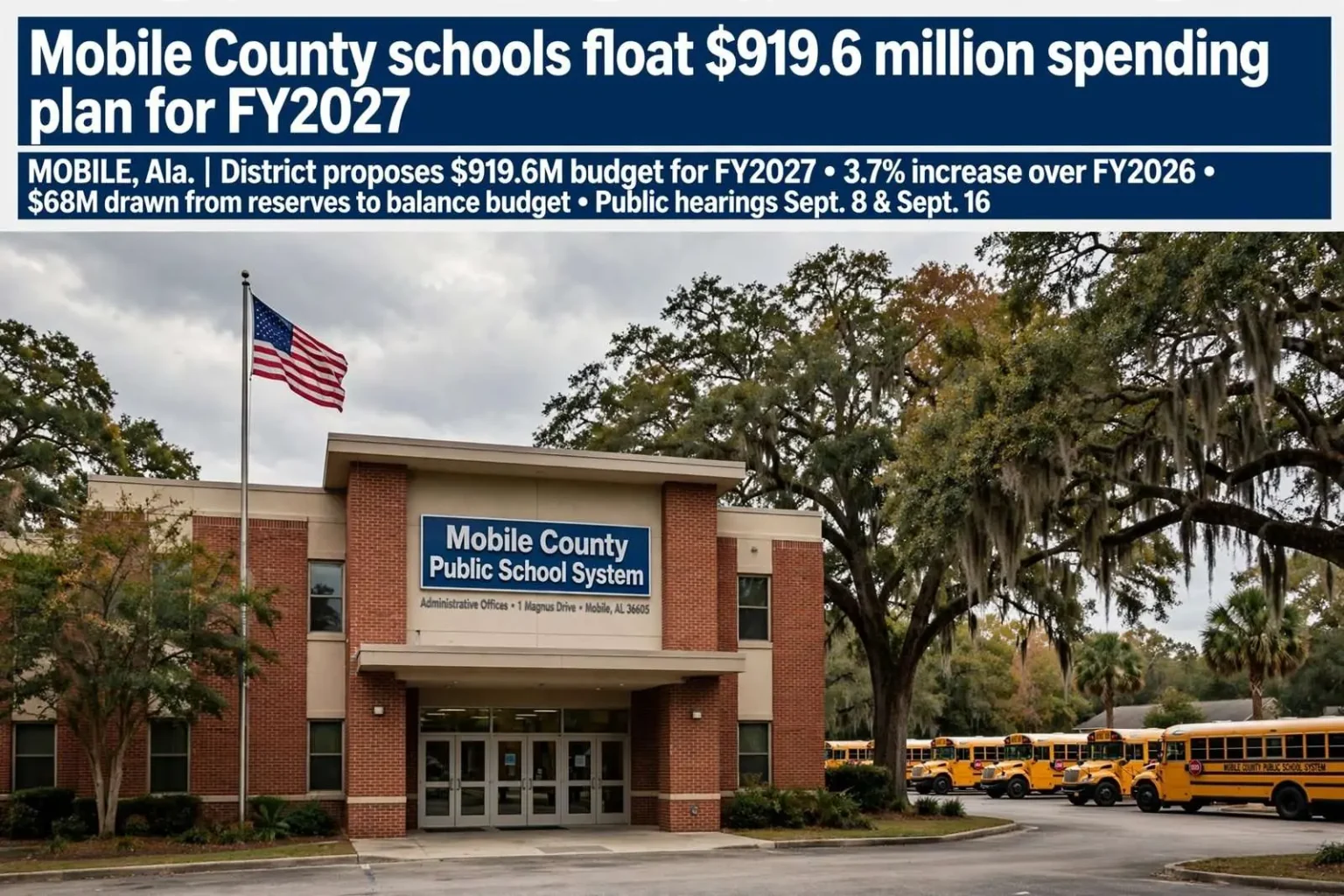
MOBILE, Ala. — The Mobile County Public School System has put forward a spending plan for the coming fiscal year that comes within striking distance of $1 billion, a proposal that would raise total outlays by 3.7% while leaning on more than $68 million in reserves and other available fund balances to close the difference between what the system expects to take in and what it expects to spend.
The proposed budget for fiscal year 2027 totals $919.6 million in expenditures and other uses of funds. Against that, MCPSS projects $850.6 million in revenue. The arithmetic leaves a planned gap of nearly $69 million, which the district intends to cover with money already sitting in its fund balances rather than with new revenue.
The proposal is not yet law. It remains a proposal, and it was scheduled for public hearings on Sept. 8 and Sept. 16 before the board takes final action.
The top-line numbers
Alabama’s fiscal year for public education runs from Oct. 1 through Sept. 30, so the FY2027 plan covers the twelve months beginning this October. That timing is why school systems across the state spend late summer and early fall assembling and advertising budgets: the new year begins just weeks after the new school year does.
Measured against the system’s FY2026 amended budget — roughly $887.1 million once transfers between funds are counted — the FY2027 proposal represents an increase of about 3.7% in total planned spending. That is a meaningful but not dramatic year-over-year change, and it is worth noting that the comparison is being made to an amended figure. Amended budgets are the numbers a district lands on after a year of adjustments: grants that arrived, projects that slipped, enrollment that came in above or below the estimate. Comparing a proposed budget to an amended one is the more honest comparison, because it measures the new plan against what the district actually expected to spend by the end of the prior year rather than against a forecast made twelve months earlier.
The word “budget” in a school system of this size also covers more ground than a household would assume. It is not a single pot of money. It bundles together general operating funds, restricted state and federal program funds that can only be spent on specified purposes, capital funds tied to construction and major maintenance, and debt service accounts that exist to make scheduled payments on borrowing. A dollar in one of those buckets often cannot legally be moved into another, which is part of why a district can show a substantial fund balance while still describing budget pressure in a particular area.
Where the money would come from
The most striking revenue line in the proposal is the state contribution. MCPSS projects state revenue rising from about $418.5 million in the FY2026 amended budget to $504.6 million in FY2027 — an increase of $86.1 million, or roughly 21%. In a system this size, a single-year jump of that magnitude in one revenue category is the sort of change that reshapes the rest of the document.
State money is the backbone of public school funding in Alabama. It flows to local systems primarily through the state’s Education Trust Fund, the earmarked account that receives income and sales tax collections dedicated to education, and it is distributed to districts according to statutory formulas that account for student counts and staffing units. Because the Education Trust Fund is tied to tax receipts, the size of the pie available to distribute moves with the state’s economy, and because the distribution is formula-driven, changes in enrollment and in the state’s per-unit funding levels both feed into what any individual district receives.
Local revenue is projected to grow as well, though far less steeply: an increase of nearly $10.8 million, bringing the local total to $244.2 million. Local school revenue in Alabama typically comes from property taxes levied for education, local sales taxes dedicated to schools, and similar municipal and county sources. That category tends to track the local economy and the local property tax base more directly than state funding does.
Federal revenue moves the other way. MCPSS projects it falling by about $4.7 million, to $100.5 million. Federal education dollars are overwhelmingly categorical — that is, attached to specific programs and populations, with rules about how they may be spent — so a decline in that column generally means less program-restricted money rather than less general operating flexibility. The source material does not specify which federal programs account for the decrease.
Where the money would go
Instructional services remains, as it should in a school system, the single largest category of spending. It is budgeted at $361.9 million, nearly $14.9 million more than in the FY2026 amended budget. Instructional services is the accounting category that captures the core work of schooling: teachers and classroom staff, instructional materials, and the direct costs of delivering coursework to students.
The sharpest proportional increase anywhere in the plan is debt service, which would rise from $35.6 million in FY2026 to $57.4 million in FY2027. That is an increase of more than 61% in a single year, and in dollar terms it is nearly $22 million — a bigger swing than the increase in instructional spending.
Debt service is the line that pays principal and interest on money a system has borrowed, typically through warrants or bonds issued to finance construction, renovation, and other long-lived capital projects. A jump of this size in a debt service line ordinarily signals that new borrowing has come onto the books, that a repayment schedule has stepped up, or both. It is important to be precise about what the numbers establish: the budget document as reported shows the increase, but does not by itself explain the cause. That is a natural question for the public hearings.
Auxiliary services would increase by nearly $5 million. That category covers the support functions that make a school day physically possible — areas such as student transportation and child nutrition. Bus fleets, fuel, driver pay, cafeteria staffing and food costs all live in this general territory, and all of them are exposed to the same cost pressures that affect any large employer running vehicles and kitchens.
Two categories would shrink. Proposed capital outlay spending falls about $7.3 million, or 12%, to $53.4 million. General administrative services would decline by roughly $2.3 million.
The capital outlay and debt service lines are worth reading together. Capital outlay is what a system spends directly on buildings and major assets in a given year; debt service is what it pays on borrowing already undertaken. A plan in which capital outlay falls while debt service rises sharply is consistent with a system that has moved from paying for projects as it goes to paying for them over time — but again, the reported figures show the pattern without establishing the reason behind it.
Reading the $69 million gap
The headline number that tends to alarm readers is the planned shortfall: $919.6 million out, $850.6 million in, a difference of nearly $69 million. It is worth explaining what that does and does not mean.
Governmental budgets are not corporate income statements. A school system that plans to spend more in a year than it collects in that year is not necessarily operating at a loss in the way a business would be. Districts accumulate fund balances — accumulated unspent money from prior years, some of it restricted to particular purposes — and they routinely draw those balances down deliberately, especially when a multi-year construction project or a large one-time purchase falls inside a single fiscal year. Spending money you saved on purpose is different from spending money you do not have.
What matters, then, is the trend and the depth of the reserves being drawn from. On the trend, the proposed FY2027 gap of about $69 million sits between the two prior years: it is larger than the $54.8 million shortfall in the FY2026 amended budget, but smaller than the $84.2 million gap in the FY2025 amended budget. In other words, this is not an unprecedented figure for MCPSS, nor is it the smallest recent draw. It is the middle of a three-year range.
The reported figures also indicate the district is relying on more than $68 million in reserves or other available fund balances to cover planned expenses beyond projected revenue. What the reported material does not establish is how large the remaining balances are after that draw, how much of the balance is restricted versus unrestricted, or how many consecutive years of similar draws the system could sustain. Those are precisely the questions a budget hearing exists to surface.
What a public hearing is for
Alabama school systems present proposed budgets at public hearings before boards vote to adopt them. The purpose is straightforward: to put the numbers in front of taxpayers, parents and employees, and to give them an opportunity to ask about the assumptions underneath the totals before those totals become binding spending authority.
A budget hearing is not a referendum. Members of the public do not vote on the plan, and a board is not obliged to change a line because someone objects to it. But hearings are the moment at which the reasoning behind unusual figures is normally explained on the record, and they are the clearest opportunity for the community to establish what a number like a 61% increase in debt service actually reflects.
MCPSS scheduled two hearings, on Sept. 8 and Sept. 16, before final action on the plan.
What to watch next
Several threads in this proposal will be worth following as the budget moves toward adoption.
- The state revenue increase. A projected $86.1 million rise is the single largest change in the document, and much of the rest of the plan depends on it materializing. Projections are estimates; actual receipts are what the system spends.
- The debt service jump. An increase of more than 61% in one year is the sort of change that shapes budgets for years beyond the one being adopted, because debt schedules are long-lived commitments.
- The fund balance draw. Whether the reliance on reserves is a one-year feature tied to specific projects or the beginning of a pattern is the most consequential open question in the plan.
- The federal decline. A $4.7 million reduction in federal revenue is small relative to the overall budget but can be significant for the specific programs it supports.
- Capital outlay. A 12% reduction in direct capital spending, alongside the debt service increase, describes a shift in how the system is paying for facilities.
Until the board votes, the $919.6 million figure is a proposal and nothing more. The categories, the gap and the reserve draw are all subject to change between now and adoption, and amended budgets in later months routinely revise the figures adopted in the fall. What the proposal does establish is the shape of the system’s thinking heading into the new fiscal year: more state money, more spending on instruction, considerably more going to debt, less going directly into capital projects, and a continued willingness to draw on accumulated balances to make the two sides of the ledger meet.