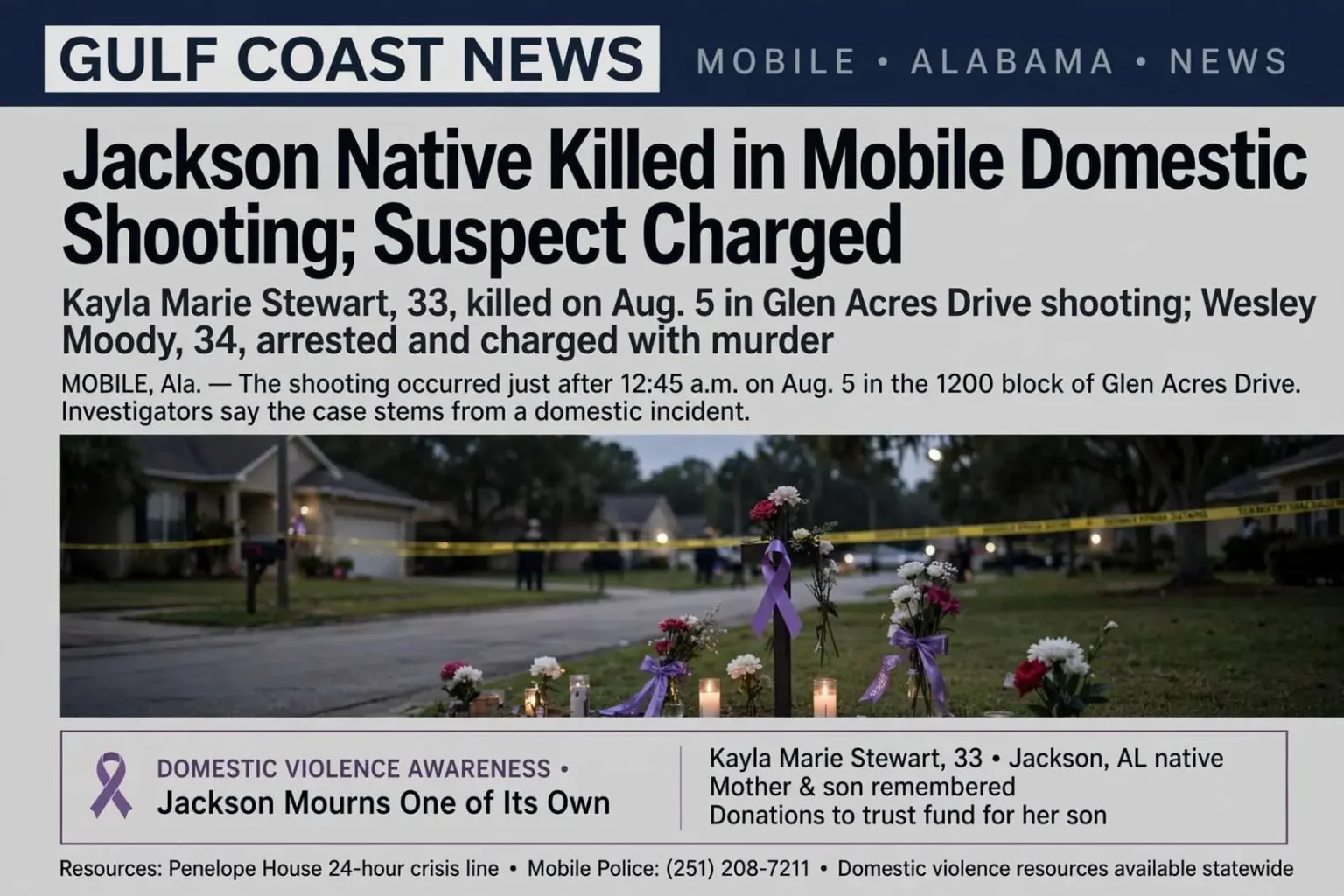
MOBILE, Ala. — A Jackson native was killed in a Mobile shooting on Aug. 5, according to the Mobile Police Department. Kayla Marie Stewart, 33, was found dead by responding officers with a fatal gunshot wound at approximately 12:45 a.m. in the 1200 block of Glen Acres Drive, the MPD said. Wesley Moody, 34, of Mobile was arrested shortly after the shooting and booked into Mobile Metro Jail on a murder charge, according to police and jail records.
Investigators determined the shooting stemmed from a domestic incident, the MPD said. The classification places Stewart among the many victims of domestic violence killed in the United States each year, a category of violent crime that advocates across Alabama have worked for decades to address through shelters, protective order laws and victim services. Domestic violence deaths draw particular attention from prosecutors because they so often follow histories of escalating abuse — patterns that, in many cases, family members and neighbors saw forming long before the violence turned fatal.
Officers responding to the scene in the Glen Acres Drive area, a residential neighborhood in west Mobile, found Stewart dead from her wound. Homicide investigators with the MPD took over the case, canvassing the neighborhood for witnesses and working to establish the sequence of events that ended in the young woman’s death. The arrest of Moody came quickly by the standards of homicide investigations, occurring within hours of the shooting, and he was booked into Mobile Metro Jail — the downtown facility that houses arrestees from across Mobile County — where he remained pending bond proceedings.
Jackson Mourns One of Its Own
Jackson, the Clarke County seat where Stewart grew up, is a small south Alabama city of roughly 5,000 residents along the Tombigbee River, a community where fatal losses of this kind land heavily and word travels fast. News of Stewart’s death spread quickly through the town’s close-knit networks of churches, schools and family connections, and friends from her hometown joined Mobile-area acquaintances in mourning a woman remembered for her warmth and devotion to her son. Small-town ties run deep in Clarke County, and the distance between Jackson and Mobile — about an hour’s drive north on U.S. Highway 43 — did little to soften the shock for those who knew her.
How to help the family: In lieu of flowers, the family is accepting donations to help cover funeral expenses, with remaining funds to be placed in a trust for Stewart’s son. Contributions may be made directly to her mother, Julie Sebastian, or through the GoFundMe established for the family. The trust arrangement ensures that whatever remains after funeral costs are paid will be preserved for the boy Stewart leaves behind — a common arrangement for families suddenly confronting both grief and unexpected expenses, and one that friends say reflects Stewart’s devotion to her child above all else.
Funeral arrangements in such cases typically bring together two communities — the hometown that watched her grow up and the Mobile community where she built her adult life — and family members said the outpouring of support from both has been a source of comfort in the hardest days. Friends described coordinating meal deliveries, child care and travel arrangements for relatives making the trip south for services.
Domestic Violence on the Gulf Coast
Advocates in southwest Alabama stress that fatal domestic incidents like Stewart’s are the endpoint of a pattern that often announces itself early. The Alabama Coalition Against Domestic Violence operates shelters and outreach programs across the state, and in the Mobile area, the Penelope House has served victims of domestic abuse and their children since the 1970s, offering emergency shelter, a 24-hour crisis line, court advocacy and support groups. Resources exist for victims at every stage of an abusive relationship, and prosecutors and advocates alike urge anyone in danger to reach out before an incident turns deadly — but they acknowledge that leaving an abuser is among the most dangerous moments a victim can face, and that many victims conceal the true nature of their situation from everyone around them.
The legal system provides multiple tools designed to intervene before violence escalates. Alabama law allows courts to issue protection orders that bar contact between an abuser and victim, and violations carry criminal penalties. In cases involving firearms, federal law prohibits possession by individuals subject to certain protective orders or convicted of domestic violence misdemeanors. Advocates say the challenge lies in enforcement and in helping victims navigate a system that can feel overwhelming while they are in crisis — a reason court advocates at organizations like Penelope House accompany victims to hearings and help them document violations.
For law enforcement, domestic calls are among the most dangerous and most frequent that officers answer. Mobile police, like departments across the country, have adopted protocols requiring officers to assess lethality factors when responding to domestic incidents — including the presence of firearms, prior strangulation, threats to kill and recent separation — and to connect victims with services before leaving the scene. Those protocols exist because the research is unambiguous: the incidents that end in death are usually preceded by a documented history that someone, somewhere, knew about.
How the Case Proceeds
Moody’s murder charge now moves into the court system, where prosecutors with the Mobile County District Attorney’s Office will present the case to a grand jury for indictment before any trial. Homicide cases in Mobile County typically take a year or more to reach resolution as investigators complete forensic work, prosecutors prepare evidence and the defense examines the state’s case. Moody remained in custody at Mobile Metro Jail as the legal process began, and court records will track each step from initial appearance onward.
Anyone with information about the shooting is asked to contact the Mobile Police Department at (251) 208-7211. Even in cases with an arrest, investigators note that witness accounts and additional details can matter enormously to prosecutors building a case. For Stewart’s family, the work of healing begins now — centered on the son she left behind, supported by a hometown in Clarke County and a Mobile community that has rallied to help, and by a trust fund that stands as her family’s promise to look after the boy the way she would have wanted.
Recognizing the Warning Signs
Domestic violence advocates emphasize that the public can play a role in preventing tragedies like this one by recognizing warning signs and offering support without judgment. Patterns that concern experts include a partner who controls access to money, transportation or phones; isolation from family and friends; explosive jealousy; threats of violence or suicide; and harm or threats directed at pets. Friends and relatives who notice such patterns are encouraged to stay in contact with the victim, share information about local resources rather than issuing ultimatums, and call 911 immediately if violence appears imminent.
In Alabama, the toll of domestic violence is documented year after year in statewide fatality reviews, which examine cases like Stewart’s to identify where intervention might have changed the outcome. Those reviews consistently highlight firearms as the dominant weapon in domestic homicides and separation — a victim leaving or preparing to leave — as one of the most dangerous moments in an abusive relationship. Advocates use the findings to push for stronger coordination among courts, law enforcement and service providers, so that the warning signs recorded in one agency’s files are visible to the next.
For now, a family in Jackson is planning a funeral no one expected, a young boy in Mobile is facing life without his mother, and a murder case is moving through the courts. Those who knew Kayla Marie Stewart remember her as a devoted mother from a hometown that claimed her proudly, and the donations flowing through the family’s GoFundMe — like the trust set aside for her son — are a way for two communities to answer an act of violence with something lasting and good.
The quick arrest in the case reflected the work of patrol officers and detectives operating in the early-morning hours, when most of the neighborhood was asleep and evidence was freshest. Mobile’s homicide clearance efforts depend heavily on that first window of investigation — securing the scene, locating witnesses before memories blur, and preserving physical evidence under conditions that become harder to reconstruct with each passing hour. The department’s major crimes unit, supported by the mobile crime lab and forensic technicians, handled the scene processing on Glen Acres Drive while detectives pursued leads that led to Moody’s arrest within hours.
Community members with questions about the case are reminded that all allegations against Moody remain accusations at this stage of the legal process, and that the presumption of innocence applies until guilt is established in court. Court dockets, jail records and the District Attorney’s Office will provide the public record of the case’s progress in the months ahead. For a grieving family in two south Alabama communities, that process — however slow it may feel — is the next chapter in a story that began with a 12:45 a.m. phone call no family should ever receive.