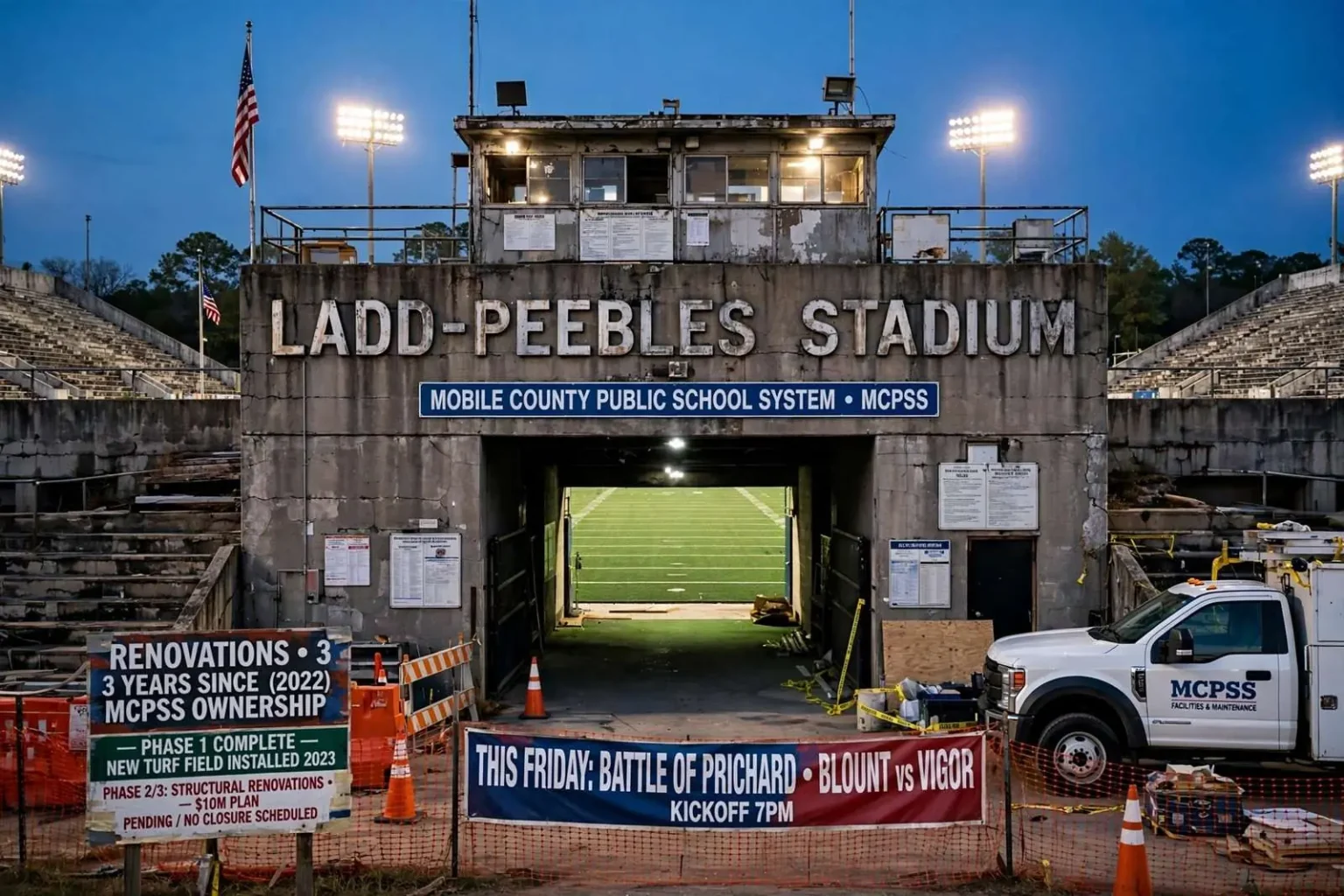
The lights are on at Ladd-Peebles Stadium, and soon the stands will once again be packed. This weekend, Blount and Vigor high schools meet for the Battle of Prichard, and in the weeks ahead Ladd will host two major HBCU football events. But as thousands of fans prepare to fill the stands, a question lingers: where does the stadium stand on the renovations promised when ownership changed hands?
The 2022 agreement
Three years ago, the City of Mobile agreed to sell the stadium to the Mobile County Public School System for one dollar. Part of that agreement called for up to $10 million in improvements and maintenance over three years. The plan also allowed the stadium to eventually close for 18 months while major renovation work was completed, but the deadline for that has passed.
The one-dollar sale was a civic handoff with real obligations attached. Mobile put its historic football venue into the school system’s hands with the expectation that the district would preserve it, maintain it and eventually restore it — a commitment measured not just in the $10 million figure but in the closure window that was supposed to make deep renovations possible. With that window now lapsed and the full renovation vision unrealized, the stadium enters another football season in the same state of limbo that has surrounded it for years.
At the time, Ladd was already showing its age. As previously reported in 2022, a 2016 engineering report gave the stadium a D-plus rating, and city officials had estimated it could take more than $30 million to fully renovate the facility. The city had also spent more than $1.5 million on repairs as of 2020.
Those numbers frame the scale of the problem. A D-plus engineering grade is the assessment of a facility held together by maintenance rather than reconstruction — seating risers, restrooms, press facilities and the concrete bones of a 1940s-era stadium all needing attention. The $1.5 million the city spent by 2020 bought repairs, not renewal, and the $30 million estimate for a full renovation was the gap that the $10 million commitment was always going to fall short of closing.
Progress since the takeover
Since MCPSS took ownership, some work has been done, including a new turf field installed ahead of the 2023 football season, but the larger renovation vision has yet to fully take shape.
The new playing surface was the most visible upgrade, and it mattered — a stadium’s field is its daily workplace, and a modern turf system gives the high school programs, band showcases and community events that use the facility a safe, reliable surface. But turf is the easiest item on the list. The heavy lifts named in the engineering report — the stands, the structures beneath them, the decades-old infrastructure — remain the measure of whether Ladd’s renovation promise is being kept.
That is especially significant as Ladd continues to serve as a major venue for HBCU football and community events such as the Port City Classic, coming Sept. 5, followed by the Gulf Coast Challenge on Oct. 3.
Kevin Ball, CEO of the Port City Classic and Gulf Coast Challenge, said the stadium has already completed what he considers the first phase of renovations. “We are excited about our partnership with Ladd-Peebles Stadium and the continued improvements being made to this historic venue,” Ball said, in remarks welcoming the return of the two showcases. “Ladd-Peebles has been an important part of Mobile’s sports and entertainment history, and we’re proud to bring the Port City Classic and Gulf Coast Challenge back to the stadium.”
A stadium with a long memory
The stakes of the renovation question are easiest to see in the event calendar. Ladd-Peebles opened after World War II as Ladd Memorial Stadium, a tribute to the city’s war dead, and it has spent most of a lifetime as the gathering place of Mobile football — the longtime host of the Senior Bowl, the home of high school championships, and for years the venue where the University of South Alabama launched its own football program before the Jaguars built a stadium of their own. Generations of Mobilians watched their first college game, their first Friday night rivalry or their first marching-band showcase in those stands.
The HBCU classics that now anchor the fall calendar carry that tradition forward while filling hotels, restaurants and shops across the city during their weekends. Events like the Port City Classic and the Gulf Coast Challenge draw traveling fans from across the region and put the stadium — and by extension the city — on display for an audience that judges the venue by what it sees in person. A fresh field and working lights make the show possible; aging concourses and deteriorating stands are what those visitors take home as the story.
The school system’s ownership deepens the community stake. High school football is Ladd’s heartbeat — games like the Battle of Prichard between Blount and Vigor are the fixtures that fill the place week after week — and the students, bands and families who use the stadium are the same population MCPSS serves. When the district took the deed, it accepted the venue not just as a real-estate asset but as part of the school experience for the county’s young people.
The unfinished list
What remains unfinished is the question every stakeholder is watching. The 2022 plan contemplated a full 18-month closure for major renovation work — the kind of project that addresses the structural issues behind the D-plus rating rather than working around them. With the deadline for that closure passed and no such shutdown underway, the stadium continues operating on a maintenance track: usable, hosted and bright on Friday nights, but still carrying the same underlying needs that were documented nearly a decade ago.
Funding is the unavoidable middle of that equation. Even the $10 million promised over three years is a third of the estimate city officials once gave for a full renovation, and the improvements made so far — the turf field most prominently — show how quickly that budget can be consumed by the most urgent items. Closing the remaining gap will take some combination of school system capital money, city support, state assistance and event revenues, none of which has yet been assembled into a comprehensive plan that the public can see.
The event partners, meanwhile, have made their position clear through their actions: they keep coming back. Ball’s characterization of the work done so far as a “first phase” leaves room for more, and the commitments of the Port City Classic and Gulf Coast Challenge give the stadium recurring anchor tenants whose calendars give the venue purpose — and whose future choices will depend on whether the next phases of renovation follow.
What to watch this fall
The coming season offers a running test of the stadium’s condition and its promise. The Battle of Prichard opens the stretch, the Port City Classic arrives Sept. 5 and the Gulf Coast Challenge follows on Oct. 3, with high school football filling the dates between. Each event puts thousands of fans through the gates, and each is an occasion for the community to see for itself what has changed and what has not.
Three years into school-system ownership, the ledger is mixed: a new field, continued operation, a steady calendar of events — but an expired renovation deadline and a structural to-do list that stretches back to a D-plus report card. Ladd-Peebles remains, for now, exactly what it has been for years: a beloved old stadium that works because people love it, waiting for the major renovation its owners promised and its history deserves.
Why the one-dollar deal happened
The 2022 transfer ended years of debate about who should own and operate the aging venue. The city had carried Ladd-Peebles through decades of maintenance shortfalls and operating losses, and the sale to the school system was framed at the time as the most practical path: the district was already the stadium’s most consistent user through high school football, and public ownership by the schools tied the facility’s future to the students who play on its field. The dollar consideration formalized what was essentially a transfer of responsibility from one public body to another, with the improvement commitments written in as the price.
For the school system, the arithmetic was a gamble on future value. A renovated Ladd-Peebles gives MCPSS a first-class venue for its own athletics, graduations and showcases, and preserves an anchor for the community events that bring revenue into the facility. An unrenovated one risks the opposite — escalating repair costs, event partners drifting to newer venues and, eventually, a stadium too far gone to save. The agreement’s renovation schedule was designed to prevent the second outcome; its expiration keeps the question open.
The venue’s place in the region’s calendar
Beyond the two HBCU showcases, Ladd-Peebles fills its fall with the rhythms of local football life. High school programs across the county use it for marquee matchups, band competitions fill it with music on weekends, and community organizations treat a date at Ladd as the region’s biggest stage. That steady local demand is a quiet argument for the renovation: the stadium is not a white elephant waiting for a tenant, but a working venue whose usage justifies investment.
Its history amplifies the point. The stadium has hosted generations of momentous games — championship deciders, legendary rivalries, the early seasons of a college program, and decades of the all-star football that made Mobile famous among pro scouts. Few venues in the state carry that much accumulated memory, and the people who champion its restoration often make the case in exactly those terms: some places are worth keeping because replacing them is impossible.
The coming weeks will show the balance as it stands today — new turf beneath the lights, packed stands for the Battle of Prichard and two signature HBCU events, and an unfinished renovation promise hanging over every touchdown. For the school system, the city and the event partners, the fall of games ahead is both a showcase and a countdown: the stadium works, the crowds are coming, and the work everyone promised is still to be done.