Cheriogotis Says Downtown Rewrite Is About Protecting Character, Not Slowing Growth
Mayor Spiro Cheriogotis says Mobile’s Downtown Development District rewrite aims to protect historic, walkable character while making standards clearer. A draft goes out for public comment this fall, with City Council approval expected in early 2027.
Mobile is rewriting the rulebook that governs what can be built downtown, and Mayor Spiro Cheriogotis used his weekly newsletter to make the case that the exercise is about clarity rather than restriction.
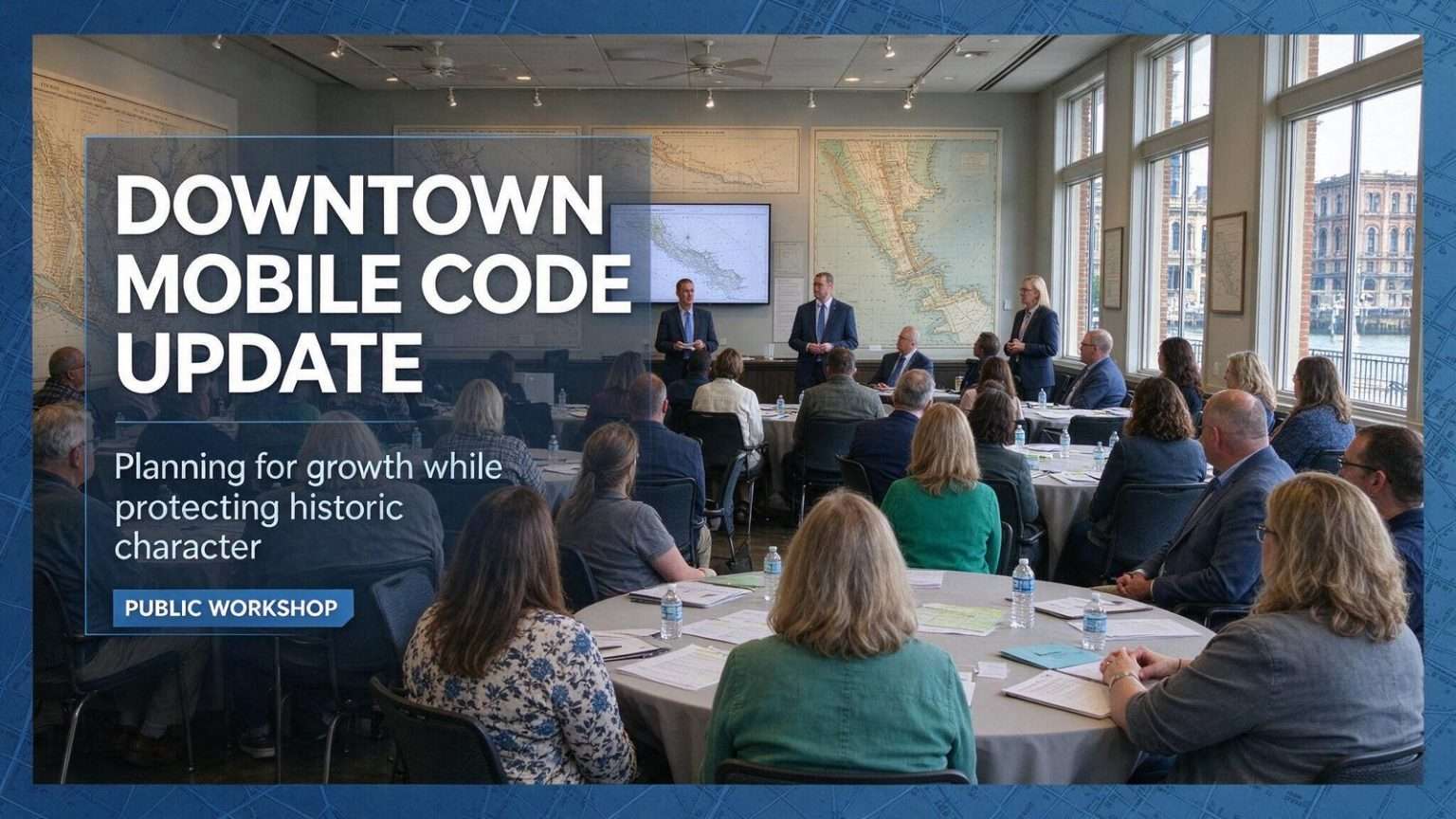
In his Good Evening Mobile newsletter Friday, Cheriogotis pointed to Wednesday’s Downtown Development District Update Community Workshop and said the city had a strong turnout of residents taking part in the process.
“As our downtown grows, we need to ensure it maintains its character and the historic nature of a 300-plus-year-old city,” Cheriogotis wrote.
The workshop itself drew investors, developers and community members to the National Maritime Museum of the Gulf, where city planners and zoning officials walked through the review with the people whose projects and neighborhoods the code will govern. Cheriogotis said the purpose was to hear what the public wants as the city continues to grow and change.
“I want to make sure that Mobile is the city that people love to live in, one that stands the test of time, and part of that is knowing that we’re going to grow, we’re going to change as a city,” Cheriogotis said. “We need to make sure that we maintain our character and our downtown continues to celebrate its historic past.”
What the DDD Actually Governs
The Downtown Development District — universally shortened to the DDD — governs development within much of the city’s Central Business District. It is the layer of regulation that determines what a new building downtown may look like, how it meets the sidewalk, how tall it may rise, how it handles parking and how it relates to the historic fabric already standing around it.
Cheriogotis said the rules are intended to guide developers toward designs that complement downtown’s historic character and its pedestrian-oriented environment. That is the animating idea behind a district-specific code: rather than applying the same generic zoning standards downtown that apply to a suburban commercial corridor, the city writes a set of rules tailored to a dense, walkable, historically significant place.
The city is now reviewing that code after more than a decade of use.
Where the Code Applies — and to What
The geography is narrower than the phrase “downtown development” suggests, and the mayor drew the boundary himself.
“The Downtown Development Code only applies really in that downtown loop,” Cheriogotis explained. “So that Hank Aaron, Broad Street, Beauregard, Water Street loop.”
That ring — Hank Aaron Loop and Broad Street on the west, Beauregard Street on the north and Water Street along the river on the east — encloses the core of the city: the Central Business District, the government complex, the convention and waterfront district, the entertainment corridor along Dauphin Street and the historic residential blocks tucked between them. Property outside the loop falls under the city’s general zoning rules instead.
The code will apply to new construction, major exterior renovations and other changes within that boundary. That scope is worth understanding for property owners: a code rewrite of this kind is not only a matter for developers assembling new buildings. A substantial exterior renovation of an existing structure — a facade replacement, a storefront conversion, an addition visible from the street — is the kind of project that runs through the same standards.
Cheriogotis said he hopes the update helps draw more people into the area, and he was specific about what he wants downtown to become.
“I would love to see our downtown be better connected to our waterfront, that the two don’t feel completely separate,” he said. “I would love to see more people living in downtown. I want to see more restaurants, bars, more hotels, more places for people to, you know, be entertained, more retail, more shopping. I think to do that, we really need more people down here on a regular basis.”
That last sentence is the crux of the argument. Restaurants, shops and nightlife are not conjured by zoning; they follow customers. A downtown code that makes housing easier to build is, in the medium term, a restaurant policy and a retail policy as well — because rooftops downtown supply the weekday, off-season, non-event demand that keeps small businesses open between festivals and cruise sailings.
A Code Built to Be Revisited
The rewrite is not an improvised response to a controversy. The city’s unified development code was established in 2014 with the expectation that it would be revisited on a regular basis to address issues that emerged in practice and to reflect changes in modern planning.
That is the standard professional model for development regulation, and it is one that many cities adopt in principle and then quietly ignore. Codes are difficult and expensive to write, the political capital required is considerable, and once adopted a code tends to sit untouched except for narrow amendments that solve one applicant’s problem at a time. Over a decade, those piecemeal amendments are exactly what produces the internal contradictions a comprehensive review is meant to clear out.
A Successful Code Is Not Necessarily a Clear One
Cheriogotis was careful to frame the review as a refinement rather than a repudiation. He said the DDD has been successful, but that the update is an opportunity to make its standards clearer, more user-friendly and more effective at producing development the community can be proud of.
That distinction matters, and anyone who has worked on either side of a development review will recognize it. A code can produce good outcomes while still being difficult to use. Standards accumulate amendments. Terms drift. Provisions that made sense in isolation begin to contradict one another. Applicants cannot tell in advance what will be approved, so they either over-design defensively or submit and negotiate. Staff spend time interpreting rather than reviewing. Neighbors cannot predict what the code permits next door.
The practical result of an unclear code is not less development. It is slower, more expensive and less predictable development — and, frequently, more variance requests, because it becomes easier to ask for an exception than to decipher the rule.
Codes written more than a decade ago also predate shifts the market has since delivered. Downtown residential conversion, ground-floor activation, outdoor dining, short-term rentals, electric vehicle charging, stormwater management and structured versus surface parking have all changed in emphasis since the DDD was adopted.
The Sept. 2 Workshop
The Downtown Development District Update Community Workshop was held Wednesday, Sept. 2, at the National Maritime Museum of the Gulf as part of the review process. Cheriogotis characterized turnout as strong, and the room mixed the constituencies that rarely sit down together on a code question: investors and developers who have to build within the rules, residents who live with the results, and the city planners and zoning officials who administer them.
Cheriogotis said he hopes stakeholders come away feeling heard as the city updates the code.
Workshops of this kind typically sit early in a code rewrite, before draft language exists. The value of that sequencing is that residents shape the objectives rather than reacting to a finished product. It is considerably easier to influence what a code is trying to achieve at the goal-setting stage than to alter specific standards after a draft has been circulated and stakeholders have taken positions on it.
The city has indicated that additional opportunities for public input are expected this fall.
Three Hundred Years of Accumulated Fabric
Cheriogotis’ reference to a “300-plus-year-old city” is not rhetorical flourish. Mobile was founded in 1702 and is among the oldest European-founded settlements in the United States, predating New Orleans and serving at one point as the capital of French Louisiana.
That history is legible in the built environment. Downtown Mobile holds several historic districts containing a range of architecture that accumulated across centuries: antebellum townhouses, Victorian commercial blocks, early twentieth-century office buildings, mid-century construction and contemporary infill. The result is a downtown whose character comes from layering rather than from a single unified period.
Codes governing places like this face a particular difficulty. Rules loose enough to permit genuine architectural variety can also permit development that ignores its surroundings entirely. Rules tight enough to guarantee compatibility can freeze a district into imitation of its own past and discourage building altogether. Finding the line is the substantive work of a rewrite.
Walkability as a Regulatory Product
The mayor’s emphasis on downtown’s “pedestrian-oriented environment” points to what is arguably the most consequential category of decisions in a downtown code.
Whether a district is comfortable to walk in is largely determined by regulatory choices that sound technical: how far buildings sit from the sidewalk, whether ground floors must contain active uses, how much glazing street-facing facades require, where parking may be located relative to the street, how wide curb cuts may be, and whether blank walls are permitted along pedestrian frontages.
Get those provisions right and a district feels continuous and inhabited. Get them wrong and a downtown acquires gaps — surface lots, blank facades, buildings set back behind parking — that break the walking experience even when the individual buildings are perfectly good ones. Once built, those gaps persist for decades.
The mayor’s wish to see downtown “better connected to our waterfront” is a version of the same problem at larger scale. Water Street forms the eastern edge of the DDD loop, and a wide, fast arterial between a downtown and its river is a familiar obstacle in American port cities. Bridging that separation is partly a capital project and partly a code question — what gets built along the corridor, how it faces the street, and whether the walk from Dauphin Street to the water feels like a continuous place or a crossing to be endured.
The Path to Adoption
The review now moves toward a written product. A drafted proposal is expected to be shared during a public comment portion later this fall. From there the draft goes to the Mobile Planning Commission, and then to the Mobile City Council for approval. City officials expect that approval in early 2027.
That sequence is worth reading carefully, because each stage narrows what can still change. The public comment period on a draft is where specific standards — a height limit, a setback, a parking ratio, a permitted-use table — are still genuinely in play. The Planning Commission stage is a technical and quasi-judicial review that produces a recommendation. By the time a code reaches the council, the debate has usually contracted to a handful of contested provisions.
An early-2027 adoption target also means projects entering design over the coming months will be planned against one set of rules and, in some cases, permitted under another. Developers and property owners with work in the pipeline generally track a rewrite closely for exactly that reason.
How to Weigh In
Residents can submit comments about the Downtown Development District update through the city’s Map for Mobile unified development code portal at mapformobile.org/udc/.
The portal channels the DDD review into the city’s broader unified development code work, which consolidates zoning, subdivision and related regulations into a single coordinated framework rather than a set of separately amended ordinances.
Additional public input opportunities are expected this fall. For residents, property owners, business operators and developers with a stake in what downtown looks like a decade from now, the comment window is open while the objectives are still being set — which is the point in the process where public input carries the most weight.