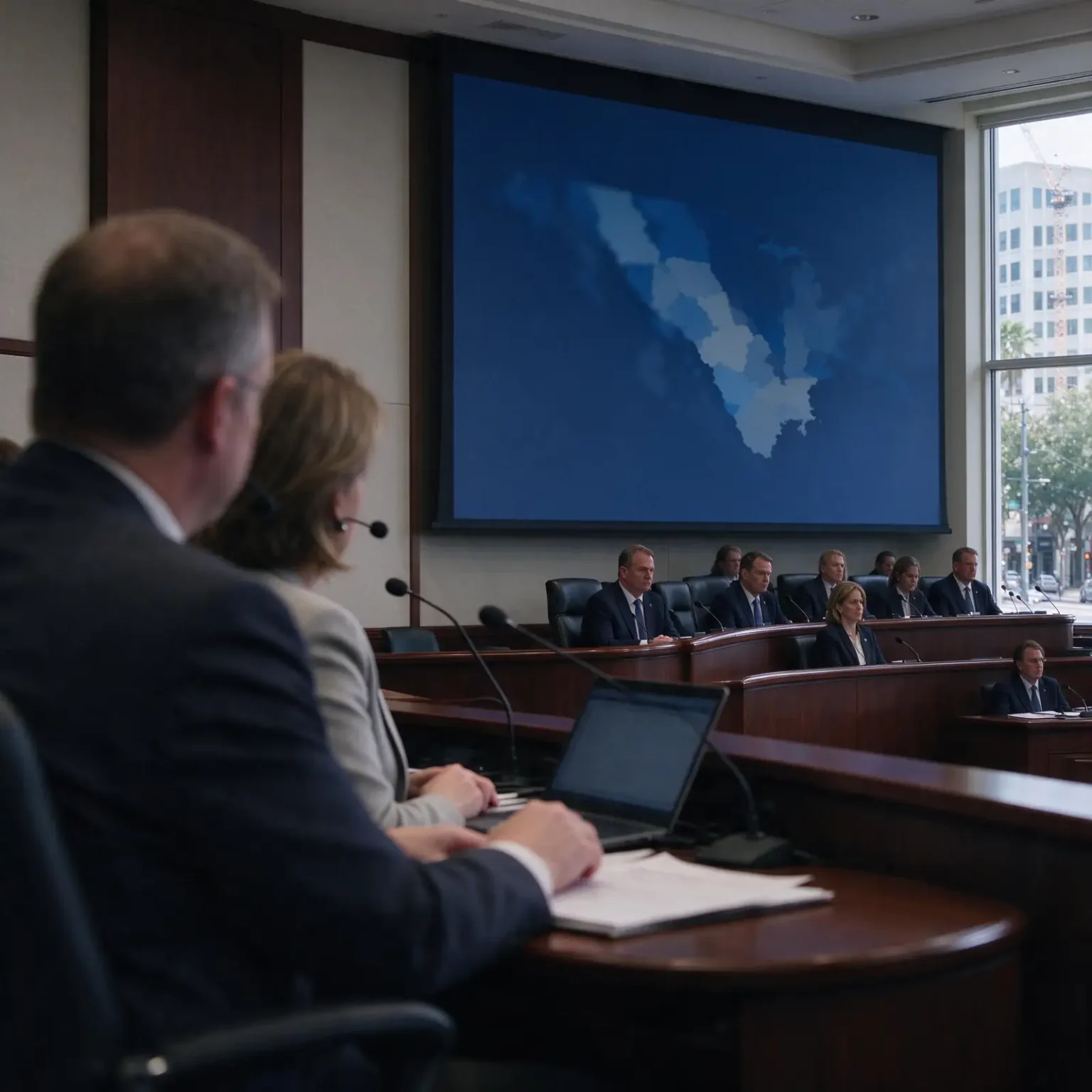
MOBILE, Ala. — The Mobile City Council will put its questions about the city’s $14.7 million fraud loss to Mayor Spiro Cheriogotis’ administration at its regular meeting on Tuesday, Oct. 27, after Council President C.J. Small said he would not call an emergency session. Several members said this week that they want to know who is responsible, whether the money can be recovered and what will stop it from happening again.
The council learned of the loss on Tuesday, Oct. 20, during a closed-door executive session, hours before the administration announced in a 6 p.m. news release that city funds had been transferred to a “fraudulent entity.” The FBI and the U.S. Secret Service are investigating. At a news conference the next morning, Cheriogotis said the money was a single payment in a series of large transactions tied to construction of the new Regions Arena downtown and that the loss would be covered by the arena project’s contingency budget.
Beyond that, the administration has said little about how the money was lost, and council members said Thursday, Oct. 22, that they are still trying to understand what happened at Government Plaza.
No emergency meeting, but questions on Tuesday
Small, who represents District 3, said Mobile residents deserve answers about how so many millions in taxpayer dollars disappeared, but that a special meeting before the council’s regular session would accomplish little.
“Having an emergency meeting is not going to make them give us more information,” he said. “I am looking forward to discussing this on Tuesday.”
Small said he and the other six council members will question the administration next week. He noted that the council, as a body, had received about as much information from the administration as the public had. “I believe in the next few days and weeks to come we will receive more information,” he said.
Small also said he was glad the administration contacted the FBI, calling the situation “serious.” “As a Council, we need to work together with the Administration, take a hard look at our policies and procedures, and make sure we put the right safeguards in place to keep this from happening again,” he said.
The council’s schedule for Tuesday begins with its weekly pre-conference meeting at 9 a.m., followed by the regular session at 10:30 a.m. Both are held at Government Plaza, 205 Government St., and are open to the public.
The council’s statement
Council spokesman Brandon Harrison issued a statement Thursday afternoon on behalf of the full body.
“In the last couple of days, we have all learned the city of Mobile has been the target of a criminal scheme that resulted in the transfer of nearly $15 million in city funds to a fraudulent entity. We are just as concerned as all of you about the wide ranging impact this will have on our city and our community,” the statement said. “We continue asking questions of the administration to find out what happened, who will be held responsible and what steps will be taken to prevent this from happening again. We appreciate Mayor Cheriogotis and his team for taking responsibility and being transparent. While there are multiple ongoing investigations including internal and external, ultimately our hope is to find those responsible and safeguard taxpayer funds in the future.”
‘Who is responsible?’
Individual members were more pointed. Several said they are not yet sure how to describe what happened: whether the city was the victim of a cybercrime, who inside city government bears responsibility and how similar losses will be prevented.
“I believe accountability and transparency is needed,” said District 1 Councilman Cory Penn. “I don’t know how you would classify it. We deserve more answers. Hopefully Tuesday we will find out more.”
District 2 Councilwoman Samantha Ingram said she supports the involvement of federal authorities but listed the questions she wants answered. “How did this happen? Can these funds be recovered? What safeguards were in place, and what changes will be made to ensure something like this does not happen again?” she said. “Every dollar of public money matters, and protecting those resources must remain a priority.”
District 7 Councilwoman Gina Gregory, the council’s vice president, said constituents are asking the same things the council is. “It’s the same kind of questions we have in ‘Who is responsible?’ ‘How do we move forward from this?'” she said. “It’s the same questions that everyone is asking and want answers to which are the same ones we want as well.”
District 4 Councilman Ben Reynolds said the city must own what happened. “The reaction is a gut punch,” he said. “Disappointment. A little bit of anger that we allowed this to happen to us. We know that criminals are out there. We allowed this to happen and we have to take accountability for it, the City of Mobile does, and hold those who allowed this to happen accountable.”
Councilman Beau Fleming said he, too, was angry. “I still have a lot of questions,” he said. “We all have a lot of questions. We want the investigation to play out but I think that we need to do a better job being responsible with the taxpayer money and to not be as careless … and make sure we have the (right) policies in place. And whoever is responsible, to hold them accountable.”
Fleming said he was skeptical the city will get the money back. “We all feel frustrated and upset it happened,” he said. “Hopefully the FBI can get to the bottom of it quickly. They have a job to do and we’re trusting them to do it. But I have questions and other members of council have questions (and we are) trying to not speculate.”
What the mayor has and has not said
At his Oct. 21 news conference, Cheriogotis described the $14.7 million as one payment tied to the arena project and said the city has “a fairly clear picture of how this happened internally.” He declined to say whether the city had been tricked by a phishing email or by someone impersonating a vendor, though he ruled out ransomware, in which criminals lock up a government’s computer systems or data and demand payment.
“As far as whether this was a confidence scam, impersonation, phishing, you know, I’m going to leave that detail out for the moment,” he said. “It’s our intention to be transparent about this. And as things happen and we are in a position to share them, we absolutely will.”
The mayor has also declined to say whether city policies for large payments were followed or whether any employee has been disciplined. He has said the city hired a national law firm and a forensic accounting firm, notified its cyber-insurance carrier and now requires payments of $1 million or more to be made by hand-delivered check rather than by wire. He has said the loss is unlikely to affect city services this year but could affect capital projects starting next year. The city’s current fiscal year runs through Sept. 30, 2027.
More on the mayor’s account, the federal investigation and similar schemes against other governments is in our earlier report on the $14.7 million Mobile city fraud.
‘Walking a tightrope’ on what can be made public
Council members acknowledged there may be limits on what the administration can disclose while federal agents are investigating. Reynolds said the council is weighing how to keep the public informed without undermining efforts to recover the money or prosecute those responsible.
“We’re trying to figure out on our end as a City Council how we are going to proceed,” he said. “We know that we want to get as much information as we can about this and get it to the public as quickly as possible while still protecting our possibilities of recovery. We’re walking a little bit of a tightrope here.”
Reynolds said the loss will come up in many public meetings and closed sessions in the months ahead. “Some of this will have to be held in an executive session,” he said. “That’s a fact of the matter if we want a chance of recovery or have a chance of bringing these criminals to justice.”
Alabama’s Open Meetings Act allows city councils and other public bodies to go into closed executive session only for a limited list of purposes, such as certain discussions with attorneys about pending or likely litigation and some matters involving criminal investigations. The law requires that any vote be taken in public, and a body must vote openly to enter executive session and state the reason.
Reynolds said he still does not know where the breakdown occurred. “We’ve been told they are taking steps to mitigate that and they are bringing in professionals on it,” he said. “I haven’t been told what we are doing to stop this from happening again. I don’t know where the failure happened. We will get the answers at some point but how we get to that place where we allow everyone know what happened, we are working on that currently.”
A possible role for the Finance Committee
The council’s Finance Committee, chaired by District 6 Councilman Josh Woods, oversees the council’s part in the annual budget process and could become a venue for further discussion. Woods said it is “to be determined” whether his committee or another avenue will be used.
“It’s a new experience for all of us,” Woods said. “All avenues from the council we’ll explore and make sure we exercise our full power. My initial thoughts and from conversations with a council member or two is we make sure we stay on it and really make sure there is open and honest transparency from those who are handling the issue on behalf of the city.”
Under Mobile’s mayor-council form of government, the mayor runs the city’s daily operations, including its finance department, while the seven council members, each elected from a single district, adopt the budget, approve contracts and set policy. That division means the council’s main tools are its questions in public meetings, its control over spending and any policy changes it chooses to adopt by ordinance or resolution.
Cybersecurity training back in focus
The loss has also renewed attention on the city’s cybersecurity training. Mobile requires the training for its employees and even for elected officials, though the scope of the current program is unclear, and it is not known whether the training played any role in this case.
The requirement drew controversy in 2021, when then-Councilman Fred Richardson, who was challenging then-Mayor Sandy Stimpson in that year’s mayoral race, refused to complete it. His city email account was suspended, and Richardson argued that the administration lacked the authority to force an elected council member to take the course.
At the time, 18 of the 1,748 city employees required to take the training, about 1%, had opted not to. The course consisted of five modules of roughly 10 minutes each, plus review questions. It is not clear whether a similar program remains in place under the current administration.
What happens next
The council is expected to question the administration at its Oct. 27 meetings, though some details may be held for executive session. The FBI, the Secret Service, Mobile police and the U.S. Attorney’s Office are involved in the criminal investigation, and the city’s outside law firm and forensic accountants are reviewing its financial policies and procedures. No arrests or charges have been announced, and anyone eventually charged would be presumed innocent unless proven guilty in court.
Residents who want to follow the issue can:
- Attend the council’s pre-conference meeting at 9 a.m. or regular meeting at 10:30 a.m. on Tuesdays at Government Plaza.
- Sign up to speak during the public comment portion of the regular meeting.
- Contact their district council member with questions or concerns.
- Report suspected fraud to the FBI’s Internet Crime Complaint Center at IC3.gov.