Brewton police ask for help identifying two women in Walmart theft
Brewton police are asking for the public's help identifying two women accused of stealing from the Walmart on Douglas Avenue in Brewton.
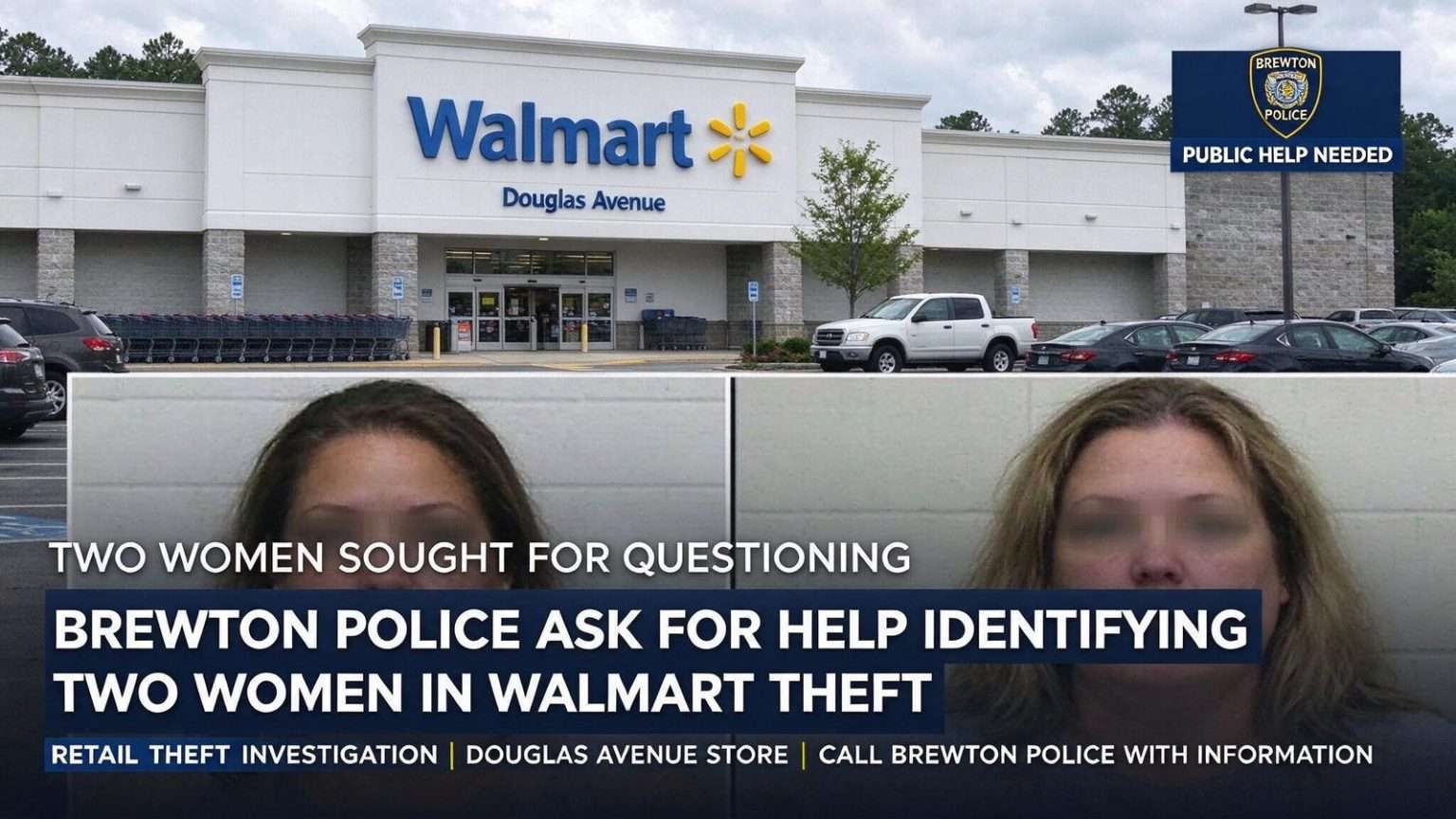
BREWTON, Ala. — Brewton police are asking for the public’s help identifying two women wanted in a theft at Walmart, and the department’s appeal puts one of the city’s busiest retail locations at the center of an active investigation. The women are accused of stealing from the store on Douglas Avenue, though authorities have not said what was taken or how much it was worth. Anyone with information that could help authorities locate the women is asked to call Brewton Police.
The request follows a familiar pattern in retail theft cases across the region: store security detects the theft, surveillance images are collected, and police turn to the public to put names to faces. Brewton’s department, like most small-city police forces in Alabama, does not have the staffing to run prolonged canvasses on every shoplifting case, which makes residents’ tips genuinely decisive. A single call from someone who recognizes a face in a surveillance photo often closes an investigation that would otherwise go unsolved.
The investigation in Brewton
The Walmart on Douglas Avenue serves as the principal big-box retail destination for Brewton and the surrounding communities of Escambia County, drawing shoppers from East Brewton, Flomaton, Atmore, and the smaller communities across the county line in Conecuh and Monroe counties. That role makes the store’s loss-prevention operation a busy one, and it means a theft there is investigated against a backdrop of heavy traffic — many customers, many cameras, and many potential witnesses. Police have not released the date of the theft or a detailed account of what the women are accused of taking, but the department confirmed the investigation is active and that the two women shown in connection with the case are wanted for questioning.
Retail theft investigations in Alabama follow an established legal framework. Theft of property under $1,000 in value is classified as theft in the fourth degree, a misdemeanor, while amounts above that threshold move the case into felony territory, with the degree increasing along with the value. Prosecutors in Escambia County handle the charges once identification and arrest are made, and stores like Walmart pursue theft cases systematically — loss-prevention staff document the incident, and the company’s civil recovery program can separately seek restitution from identified offenders.
Identification is the bottleneck in most such cases, which is precisely why departments appeal to the public. Surveillance systems capture faces and clothing well enough to describe, but matching an image to a name requires someone who recognizes the person — a neighbor, a coworker, a family member. Brewton’s size works in the department’s favor here: in a city of roughly 5,000 people that serves as the commercial hub for a wider rural area, surveillance photos travel quickly through word of mouth and social media, and recognition often follows.
Why police ask the public
Public appeals are a core tool of modern policing in small Alabama cities, and Brewton police have used the approach consistently in theft, fraud, and warrant cases. The mechanics are simple: police release what they can — surveillance images, a description, the location and general circumstances — and ask anyone with information to call. Tips that come in through the department’s phone line are followed up by investigators, and the department can protect the identity of those who call when the case requires it. Residents who recognize the women in this case are asked to call Brewton Police directly with what they know.
Departments generally ask tipsters for specifics rather than suspicions. A useful tip includes where and when the person was seen, a current address or workplace, a vehicle description, or other verifiable detail that connects a face in a photo to a name. Guesses made on the basis of general resemblance can waste investigative time and unfairly implicate innocent people, so departments urge residents to report what they actually know — a confirmed recognition, a firsthand sighting — rather than what they think they see.
The economics of retail theft also explain why the appeals matter to a community like Brewton. Shrinkage from theft is priced into the retail model, but its costs land disproportionately on smaller markets: stores that lose merchandise to repeated theft raise prices, restrict access to goods, and in extreme cases reduce hours or close locations — outcomes that hit rural shoppers hardest, since the alternatives can be a long drive away. When a community helps identify offenders, it is protecting more than a corporation’s inventory; it is helping keep a retail anchor whole.
How retail theft cases proceed
Once the women are identified, the case moves through the standard sequence. Warrants are sought based on the evidence — surveillance footage, loss-prevention documentation, and any witness statements — and arrests follow either through a traffic stop, a visit to a known address, or a voluntary surrender arranged through an attorney. First offenders in misdemeanor theft cases in Alabama often encounter a range of outcomes from fines and restitution to diversion programs, while repeat offenders and felony-level cases draw stricter handling. The store’s loss-prevention records give prosecutors a documented, timestamped account that makes these cases straightforward to prove once a defendant is identified.
The investigation remains open in the meantime, and police have not indicated whether additional suspects are being sought or whether the theft was part of a pattern. Residents who may have information are asked to call Brewton Police. As with any public appeal, authorities caution against confronting or following the individuals seen in surveillance images — identification and location are the public’s role, and the arrest is the police department’s.
The Douglas Avenue store and the police department both serve the same community, and the appeal that connects them reflects how law enforcement actually works in a city Brewton’s size. Cameras and reports document a theft; only people — neighbors, customers, acquaintances — can supply the names. That is the department’s message this week: two women wanted in a Walmart theft are unidentified, and someone in Escambia County almost certainly knows who they are.
Brewton and its retail role
Context helps explain why a Walmart theft investigation draws attention in Brewton specifically. The city is the seat of Escambia County, Alabama, and its commercial district along Douglas Avenue and Highway 29 serves a broad rural trade area that stretches toward the Florida line. For thousands of residents in surrounding communities, the trip to Brewton for groceries, hardware, and general merchandise is a weekly routine, and the retailers on that corridor — Walmart chief among them — function as regional infrastructure rather than mere storefronts. An incident at that store is felt across the trade area, not just inside the city limits.
Brewton police handle that reality with the resources typical of a city its size: a compact department, a close working relationship with the Escambia County Sheriff’s Office, and a reliance on the community relationships that small-city policing runs on. Officers in a department like Brewton’s know the town’s patterns, its households, and its trouble spots in a way that urban departments cannot replicate, and public appeals like this one extend that local knowledge into the community itself. The department’s request that residents call with information is not a formality; in cases built on surveillance images, it is the primary investigative method.
The Douglas Avenue corridor itself has been the center of Brewton’s commercial life for decades, evolving as retailers came and went while the city grew around it. Walmart’s arrival reshaped that landscape, as it did in towns across Alabama, concentrating general merchandise traffic on a single site and anchoring the surrounding shops and restaurants. That concentration is efficient for shoppers and it concentrates loss-prevention challenges too — every retail theft in the region’s biggest store is noticed, documented, and investigated.
What residents can do
For Escambia County residents, the practical takeaway is straightforward. Anyone who recognizes either of the two women seen in connection with the theft, or who has information about the incident at the Douglas Avenue store, is asked to call Brewton Police. Callers should be prepared with specifics: where they recognize the person from, where the person can be located, and any direct knowledge of the incident. Those who wish to remain anonymous can discuss options with the department when they call; many Alabama departments also accept tips through regional crime-stoppers channels that preserve caller anonymity.
Residents should not attempt to identify suspects publicly on social media or confront anyone themselves. Naming private citizens in connection with an uncharged theft carries real legal and personal risk — mistaken identification is common in viral posts — and departments uniformly ask that recognitions be reported to investigators rather than published. The line between helping and overstepping is the difference between a phone call to Brewton Police and a Facebook post, and the department’s appeal is explicitly a request for the former.
Merchants and residents across the region watch these cases for a simpler reason too: they demonstrate that retail theft is not consequence-free. The women in this case were photographed, the theft was documented, and the process of identification is underway with the community’s help. For a business deciding whether to invest in a small Alabama city, and for the residents who rely on that business, that track record matters. Brewton police will continue the investigation until the two women are identified and located, and the department’s phone line remains open to anyone who can help.