Prichard Puts a $100,000 Salary and a Search Firm Behind Its Next Police Chief
Mayor Carletta Davis named POLIHIRE's Chuck Kimble to lead the search for Prichard's next police chief, set a target of hiring by early next year, and proposed raising starting officer pay to $40,000 — still below every neighboring department.
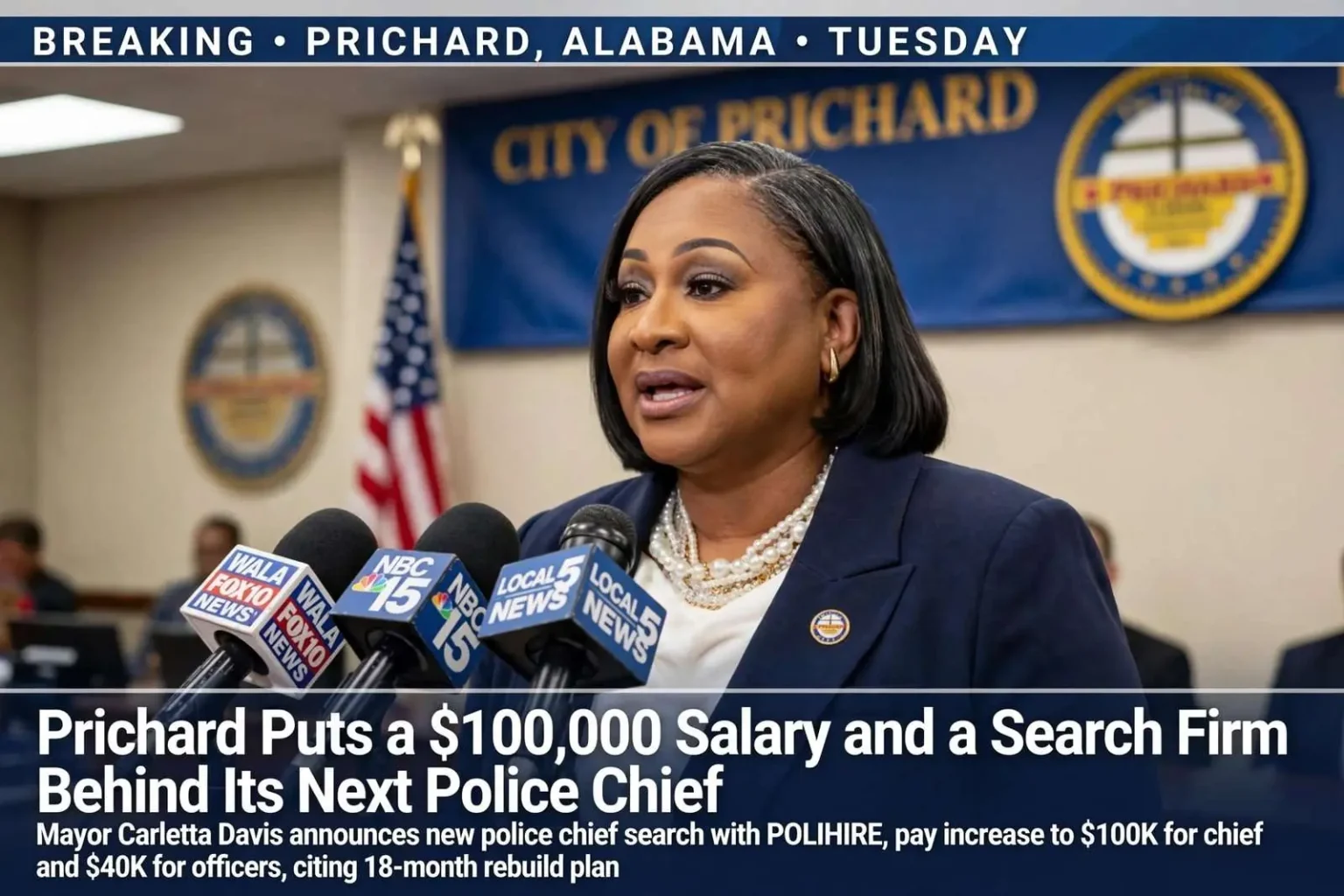
PRICHARD, Ala. — The city that spent the summer watching its police department come apart in public spent Tuesday describing how it intends to put one back together.
Mayor Carletta Davis, speaking at a news conference, laid out the first concrete steps: an outside executive search firm, a police chief’s job advertised at $100,000 a year, a starting officer wage lifted from $36,000 to about $40,000, and a target of having a new chief in place by the end of this year or the beginning of next.
She also set an expectation about how long the rest will take. After a chief is hired, Davis said, the full rebuild will take 18 months to two years. She added that she will not be held to arbitrary deadlines.
“We are not going to rebuild by simply recreating the system that we had before,” Davis said. “This process must produce a department that is professional, that is accountable, operationally sound, and worthy of the trust of our people that we serve and our partners.”
Why the City Hired a Search Firm
Prichard is paying POLIHIRE, a consulting firm that specializes in recruiting law enforcement executives, up to $50,000. Leading the effort is Chuck Kimble, the firm’s senior director, a law enforcement veteran who has served as chief of three departments in Texas and North Carolina cities.
“The next chief cannot be selected as if there were a routine vacancy,” Davis said. “Our public profile calls for an organizational turnaround — executive, and a cultural-change leader.”
That sentence is doing a specific piece of work. A conventional chief search asks who can run the department that already exists. Prichard, by the mayor’s own description, is asking for something else: someone who can change the practices of the department that existed and stand up something different in its place. That is a materially different job description, and it draws from a materially different candidate pool.
The alternative to a search firm is faster and cheaper. A city can promote from within, or run the posting through its own personnel office and wait for applications. It also draws from a much smaller pool. A city advertising on its own largely reaches candidates who already know the city or who happen to encounter the listing. A retained search firm is, in practice, buying two things a job posting does not provide: reach into a national network of sitting commanders who are not actively job-hunting, and a structured screening process that can be described publicly afterward.
Kimble said the position has been advertised with the International Association of Chiefs of Police and other police executive organizations, and that he is also tapping his own personal network.
“I’ve already had a few inquiries about this. We have already listed the job,” Kimble said. “So I am confident, working with the mayor and her staff and the current law enforcement here, that we shouldn’t have any problems finding the next chief.”
He said he would be in Prichard all week, and described that time as being for listening rather than screening.
“I hope to have some very key conversations … with the law enforcement community, with the judicial community, with the faith-based community, and the business community to find those attributes and characteristics of the next police chief,” Kimble said.
The listening phase is not window dressing in a search of this kind. It is how the firm builds the profile it will screen against — the list of attributes a hiring authority says it wants, converted into criteria that can be applied consistently to every applicant. It is also the stage at which a search either surfaces disagreement inside a community about what the job actually is, or papers over it.
The Salary Question Is the Whole Question
The pay figures Davis announced are the most measurable part of Tuesday’s announcement, and they cut in two directions.
At the top, the increase is dramatic. Prichard is advertising the chief’s job at $100,000 a year. Former Chief Walter Knight was making $62,000, according to Davis — or $70,000, according to a lawsuit Knight filed the same day. Either figure leaves the city offering a substantial premium over what it paid before, and it needs to: the job it is advertising is considerably harder than the one Knight held.
For comparison, Mobile Police Chief William Jackson makes about $150,000 a year to run a far larger department. Prichard’s $100,000 is a real raise that is still a discount.
At the entry level, the math is less encouraging. Davis said she wants to raise starting officer pay from $36,000 to $40,000 — an increase of roughly 11 percent. Even after that raise, according to Mobile County Personnel Board data, Prichard would still sit below entry-level pay in Mobile, Saraland, Mount Vernon, Citronelle, Chickasaw and Satsuma.
In other words, Prichard would remain the lowest-paying option among the neighboring departments listed while asking recruits to join an agency that is being rebuilt in the aftermath of multiple arrests. Mobile County Sheriff Paul Burch has cited low pay as an obstacle to recruiting competent officers in Prichard.
A department that pays less than every surrounding agency is not simply slower to hire. It systematically loses the candidates who have other options, which over time shapes who is left. That is the recruiting problem the $40,000 figure narrows without closing.
It is also worth noting what the pay announcement is and is not. The $100,000 chief’s salary is already reflected in a live job posting. The $40,000 starting wage was described Tuesday as something the mayor wants. Those are different stages of the same idea.
What Happened to the Old Department
The rebuild is a response to a collapse that unfolded in stages.
In June, federal and state agencies raided the Prichard Police Department. Federal prosecutors charged former Officer Emanuel Naman Dotch II with corruption offenses. Other arrests followed. Since the June raid, five officers have been arrested.
Chief Knight was among them. He was arrested July 22 and charged with using his office for personal gain and second-degree theft; authorities allege he earned money from funeral processions and used city resources while on duty. Two days after the arrest, Davis said she had requested and accepted his resignation. Knight has since sued the city, saying he never resigned. He is presumed innocent of the criminal charges unless and until proven guilty.
Since June, the Mobile County Sheriff’s Office has been providing law enforcement coverage in Prichard. Burch has said the increased financial costs of that arrangement are not sustainable. Davis said Tuesday she is close to negotiating an agreement that would keep deputies on Prichard streets during the transition; the contract with Mobile County has not been finalized.
The 14 Remaining Officers
Prichard still has 14 sworn officers, and they have not been placed on administrative leave. Davis said she has informed them that they will be, likely in phases, after the city reaches a law enforcement services agreement with Mobile County.
While those officers are on leave, Davis said, POLIHIRE will review them to ensure they meet new standards as the department works toward accreditation.
“I was advised by multiple legal minds that we needed to make a separation or to show that we’re making some type of correction into the pattern and practices that kind of got us to where we are,” Davis said.
Two pieces of that deserve unpacking, because they carry more freight than they may appear to.
The first is administrative leave itself. Placing an officer on leave is not a finding of wrongdoing and is not a termination. It is a status that removes an officer from duty, typically with pay and typically while something else — an investigation, a review, a reorganization — is resolved. Applied to an entire remaining roster, it functions less like a disciplinary measure against individuals and more like a pause button on the agency, which is why the county coverage agreement has to come first. A city cannot stand down its patrol force without arranging for someone else to answer calls.
The second is accreditation. Law enforcement accreditation, broadly, is a voluntary process in which a department writes its policies against an external body of standards — use of force, internal affairs, evidence handling, hiring, records — documents that it actually follows them, and then submits to review by outside assessors before an accrediting body votes on the award. It is not a certification that misconduct cannot occur. It is a paper trail showing that a department has adopted written standards and can demonstrate compliance with them. Davis did not specify which accrediting body Prichard intends to pursue, or a target date.
Davis also said the new chief will have a free hand in recruiting a new staff. That promise matters considerably to the kind of turnaround executive the city says it is seeking — and it only holds if the review of the existing 14 is genuinely open-ended.
A Lawsuit Lands the Same Day
Davis’s news conference came amid a lawsuit Knight filed Tuesday in Mobile County Circuit Court, alleging that he never submitted a written resignation and that the city breached his employment contract.
City Attorney Josh Briskman declined to comment. Asked what she thought about former Mobile Police Chief Paul Prine as a potential candidate for the Prichard job, Davis said she is not commenting on individual candidates.
What the Announcement Establishes — and What It Doesn’t
Tuesday produced a plan, a firm, a price and a set of numbers. It did not produce a signed county contract, a hired chief, a completed pay ordinance, or any named finalist. Those are the things that will distinguish a rebuild from an announcement about one.
Three markers are worth watching.
The county agreement. Everything else depends on someone answering calls in Prichard during the transition. Davis said the city is still negotiating and described itself as close. If those talks stall, the timeline for placing the remaining officers on leave stalls with them, and the sheriff has already said the current arrangement’s costs are not sustainable.
The applicant pool. Kimble’s early inquiries are encouraging but not dispositive; interest is cheap at the front end of a search. The meaningful test is whether sitting chiefs and senior commanders from stable departments apply for a job that pays less than the region’s largest department while carrying a heavier lift.
The officer pay increase. Davis described the $40,000 starting wage as something she wants. Until it appears as a funded number, it is a stated intention rather than a recruiting tool — and it is the figure that determines whether Prichard can staff whatever department the next chief designs.
Davis said she will not be held to arbitrary deadlines. That is a defensible position for a project of this size, and it is also the sentence that will be quoted back to her if the end of the year arrives without a chief.
“We want our department to become a shining light and example of how police departments can be turned around,” she said.
Coverage in the Meantime, and What the Mayor Says the Search Is For
Mayor Carletta Davis said law enforcement patrols will not lapse while Prichard rebuilds its police department. The city is negotiating a contract with the Mobile County Sheriff’s Office to carry out law enforcement duties until a new department is established, and current officers are being placed on administrative leave in the interim.
The city has contracted with PoliHire to conduct the search for a new chief, at a cost of up to $50,000. Davis was direct about the limits of that arrangement: PoliHire does not replace the city’s ability to make governmental decisions, and the authority to hire remains with the city.
She framed the vacancy as something other than a routine personnel matter.
“The next chief cannot be selected as if there were a routine vacancy,” Davis said. “Our public profile calls for an organizational turnaround, executive and a cultural change leader. Someone with integrity and courage to build strong systems, to hold people accountable that are underneath them, to develop leaders, to communicate honestly and earn the community’s trust back while maintaining effective public safety services. The same principles apply to rebuilding the department.”
As part of a broader round of city pay increases, the police chief and officers will be paid more than they were in the previous department — a change the administration has tied directly to its ability to recruit.
“We want our department to become a shining light and example of how police departments can be turned around,” Davis said.
The Former Chief’s Lawsuit
The search is proceeding while former chief Walter Knight pursues a civil breach-of-contract suit against the city. Knight, who had served as chief since 2023, contends he never resigned following his July arrest on allegations that he used city resources for funeral processions while on duty. He is charged with use of official position or office for personal gain and theft by deception. According to the eight-page complaint filed in Mobile County Circuit Court, Knight says city officials wrongly stated that he resigned and stopped paying him as of Aug. 21. The suit seeks compensation.