Of Montreal Delivers Intimate Psychedelic Set at Mobile’s Alabama Music Box
Athens, Georgia's of Montreal brought its psychedelic pop spectacle to Mobile's Alabama Music Box on March 9, 2012, before a packed downtown crowd.
Athens, Georgia’s of Montreal brought its theatrical, psychedelic pop to downtown Mobile on Friday, March 9, 2012, headlining the Alabama Music Box on Dauphin Street. The show marked the band’s second visit to Mobile in two years, a return engagement that spoke to an unusually close relationship between the long-running indie band and the Port City. For local fans of independent music, it was the kind of booking that would have been hard to imagine on the Gulf Coast a decade earlier: a nationally touring act with a devoted following, playing a compact downtown club rather than a large theater or an out-of-town arena.
Of Montreal occupies a singular place in American indie rock. Founded in Athens in the late 1990s and named for an early romance of frontman Kevin Barnes with a woman from Montreal, the band grew out of the same fertile Georgia music scene that produced Elephant 6-era acts and has spent more than a decade and a half blending bright, hook-heavy pop with glittering electronic textures. Barnes, the group’s songwriter and creative engine, has guided the band through constant reinvention, from lo-fi chamber pop to the flamboyant dance-rock that defined its mid-2000s breakthrough. Along the way the band built a reputation as one of the most visually ambitious live acts in independent music.
That reputation is built on elaborate stage productions: costumes, props, dancers, projections, and psychedelic lighting designed to turn a concert into something closer to a surreal theater piece. Touring versions of the show have featured Barnes in a series of increasingly outlandish outfits, backdrops of hand-drawn animation, and moments of staged absurdity that have become the band’s trademark. In larger markets, an of Montreal show is an event as much as a concert, and fans come expecting spectacle along with the songs.
A scaled-down spectacle in an intimate room
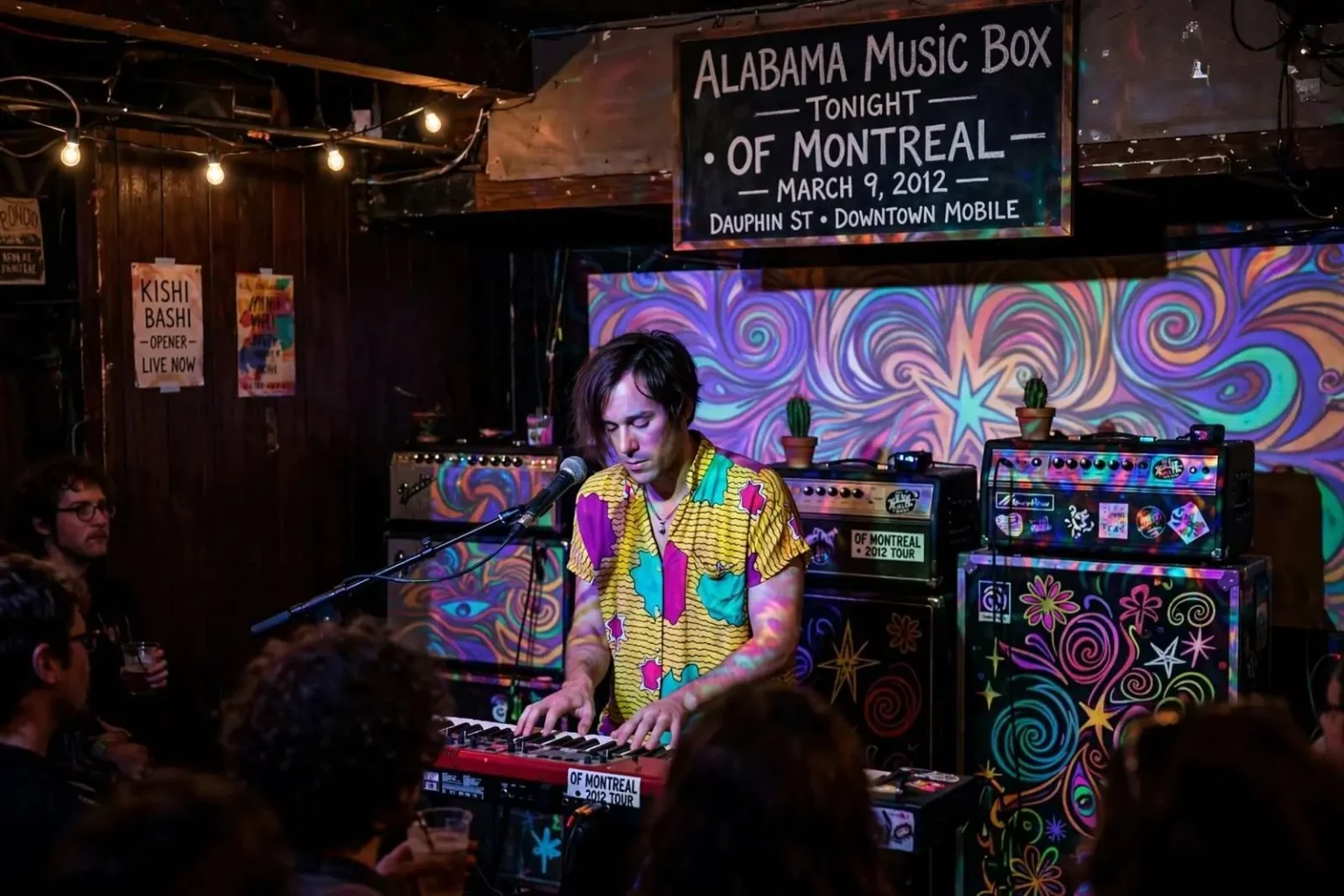
In the intimate space of the Alabama Music Box, the band scaled down the spectacle. The full theatrical apparatus that fills large stages could not fit — and would have overwhelmed — a room the size of the Dauphin Street club. Instead, Barnes performed at a keyboard just steps from the crowd while animated visuals played across the amplifiers, projecting color and motion onto the equipment itself. The reduced production put the emphasis squarely on the songs and on the strange charisma of Barnes himself, and it gave the Mobile audience a view of the band that fans in bigger cities rarely get.
Performing in close quarters also changes the texture of the music. Of Montreal’s recordings layer synths, harmonies, and studio trickery, but in a small room the core melodies and rhythms stand out, and the between-song interplay with the crowd becomes part of the show. Alabama Music Box, a converted downtown space that has hosted touring indie and hip-hop acts since opening, is exactly the kind of room where that intimacy works — low ceilings, a bar along the wall, and little separation between performers and audience.
The evening’s openers deepened the bill. Solo artist Kishi Bashi, who has toured with of Montreal as a violinist and vocalist, performed his own material, building looping arrangements of violin and voice into songs that drew rapt attention from the early crowd. Kishi Bashi’s association with of Montreal made the stop a two-for-one proposition for fans: one of indie rock’s most in-demand multi-instrumentalists in a solo setting, in the same room where his full-time band would headline later that night. Soul singer Roman GianArthur opened the evening, adding a third distinct voice to a lineup that stretched from psychedelic pop to classical-tinged loop music to retro soul.
Openers on the rise
For Kishi Bashi, the Mobile date came as his solo career was just beginning to take shape. Working primarily as a touring violinist for established acts before stepping out on his own, he had begun drawing notice for the solo project, in which he layered violin lines and vocal harmonies live using pedals, creating dense arrangements from a single performer. Opening for of Montreal gave him a national platform in front of audiences already primed for his style, and the Alabama Music Box crowd got to see that material in its earliest stage.
Roman GianArthur, meanwhile, represented a different corner of the musical world — a soul and R&B stylist whose classicist approach contrasted with the swirl of the headliner. Bills like this one, pairing an eccentric indie headliner with openers from other genres, were a hallmark of the touring circuit that of Montreal had helped build, and they gave Mobile audiences a broader sampling of the independent music landscape than a single-genre show would have.
The venue was well filled, and the crowd responded warmly to a set that drew on both the band’s newer material and its older catalog. Longtime fans heard songs reaching back through the band’s discography alongside selections from its recent releases, and the room’s size meant that even the deepest cuts landed with the force of singles. By the end of the night, the dance floor in front of the stage was crowded, and the response suggested the band’s fondness for the city was fully reciprocated.
A band with a soft spot for Mobile
The band has been open about its fondness for Mobile. Members have returned to the city several times and specifically requested the Alabama Music Box as the venue when routing tours through the Gulf Coast, a level of intentionality that is rare for national acts planning itineraries. Booking agents typically slot bands into whichever market-sized room is available; having a headliner ask for a specific club by name marks Mobile as a place the band genuinely wants to play, not merely a dot on the route between New Orleans and Atlanta.
Barnes has praised the enthusiasm of Mobile audiences in interviews, and the March 2012 crowd gave him little reason to change that assessment. For a band whose live show depends so heavily on energy exchange with the audience — costumed, theatrical, and unapologetically strange — playing a room full of receptive fans matters more than the size of the room. Mobile’s turnout and reaction reinforced the sense that the city had become a reliable stop on the band’s itineraries rather than an afterthought.
The relationship also reflects well on the venue itself. The Alabama Music Box had, in a short time, positioned itself as downtown Mobile’s home for independent touring acts, booking national artists who would otherwise have skipped the city entirely on trips between larger Southeastern markets. When a band of Montreal’s stature requests a room by name, it signals to other touring acts and their agents that the venue can deliver a good show — a self-reinforcing advantage in the competitive business of regional booking.
Mobile’s downtown music scene grows up
The concert underscored the growth of Mobile’s downtown music scene, where venues such as the Alabama Music Box, The Blind Mule and Soul Kitchen have helped bring national touring acts to the city. Through the early 2010s, the stretch of Dauphin Street and its surrounding blocks had become the center of a revitalized entertainment district, with restaurants, bars, and music rooms clustering downtown after years in which the city’s nightlife had scattered to the suburbs. That concentration gave touring bands multiple options in a single walkable district and gave local fans the critical mass needed to sustain regular shows.
The timing also coincided with broader momentum downtown. Mobile’s historic core, anchored by Bienville Square and the Dauphin Street corridor, had been the beneficiary of revitalization efforts aimed at filling vacant storefronts and drawing foot traffic back after dark. Live music was central to that strategy: venues that could host national acts gave residents a reason to come downtown and gave visitors an evening destination, and the spillover benefited neighboring restaurants and bars on show nights.
For a band from Athens, Georgia — a small city that built one of America’s most celebrated music scenes on exactly this kind of club ecosystem — Mobile’s trajectory would have looked familiar. Athens in the late 1970s and 1980s produced world-famous bands out of small rooms, a college town audience, and a dense network of local venues. Of Montreal itself is a product of that environment, and its members understand as well as anyone how a handful of good rooms can seed an entire regional scene.
What the show meant for local fans
For the people who packed the Alabama Music Box on that Friday night, the show delivered an evening that larger venues rarely match. Standing a few feet from Kevin Barnes as he worked a keyboard, with animation washing over the amplifiers and the openers’ instruments still warm on stage, is the kind of experience that builds lifelong followings. It is also the kind of experience that depends on small, independently run venues taking chances on acts whose commercial ceiling is uncertain but whose artistic reputation is secure.
The March 2012 date stands as a snapshot of a moment when Mobile’s music infrastructure was expanding in ambition. Within the same stretch of months, downtown rooms were booking indie headliners, regional festivals were taking shape, and the city’s reputation among touring acts was improving act by act. A band of Montreal’s profile — veterans of festival stages and late-night television, with a catalog spanning more than a dozen years — choosing to play a compact Dauphin Street club for the second time in two years said as much about where Mobile was headed as anything happening on stage that night.
As the crowd filed out onto Dauphin Street after the encore, the usual post-show scene played out along the block: lines at neighboring bars, groups lingering on the sidewalk, and the hum of a downtown district doing exactly what its boosters hoped it would. The band had come back because it wanted to, the room had filled because the fans showed up, and together they made the case — again — that the Gulf Coast could sustain music of any stripe, no matter how strange.