Drivers Tore Open a Sunroof to Reach a Teen and a Woman Trapped in a Rollover on Alabama 59
A teenage girl and a woman were trapped after their vehicle left Alabama 59 in Summerdale and rolled into a ditch. Passing drivers pulled the glass from the sunroof and kept them calm until Summerdale Fire Rescue and MedStar arrived. Both walked away.
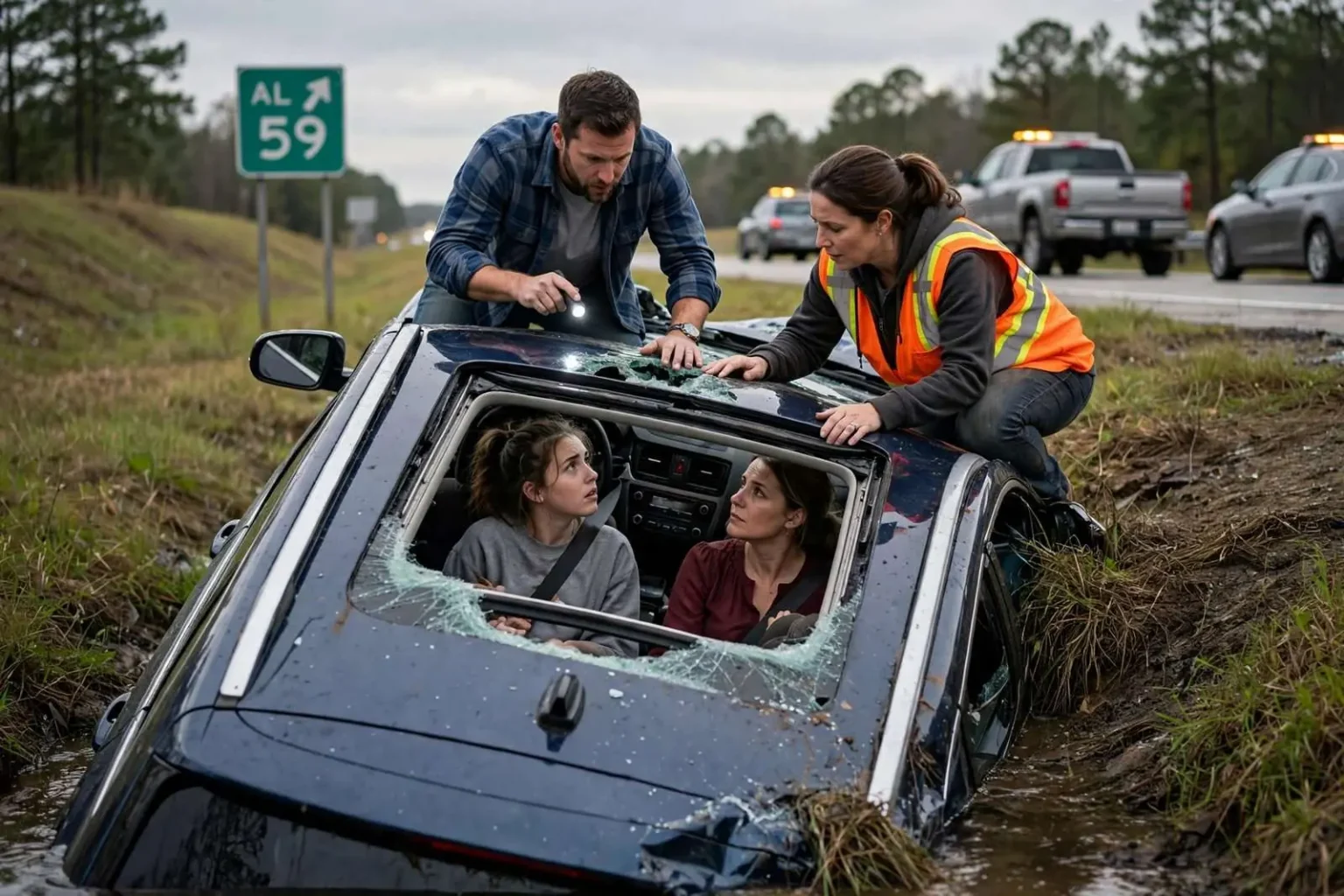
SUMMERDALE, Ala. — A teenage girl and a woman were trapped inside a vehicle that ran off Alabama 59 and rolled into a ditch, and the first people to reach them were not first responders. They were drivers who pulled over, tore the glass out of the sunroof, and stayed there talking to the two until help arrived.
Both walked away from the crash.
Summerdale Fire Rescue and Summerdale police responded along with MedStar. First responders freed the driver and passenger through the sunroof — the same opening the bystanders had cleared — and both were taken to Baldwin Health to be evaluated.
What Happened
The vehicle left the roadway on Alabama 59 and overturned in a ditch. A teen girl and a woman were inside and could not get out.
Passing drivers stopped. They removed glass from the sunroof to create access, and then did the thing that most accounts of roadside rescues leave out: they kept the two calm. That detail is worth pausing on, because in an entrapment situation it is frequently the most useful contribution an untrained bystander can make.
Why the Sunroof Mattered
A rollover changes the geometry of a vehicle in ways that make conventional exits unreliable. When a car comes to rest on its roof or on its side in a ditch, the doors may be pinned against the ground, the frame may be deformed enough that latches will not release, and the weight of the vehicle can rest directly on the door structure.
Window glass in a modern vehicle comes in two types, and the difference determines what is possible in a rescue. Side and rear windows are typically made of tempered glass, engineered to shatter into small blunt granules under sharp impact. Windshields are laminated — two layers of glass bonded to a plastic interlayer — specifically so they do not break apart, because the windshield keeps occupants inside the vehicle during a crash.
Sunroofs are generally tempered, which is why one can be cleared by hand or with a tool in a way a windshield cannot. In a vehicle resting in a ditch, a sunroof may also be the opening most accessible from outside and the one least likely to be blocked by the ground or by deformed sheet metal.
None of that means bystanders should routinely break glass. It means that in this instance, the people who stopped found the one opening that worked.
What Bystanders Should and Should Not Do
Roadside rescues by passersby are common, and the outcomes are usually good. But emergency responders are consistent about a few points, and a case that ended well is a reasonable moment to review them.
Call 911 first, and stay on the line. Everything else is secondary to getting trained responders and equipment moving. Dispatchers can also relay instructions in real time.
Secure the scene before approaching. More people are injured at crash scenes by secondary collisions than by the original crash. Hazard lights, distance from the travel lane, and awareness of oncoming traffic come before anything else — particularly on a highway like Alabama 59, where traffic moves at speed and a vehicle in a ditch may not be visible until drivers are on top of it.
Do not move an occupant unless there is an immediate threat. Fire, submersion or an unstable vehicle position may require removal. Absent those, moving a person with a possible spinal injury can cause harm that the crash itself did not. Reaching a trapped person to talk to them, monitor their breathing and keep them still is frequently the better intervention.
Keep them calm and keep them talking. This is what the drivers on Alabama 59 did, and it is genuinely useful. A person who is panicking may struggle against a seat belt or a deformed structure and worsen an injury. Conversation also provides continuous information about consciousness and breathing that responders will want on arrival.
Turn off the ignition if it is safe to reach. This reduces fire risk from a running engine near spilled fluids.
Alabama’s Good Samaritan Protections
People sometimes hesitate to assist at a crash out of concern about liability. Alabama, like every state, has Good Samaritan provisions in its code that extend protection to individuals who render emergency assistance in good faith and without expectation of compensation. The protections are designed precisely to remove that hesitation.
The practical guidance from responders is not to avoid helping but to help within the limits of what an untrained person can do safely — which, in most cases, means calling for help, protecting the scene and providing reassurance rather than attempting extrication.
Alabama 59 Through Summerdale
Alabama 59 is the primary north-south artery through central Baldwin County, running from Bay Minette south through Loxley, Robertsdale, Summerdale and Foley before reaching Gulf Shores. It carries a mix that makes it distinctive among the region’s highways: local commuter traffic, agricultural vehicles, commercial trucking, and heavy seasonal tourist volume moving toward and away from the beaches.
Summerdale sits along that corridor as a small town of roughly 1,300 residents. Through and around town, the highway alternates between developed commercial frontage and stretches with open shoulders and drainage ditches on either side.
Those ditches are a routine feature of highway drainage design in a region that receives substantial rainfall. They are also the reason a vehicle that leaves the roadway at speed frequently ends up inverted rather than simply stopped. A vehicle that drops a wheel off the pavement edge and then encounters a slope has the ingredients for a rollover: a sudden change in surface, a lateral load, and an incline.
The Roadway Departure Problem
Crashes in which a vehicle leaves the travel lane account for a disproportionate share of serious and fatal outcomes on rural highways nationally, and Alabama is no exception. The Alabama Department of Transportation and the state’s highway safety office have directed substantial funding toward countermeasures aimed specifically at this crash type.
Those countermeasures are the unglamorous features drivers rarely notice: rumble strips along shoulders and centerlines, high-friction surface treatments at curves, wider paved shoulders, improved edge-line markings and safety-edge pavement design, which tapers the drop-off at the pavement edge so a wheel that leaves the lane can be steered back without catching.
The value of these treatments is that they address the moment before the crash rather than its consequences. A driver who drifts and can recover does not become a rollover in a ditch.
The Outcome
Both the driver and the passenger walked away from a vehicle that had overturned. They were transported to Baldwin Health for evaluation, which is standard following a rollover regardless of whether obvious injuries are present. Rollovers generate forces in multiple directions, and injuries — particularly to the neck, spine and internal organs — are not always apparent immediately.
Summerdale Fire Rescue, Summerdale police and MedStar all responded. Small-town departments in Baldwin County operate with limited staffing and depend on mutual aid arrangements with neighboring agencies, which is part of why the interval before their arrival — the interval covered by the drivers who stopped — can matter.
The crash remains under investigation. Authorities have not released the names of those involved or a cause.