
Carnival Extends Cruise Cancellations Through April 30, 2021, Including Mobile Sailings
Carnival Cruise Line extended its pause of U.S. departures through April 30, 2021, keeping Port of Mobile cruises on hold during the pandemic.
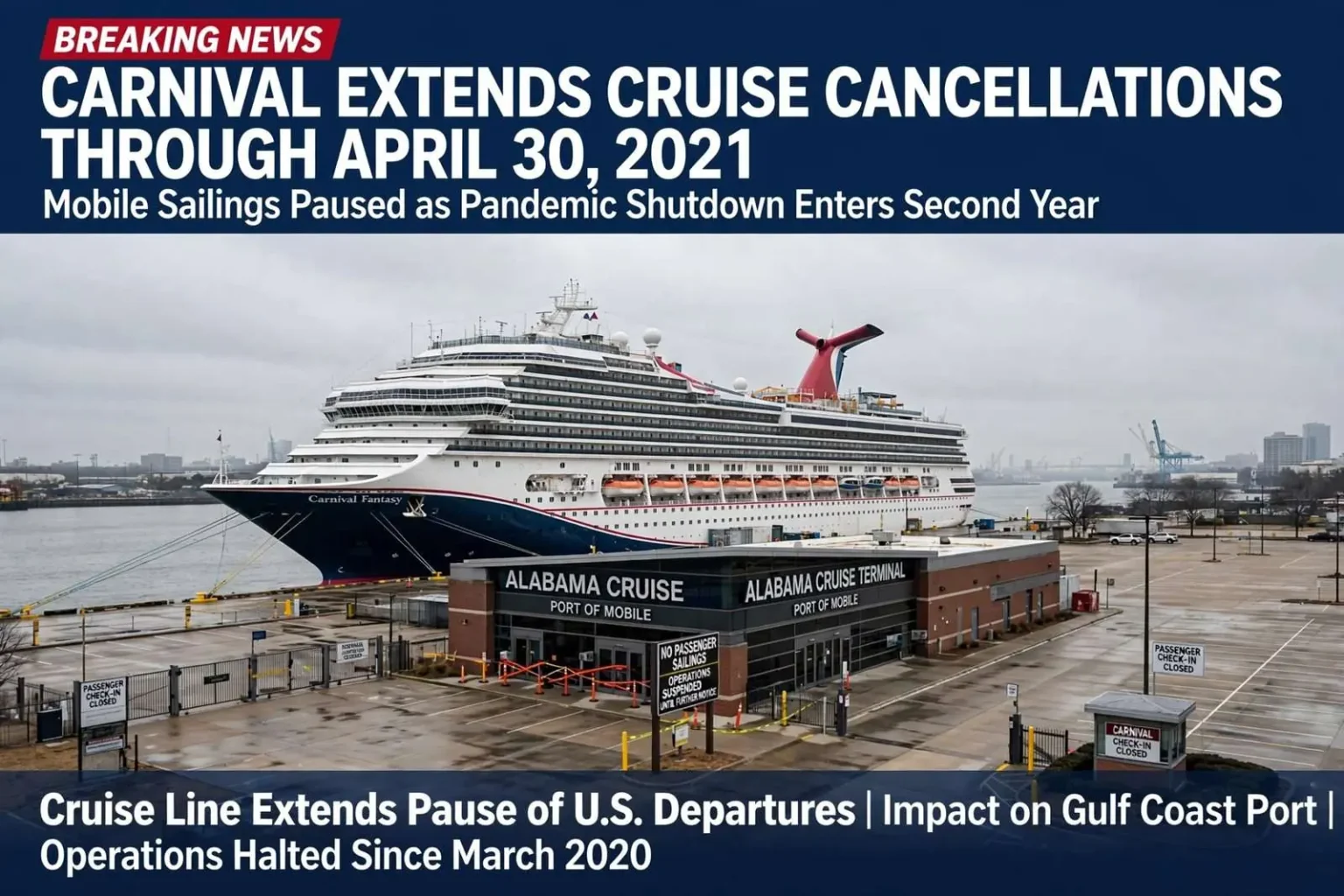
Cruise fans waiting to sail from Mobile will have to keep waiting. Carnival Cruise Line announced it is extending its pause of U.S. departures through April 30, 2021, wiping out another round of sailings including those planned from the Port of Mobile.
The extension, which Carnival framed as a continued response to the global pandemic and the ongoing public health conditions surrounding it, pushes the cruise industry’s nationwide shutdown well past the one-year mark. Passenger cruising from U.S. ports had been halted since March 2020, when the major lines voluntarily suspended operations amid the early spread of the coronavirus and the Centers for Disease Control and Prevention moved to restrict cruise ship travel.
The line is notifying booked guests and travel agents directly of the cancellations. Affected passengers can choose a future cruise credit paired with an onboard credit package or request a full refund. The two-option approach became Carnival’s standard remedy during the pandemic pause, with the cruise credit offer sweetened by onboard spending money as an incentive for guests to keep their bookings alive rather than asking for their money back. Travelers who opted for the credit were generally able to apply it toward a future sailing booked within a set window.
For travel agents along the Gulf Coast, the wave of cancellation notices had become a recurring chore throughout 2020 and into 2021. Each time Carnival extended its pause, agents had to rebook or refund clients whose vacation plans dissolved again — a process the industry said strained small agencies but also kept relationships with loyal cruise customers intact.
More than just U.S. departures
The extension reaches well beyond the Gulf Coast. Carnival also canceled its Australian operations through May 19, 2021, and scrapped the European itineraries for the Carnival Legend that were set to begin in May, running through October 31. The moves reflected the patchwork nature of the pandemic’s impact: different regions of the world had different infection rates, border policies and government restrictions, and cruise lines had to make cancellation decisions region by region rather than in a single global announcement.
The pandemic’s ripple effects even delayed Carnival’s newest flagship. The Mardi Gras, which was to debut from Port Canaveral, had its first sailing pushed to May 29, 2021, partly because of conditions in Europe affecting the ship’s transatlantic positioning. The Mardi Gras, one of the largest cruise ships ever built for the line and the first in North America powered by liquefied natural gas, had been one of the most anticipated new cruise ships in years, and its delayed debut became a symbol of how thoroughly the pandemic had disrupted every corner of the cruise business — from the Gulf Coast’s small homeports to the shipyards of Europe.
Carnival’s successive extensions tracked the broader industry’s struggle to satisfy regulators and public health officials. The CDC’s framework for a return to sailing required lines to meet a series of increasingly demanding conditions covering crew testing, simulated voyages and onboard medical capacity, and the timelines kept slipping as case counts around the country fluctuated.
What it means for Mobile
Mobile’s Alabama Cruise Terminal has now been without passenger sailings for most of a year since the pandemic halted cruising in March 2020. The terminal, located on the Mobile River in the heart of the city’s working waterfront, normally processes thousands of passengers per sailing as they board for four- and five-day trips to the western Caribbean.
The extension pushes the earliest possible restart of the Carnival Fantasy’s Mobile schedule into May 2021 at best — pending any further cancellations. The Fantasy has been the city’s only homeported cruise ship since Carnival returned to Mobile, and its departures are a regular sight downtown, with the aging but popular vessel casting off from the terminal on a schedule that had become part of the rhythm of the port city.
The economic stakes for Mobile are considerable. Homeported cruise ships bring spending into downtown restaurants, hotels and parking operations on every sailing day, and the terminal itself supports steady part-time work in baggage handling, security and guest services. Local tourism officials had spent much of the pandemic emphasizing that the cruise business — along with conventions and group travel — represented one of the city’s most visible economic losses during the shutdown.
Company president Christine Duffy said guests continue to show strong loyalty and booking demand remains encouraging, but the line determined a longer pause was necessary before ships could safely return to service. That contrast — robust future bookings alongside an ongoing operational pause — defined the industry’s position through the winter and spring, as lines banked reservations for later in 2021 and 2022 while their ships remained idle at piers around the world.
For now, Mobile cruise fans face the same calculus as travelers everywhere: rebook with a credit and gamble on the restart holding, or take the refund and wait for the industry’s return to become certain. Either way, the days of deciding on short notice to drive downtown and catch a sailing from the Port City remain on hold.
The Carnival Fantasy itself occupies a unique place in Mobile’s recent history. The ship was the vessel that launched Mobile’s cruise era in the first place, homeported at the Alabama Cruise Terminal for years before Carnival’s first departure from the market, and then brought back when the line returned to the city to serve the western Caribbean market with shorter itineraries. Its four- and five-day cruises — typically calling on destinations such as Cozumel and Costa Maya in Mexico — appealed to drivers from across the central Gulf Coast who could reach Mobile by car, park at the terminal and be at sea the same day, avoiding the cost and complexity of flying to larger cruise hubs like Galveston or New Orleans.
That drive-to-market model is precisely why the pause mattered so much to the terminal’s fortunes. Mobile is not a destination port where passengers fly in from around the country; its customer base is regional, drawing from Alabama, Mississippi, the Florida Panhandle and Louisiana. Every canceled sailing therefore represented lost revenue not just for the port but for a band of businesses within a few blocks of the terminal, from the downtown hotels where many passengers spend the night before an early boarding to the restaurants that fill up on embarkation eve.
The port authority, which operates the terminal in partnership with the cruise line, had continued to emphasize through the shutdown that the cruise partnership remained intact and that the facility stood ready to resume operations as soon as sailing was allowed to restart. Terminal staff, like cruise workers themselves, spent the pause in a kind of operational limbo — maintaining a facility built to process large volumes of passengers while processing none.
An industry frozen in place
The scale of the industry-wide shutdown was without precedent in modern cruising. Dozens of ships from the major lines sat idle at anchorages and piers, many with skeleton crews aboard maintaining the vessels. The Centers for Disease Control and Prevention’s no-sail framework, first imposed in the spring of 2020 and later replaced by a phased conditional sailing order, set out requirements covering everything from laboratory arrangements to onboard isolation capacity that lines had to satisfy before carrying paying passengers again.
Cruise operators argued the rules were workable but slow, and the industry spent months in negotiation with federal health officials over timelines and testing protocols. In the meantime, lines kept extending their pauses in roughly monthly increments — a rhythm that frustrated travelers but avoided the alternative of canceling an entire season at once while negotiations continued.
The Mardi Gras delay illustrated a different dimension of the same problem. Even ships that were ready for service depended on functioning international travel to position crew and complete final construction milestones. With European shipyards and borders operating under their own pandemic restrictions, the ship’s journey from Europe to Florida — the transatlantic positioning voyage that would bring it to Port Canaveral — was pushed back, cascading into a later inaugural season.
For Gulf Coast residents who follow the industry, the spring of 2021 became a waiting game played out in press releases. Each announcement from Carnival, and from the CDC, was parsed for signals about when the restart might actually come. The extension through April 30 meant Mobile’s next realistic embarkation was weeks away at minimum, and everyone from travel agents to downtown merchants had learned by then that “at best” was the operative phrase.
What kept optimism alive on both sides was the booking data. Carnival and its rivals repeatedly reported that demand for future cruises — particularly for 2022 and beyond — remained strong despite more than a year of continuous cancellations. Guests who chose future cruise credits over refunds, as many did, represented a form of committed demand that cruise lines cited as evidence the market would return quickly once ships were allowed to sail. For Mobile, that demand was the basis for believing the Fantasy’s return — whenever it came — would be greeted by a full parking lot at the Alabama Cruise Terminal rather than a cautious trickle of travelers.


