A Florida Firm Outbids Hanwha for Austal USA, Offering Up to $1.35 Billion for the Mobile Shipyard
Wildcat Infrastructure LLC has made a non-binding offer of $1.25 billion to $1.35 billion for Austal USA, topping Hanwha's $1.2 billion bid. Austal Ltd. shares closed 7.1 percent higher after trading resumed Wednesday.
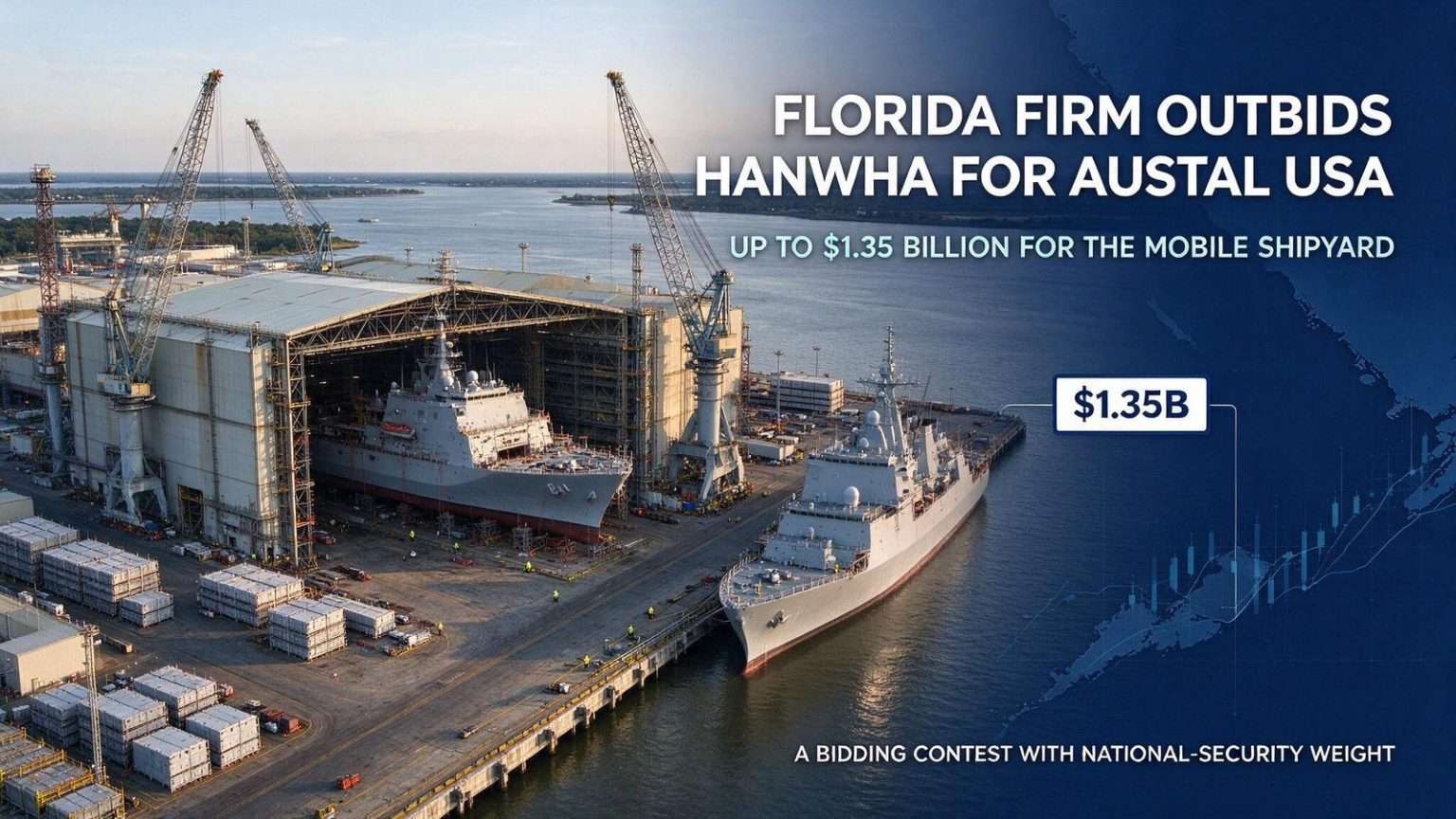
MOBILE, Ala. — A second bidder has emerged for Austal USA, one of southwest Alabama’s largest employers, and it is offering more money than the first.
Trading in Austal Ltd. stock on the Australian Securities Exchange was briefly halted Wednesday pending a statement from the company about a proposal first reported over the Labor Day weekend. The statement confirmed preliminary terms of a new offer from Florida-based Wildcat Infrastructure LLC, and Austal shares rose when trading resumed, closing 7.1 percent higher after gaining as much as 9 percent during the session.
Austal Ltd. said it had received a “non-binding indication of interest” from Wildcat, which proposed a value of $1.25 billion to $1.35 billion on a “cash free, debt free basis.” The preliminary offer is contingent on Wildcat being able to conduct four weeks of due diligence. Austal said its board and advisers will consider the proposal.
How the Bidding Got Here
Mobile-based Austal USA is a subsidiary of Australia-based Austal Ltd. In mid-August, Korean conglomerate Hanwha announced that its subsidiary Hanwha Defense USA was interested in acquiring Austal USA for up to $1.2 billion. Hanwha has since spent four weeks conducting due diligence on the shipyard, and shortly after that proposal was announced, a delegation of state and local officials traveled to Hanwha facilities in South Korea.
Austal Ltd. CEO Paddy Gregg said recently that the process had “great momentum” and that he believed the Hanwha deal had support from “senior people in the Department of War.”
Austal Ltd. initially said it had participated in discussions with Wildcat but had not yet received an offer. Reports that a competing bidder existed pushed Austal Ltd.’s stock price upward — the ordinary market response to the emergence of an auction where there had been a single buyer.
The Policy That Set This in Motion
Hanwha’s original offer coincided with a memorandum from President Donald Trump proposing a pathway for foreign shipbuilders to build warships for the U.S. Navy. The memorandum would allow foreign companies to build some U.S. warships abroad if they buy or build a shipyard in the United States.
That policy transformed American shipyards from industrial assets into strategic entry tickets. A foreign shipbuilder that acquires a qualifying U.S. yard gains access to a market it was previously excluded from, which changes what such a yard is worth to that buyer.
Hyundai has also been identified as a party interested in taking advantage of the policy. According to industry reports, Hyundai has been negotiating with Texas and West Coast shipyards.
Who Wildcat Is
Wildcat Infrastructure describes itself as a privately held family investment firm led by Eric and George Nicolaides. Its stated experience is primarily in energy and telecommunications infrastructure. The firm launched a defense business this year “in response to global events and increases in U.S. and allied defense spending.”
One of its top officers, Managing Director William Elischer, is a former senior official in Australia’s Department of Foreign Affairs and Trade. Elischer joined Wildcat two months ago as its head of defense.
The Argument: ‘American Capital’
Elischer’s pitch is not primarily about price. It is about ownership.
“There are very few yards in the US qualified to build submarine modules to the standard these programs demand, and [Austal’s] is one of them. Clearly this matters to Australia and AUKUS,” Elischer said, referring to the defense pact between the United States, Australia and the United Kingdom.
“There is no quick way to build another facility,” he said. “We are in a race against the clock. That makes the ownership of this yard a security question as much as a commercial one. Ours is American capital that commits to the long term — the rate these vessels get built matters for the Allies on which our mutual security depends, and we are laser-focused on that.”
According to Austal, Wildcat has indicated it intends to operate the company as a standalone platform, retaining the Austal brand and the company’s U.S. operations.
That framing sets up the choice facing Austal Ltd.’s board in terms that go beyond the roughly $50 million to $150 million spread between the two offers. Hanwha brings the manufacturing scale and capital of one of the world’s largest shipbuilding groups, along with the strategic logic of the Trump memorandum. Wildcat brings domestic ownership, which in the defense-industrial context carries its own regulatory and political weight, particularly around facility clearances, foreign ownership review and the sensitivities of submarine industrial base work.
Why the Submarine Work Matters
Elischer’s reference to submarine modules points to the most strategically significant part of Austal USA’s business.
The U.S. Navy’s submarine construction programs have been constrained not by funding but by industrial capacity — the number of facilities and skilled workers capable of fabricating submarine components to the exacting standards the work requires. That bottleneck has become more consequential under AUKUS, the trilateral pact under which Australia is to acquire nuclear-powered submarines, because the arrangement depends on American production capacity being sufficient to serve both navies.
Efforts to expand the submarine industrial base have extended across multiple states and into community college workforce pipelines, including programs in Alabama. A yard qualified to do this work is, as Elischer put it, not easily replaced.
What This Means in Mobile
Austal USA employs more than 3,000 people in Mobile, with expansions in progress that could push that total past 5,000. The company also operates a West Coast repair and maintenance facility and a technological research facility in Virginia.
For the Mobile area, the employment figure is the number that matters. A workforce of that size, in skilled trades with wages well above regional averages, anchors an entire supplier network and a substantial share of local economic activity. The shipyard has been central to the region’s manufacturing identity since Austal established operations on the Mobile River.
Both bidders have indicated an intention to continue and expand U.S. operations. Neither has suggested a scenario involving reduced employment in Mobile. But acquisitions of this scale invariably raise questions about capital allocation, program priorities and how a new owner values one facility against others in its portfolio — questions that cannot be answered from a non-binding indication of interest.
Where the Process Stands
Hanwha has completed four weeks of due diligence. Wildcat’s preliminary proposal is contingent on receiving a comparable four-week period. Austal Ltd. said its board and advisers will consider the Wildcat proposal.
Neither offer is binding. A non-binding indication of interest establishes a price range and a framework for negotiation; it does not commit either party. Definitive agreements, regulatory review and — given the defense work involved — national security review through the Committee on Foreign Investment in the United States for any foreign acquirer would all follow before a transaction could close.
The market’s reaction Wednesday reflected the simplest dynamic in any acquisition: a single interested buyer sets a price, and a second interested buyer discovers one. For a company whose shares rose as much as 9 percent on the news, the arrival of competition is the point.
South Alabama News will continue to follow developments in the sale process and their implications for Austal USA’s Mobile workforce.