When the Pentagon passed over Austal USA for the Navy’s frigate contract in April 2020, observers warned that Mobile’s largest industrial employer faced an existential crisis. The decision left the shipyard with a product line built around a hull form the Navy had signaled it was moving away from, and with thousands of skilled workers whose futures suddenly depended on what came next.
Less than three years later, the shipyard on the Mobile River across from downtown is in the middle of a transformation that company leaders say saved hundreds of jobs. The story of how the yard pivoted from a single-warship niche to a diversified military and commercial portfolio has become one of the more closely watched industrial turnarounds on the Gulf Coast.
For its first 15 years on the waterfront, Austal built only aluminum warships — 19 Littoral Combat Ships and 16 Expeditionary Fast Transport vessels. The company’s Australian parent brought high-speed aluminum shipbuilding to Mobile in the 2000s and rode the LCS program, one of the Navy’s largest construction efforts, to a position as the city’s dominant industrial employer, employing thousands at its riverside complex.
But with those programs winding down and the Navy signaling a preference for steel hulls, the company changed course. Aluminum had defined Austal’s identity — fast, lightweight ships prized for speed — but the Navy’s next generation of surface ships leaned toward heavier, more survivable steel construction, and Austal’s future depended on whether it could learn to build in a material it had never worked at scale.
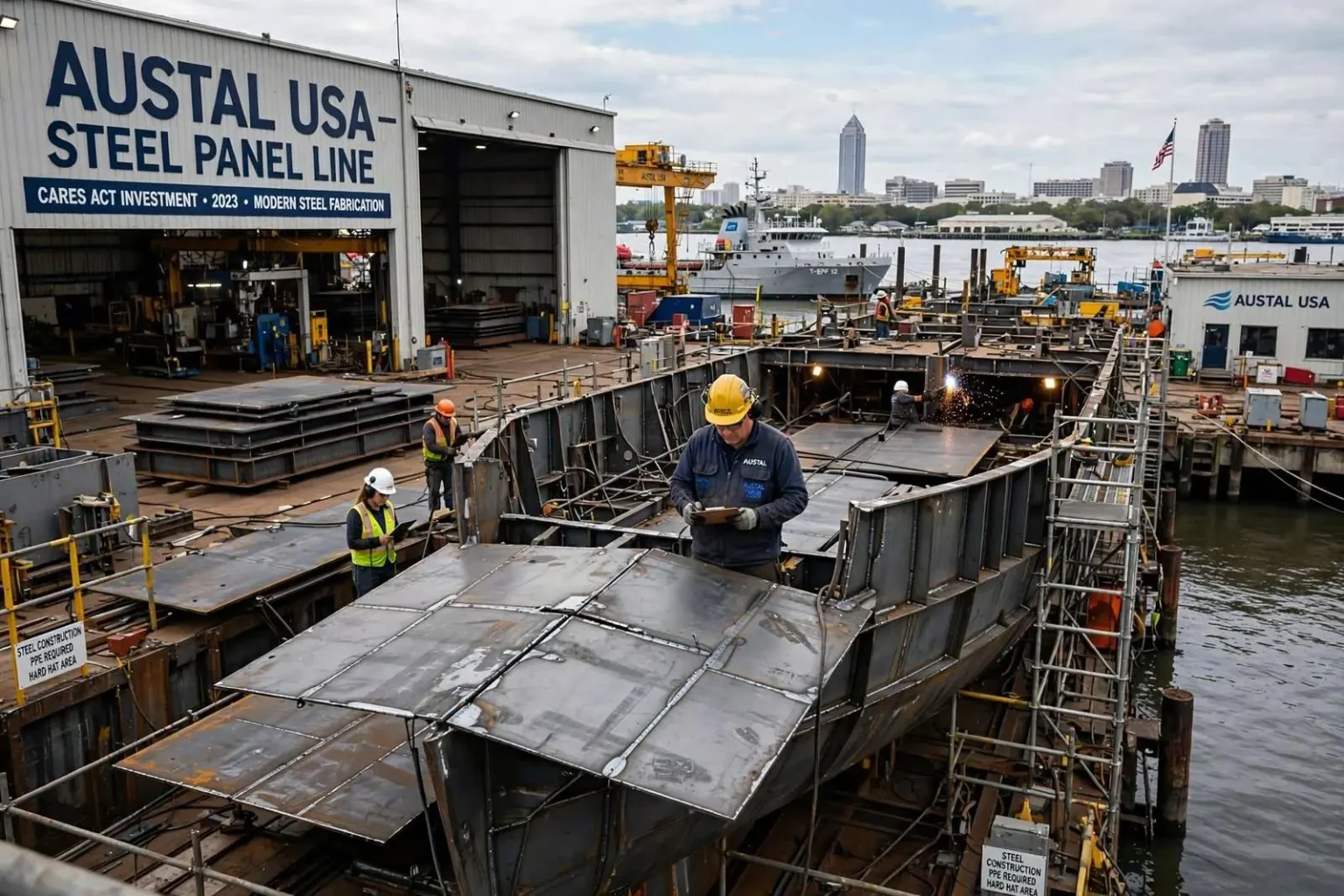
Using a $50 million grant under the CARES Act, Austal built a modern steel panel line at its Mobile yard. The federal money, distributed to shore up critical industries during the pandemic downturn, arrived at a moment when shipbuilding was among the few sectors positioned to convert assistance directly into permanent industrial capacity.
Learning to Work Steel
Rusty Murdaugh, president of Austal USA, said the Navy had long pushed the company to look beyond aluminum. The message from the service’s leadership had been consistent for years, he indicated, and the frigate loss made the stakes plain: a yard that could build only aluminum would be bidding on a shrinking share of Navy work.
Neil Seddon, who oversees the new steel manufacturing operation, said about half of Austal’s workforce already had experience with steel, and that welding steel is actually simpler than welding aluminum, which eased the transition. The point matters more than it might appear: aluminum welding demands extreme care because the metal conducts heat so readily, while steel is more forgiving of variation — a difference that helped the yard’s veteran tradespeople convert their skills rather than relearn them.
The workforce angle shaped the company’s planning. Shipyard trades — fitting, welding, pipefitting, electrical — transfer across hull materials more readily than outsiders might assume, and the half of the workforce with steel backgrounds gave Austal a core around which to train the rest. The yard continued hiring through the transition, adding to a labor pool that also supports the region’s other industrial employers.
The steel panel line itself represents the visible investment: a production facility that turns steel plate into assembled panels, the building blocks of ship hulls, at a rate and precision the yard’s aluminum lines could not match. Automated cutting, forming and welding stations feed an assembly flow that resembles the approaches used at the nation’s larger steel shipyards.
The diversification strategy has produced a string of new work: a steel towing, rescue and salvage ship (T-ATS) now under construction; a massive floating dry dock slated for the following year; and, beginning in 2025, nearly a dozen steel patrol cutters for the U.S. Coast Guard.
Each contract fills a different niche. The T-ATS is the Navy’s replacement for its aging fleet of ocean tugs and salvage ships — workhorse vessels that tow, fight fires, rescue crews and recover stranded craft. The floating dry dock is infrastructure that other shipyards and fleets need to lift and repair vessels, the kind of industrial asset that generates steady commercial demand. And the Coast Guard’s patrol cutters represent the service’s effort to renew its offshore fleet, a program expected to keep Austal’s steel lines busy for years.
Beyond Ships
The pivot extends past steel hulls. Austal is building an aluminum, partially solar-powered unmanned sail drone for the Navy, plans to adapt an EPF design into a fast military medical ship, and for the first time will act as a subcontractor, producing aircraft elevators for two Ford-class carriers and modules for Virginia- and Columbia-class submarines.
Each piece of that portfolio tells something about where Navy shipbuilding is heading. The unmanned sail drone reflects the service’s accelerating interest in autonomous vessels that can stay on station for long stretches without crews. The medical ship concept leverages the yard’s existing fast-transport hull — designed for speed and large cargo capacity — for a role that became newly urgent during the pandemic era.
The subcontracting work may prove the most strategically significant of all. Aircraft elevators for the Ford-class carriers and modules for Virginia- and Columbia-class submarines fold Austal into the supply chains of the nation’s largest defense shipbuilders, making the Mobile yard part of programs run from yards in Virginia, Connecticut and Rhode Island. In an industry where the submarine force and the carrier fleet command the Navy’s largest budgets, being inside those programs cushions Austal against the cyclical nature of any single ship class.
The diversification also mirrors a broader reality of Gulf Coast shipbuilding: no single contract, however large, can sustain a yard indefinitely, and the region’s survivors are the ones that combine Navy, Coast Guard and commercial work. Mobile’s riverfront has hosted shipyards since before World War II, when the city’s yards churned out vessels for the war effort, and the modern industry has followed the same principle of staying flexible.
Bradley Byrne, who dealt frequently with the shipyard as the area’s congressman from 2013 to 2020 and now leads the Mobile Area Chamber of Commerce, said the company would likely have shrunk dramatically — or disappeared — without the change in direction. His assessment reflects the view from the local economy: Austal’s payroll ripples through the region’s suppliers, trades and service sector in ways that make the yard’s fortunes a civic concern as much as a corporate one.
What the Pivot Means for Mobile
Mobile’s shipbuilding complex is among the largest concentrations of maritime industrial labor on the Gulf of Mexico. The yard’s workforce, combined with the suppliers and specialty contractors that orbit it, supports thousands of families across the metropolitan area, and the skills concentrated there — welding, fitting, systems installation — are exactly the ones the national shipbuilding enterprise is short of.
The stakes extend to the region’s economic identity. City and county leaders have spent decades courting aerospace, manufacturing and maritime employers, and Austal’s arrival two decades ago anchored the waterfront’s modern industrial era. A collapse of the yard would have removed not just jobs but the training pipeline — apprenticeships, technical programs, veteran tradespeople — that other maritime employers draw on.
Washington’s interest in the yard has remained strong across administrations. Congressional delegations from shipbuilding states defend construction accounts fiercely, and Mobile’s representatives have consistently argued for workload that keeps Gulf Coast yards busy. The CARES Act investment was one expression of that support; the string of contracts since has been another.
For the Navy, the transformation of Austal adds capacity to a national industrial base that is stretched thin. The service’s shipbuilding plans depend on yards that can absorb more work, and a Mobile yard building steel cutters, salvage ships and submarine modules alongside its aluminum transports gives program managers more options than they had when Austal’s output began and ended with one hull form.
The yard’s aluminum heritage is not being abandoned. Austal continues LCS and EPF work as the aluminum programs wind through their production runs, and the unmanned sail drone keeps the company at the front of the Navy’s experimentation with autonomous surface craft — a field many analysts expect to expand rapidly in the coming decade.
The T-ATS program illustrates how the new steel work fits together with the old. Vessels of that class do the unglamorous work that keeps a fleet moving — towing disabled warships, salvaging grounded craft, standing rescue duty — and their construction demands the heavy-plate fabrication skills the new panel line was built to supply. The same line supports the Coast Guard cutters, whose offshore patrol mission places them on the front line of the service’s counter-drug and migrant-interdiction operations in waters Florida and the Gulf states know well.
The floating dry dock, meanwhile, ties the yard to the business of maintaining ships rather than only building them. Dry docks are the infrastructure that makes repair and overhaul possible — giant, sinkable basins that lift vessels clear of the water — and as the Navy pushes more of its maintenance work to private yards, the companies that own the docks position themselves for decades of steady service work.
Labor remains the swing factor in how much of this work the yard can absorb. Gulf Coast yards compete for certified welders and tradespeople against construction, energy and each other, and Mobile’s training institutions — from the community college system to the yard’s own apprenticeship programs — sit at the center of that competition. Company leaders have consistently pointed to workforce development as the constraint that will shape how fast the steel operation scales.
The lesson Mobile takes from the turnaround is a familiar industrial one: adaptability, backed by capital investment and a workforce willing to stretch, is what keeps a factory alive when its founding product fades. Three years after the frigate decision, the shipyard across from downtown is busier than it has ever been — and busier in more ways than one.