Escambia Bay residents still rebuilding weeks after Hurricane Sally’s storm surge
Weeks after Hurricane Sally, residents along Escambia Bay near Pensacola are still rebuilding from a storm surge that destroyed belongings stored on lower.
More than two weeks after Hurricane Sally, many residents along Escambia Bay are still rebuilding their lives and hoping for federal help. Sally came ashore in mid-September near Gulf Shores as a slow-moving Category 2 storm, and while its winds faded quickly inland, the water it pushed into the bays and bayous along the coast kept destroying homes long after the rain stopped. Along Escambia Bay, north of Pensacola Beach, entire streets of waterfront houses took the brunt of the surge.
Someone who stayed during the hurricane recorded video of the dangerous storm surge pushing water through homes from the bay, footage that shows water moving through the lower floors of elevated houses with the force of a river. The recordings, shared widely in the days after the storm, documented an uncomfortable truth about Sally: the storm’s damage was never about dramatic wind footage — it was about hours and hours of relentless water.
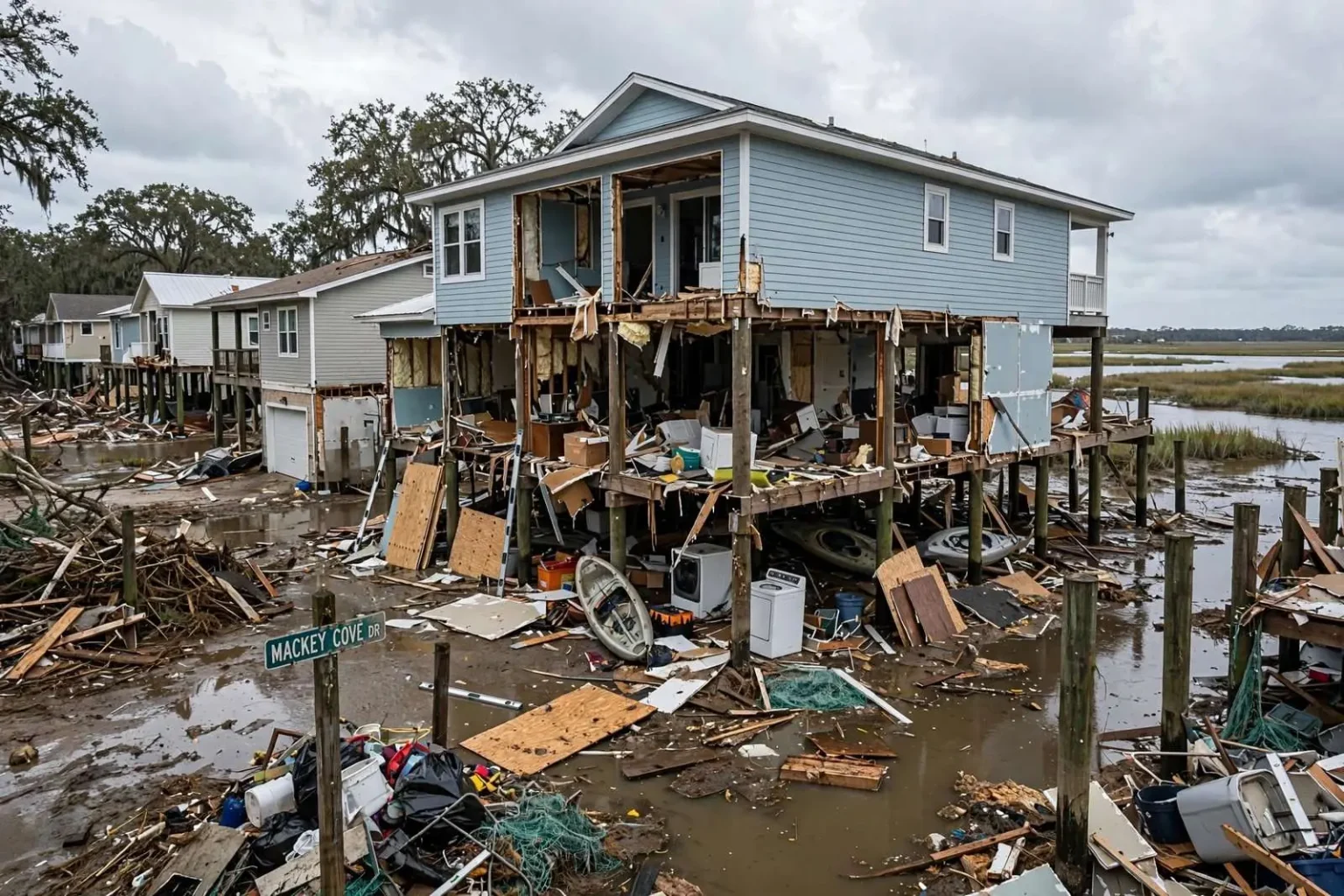
Kirk Anthony, who lives on Mackey Cove Drive, said the surge — which some estimated at 6 to 10 feet — did the real damage, not the wind. All of the homes there are elevated, built on pilings or raised foundations designed to lift the living space above historic flood levels. That elevation was exactly what the building codes intended, and it is why the houses themselves still stand. But everything kept on the lower levels was destroyed.
Anthony described watching the surge take out walls and push them into the wetlands behind the property, leaving the lower levels of the homes open to the bay. Boats, vehicles, tools, storage rooms and ground-level living space that generations of coastal families considered ordinary all vanished into the flood. The elevated house that survived the storm, he and his neighbors discovered, still lost its garage, its ground-floor rooms and everything stored in them.
A storm defined by its slowness
Hurricane Sally will be remembered as a storm that refused to move. After spinning for days in the Gulf of Mexico, it crept toward the northern Gulf Coast at a pace measured in single-digit miles per hour, allowing its winds to push seawater into the bays for an extended period rather than delivering a brief, sharp surge. Meteorologists repeatedly warned in the days before landfall that Sally’s slow speed would magnify flooding, and that is precisely what happened.
The storm made landfall on September 16, 2020, near Gulf Shores, Alabama, with winds around 105 mph. Communities from Mobile Bay east through Pensacola saw damage that was in many places worse than stronger storms had produced, because Sally parked itself over the coast. Rainfall totals in the Pensacola area measured in the range of two feet, collapsing bridges, washing out roads, and flooding hundreds of homes that had never taken water before.
On Escambia Bay, the geography amplified everything. The bay is a long, narrow body of water that funnels surge from the Gulf side toward the north end, piling water against neighborhoods that sit just a few feet above normal tide levels. When a slow storm drives wind from the south for hours, the bay has nowhere to send the water except into the streets and yards of the communities along its shoreline.
Why elevated homes still flooded
The houses on Mackey Cove Drive and streets like it were built the way coastal construction experts have urged for decades: raised, elevated, with the living space well above the base flood elevation that federal flood maps established for the area. During Sally, that decision saved the structures. Walls that would have been torn apart by standing water at the main living level held, and families did not have to ride out the storm with the bay coming through their kitchen.
But elevation standards are built around historic surge levels, and Sally’s water exceeded them. When surge reaches several feet above what a neighborhood was designed for, the lower levels — garages, storage areas, and in some homes finished rooms added over the years — flood completely. Everything stored there, from family keepsakes to vehicles to the tools people use to make a living, was submerged or destroyed.
Anthony’s description of walls being pushed into the wetlands behind the property illustrates how destructive moving water is compared to standing water. Even a few feet of surge flowing at speed can shear interior walls off their framing and carry pieces of a house hundreds of feet away. Owners who inspected their homes after the water dropped found not just wet carpet and drywall but structural damage that will take months and substantial money to repair.
For many families, the practical loss was nearly total even though the house technically stood. Insurance adjusters and inspectors who worked the Escambia Bay neighborhoods after Sally described ground floors that looked like they had been gutted, with insulation stripped out, wiring soaked, appliances overturned and personal property scattered across the marsh.
Waiting on federal help
Homeowners along the bay are applying for FEMA assistance as they begin the long process of recovery, and the wait has tested them. In the weeks after a major disaster, the federal machinery moves at a pace that feels glacial to families whose homes are damaged: declarations must be signed, application portals opened, inspectors scheduled, claims reviewed, and payments issued. Residents who lived through Ivan in 2004 and other storms know the rhythm, but knowing it does not make waiting easier when the lower floor of your house is gone.
The process starts with a federal disaster declaration that opens Individual Assistance programs for residents in the affected counties. Homeowners register with FEMA by phone or online, document their damage, and wait for an inspector to visit. From there, grants can cover temporary housing, essential home repairs and other serious needs, while low-interest disaster loans through the federal Small Business Administration can finance larger repairs for those who qualify.
Flood insurance is the other pillar of recovery along Escambia Bay. Because these neighborhoods sit in mapped flood zones, most mortgage holders carry federal flood policies. But flood insurance covers the structure and its contents up to policy limits, and it does not cover everything a storm takes — detached structures, some finishes, vehicles, and the kinds of improvements owners add below elevated living space are frequently excluded or capped. That gap is why so many Sally victims describe insurance checks that arrive promptly and still fall well short of the real cost of rebuilding.
Residents who did not carry flood insurance, or who lived in homes they assumed were high enough, face a harder road. FEMA grants for uninsured damage are modest by design — meant to make a home safe and livable, not to restore it entirely — so many families are combining grants, loans, savings and contractor sweat equity to piece their houses back together.
What the video footage captured
The video recorded from inside a home during the surge has done more than any official report to explain what happened on the bay. Where the wind was largely survivable, the footage shows water flowing through the lower levels of elevated houses, rising against pilings, and carrying debris through yards. For neighbors deciding whether to ride out the next storm, and for officials weighing future building standards, the recordings are a document of how Sally behaved.
Storm surge is consistently the deadliest hazard in landfalling Gulf hurricanes, and it is also the least predictable at the level of an individual street. Forecasters can predict a range of surge heights along the coast, but water behavior in a specific bay, bayou or cove depends on wind direction, bathymetry, and features as small as a roadbed that acts like a dam. The Escambia Bay recordings give residents a calibrated sense of what “six to ten feet” actually looks like from inside a home.
They also raise a question that coastal communities across the northern Gulf will be debating for years: how high is high enough? Building codes written after earlier storms raised living spaces several feet above the ground, and Sally pushed water beyond even those levels in places. Each storm that overtops the standards forces engineers and local officials to reconsider requirements for new construction and the economics of elevating existing homes.
The recovery ahead
Two weeks after landfall, the neighborhoods along Escambia Bay were in the stage of recovery that outsiders rarely see. The emergency phase — water rescues, shelter openings, road clearances — had passed. What remained was the grinding work: drying out framing, filing claims, meeting with contractors, arguing with adjusters, and living in apartments, campers or relatives’ homes while the paperwork moves.
Local government has its own recovery running in parallel. Roads and bridges damaged by the flood have to be assessed and repaired, debris has to be collected, and municipal budgets that suddenly lost tax revenue have to absorb enormous storm costs. Federal public assistance programs reimburse much of that spending, but only after local governments document it in detail — a burden that falls on small staffs already stretched thin.
For the families of Mackey Cove Drive and the streets around it, the immediate measure of recovery is simple: when the lower level is rebuilt and life feels normal again. The long-term measure is harder — whether the next storm meets the same elevated homes with the same force, and whether the lessons of Sally change where and how the Gulf Coast builds.
Preparing for the next one
Every family riding out the recovery is also quietly deciding what to do differently before the next storm. Some are storing nothing of value on the ground floor, treating the lower level of an elevated home as sacrificial space. Others are photographing their possessions for insurance documentation, raising electrical panels and mechanical equipment, or rethinking whether they will ever ride out a hurricane on the bay again.
Emergency managers across the northern Gulf Coast spent the weeks after Sally emphasizing the same list they always do: know your evacuation zone, keep a go-bag ready, document your property before the storm, and carry flood insurance even when the mortgage does not require it. Sally reinforced the point that the water does not respect assumptions — a storm that was, by wind measurements, a Category 2 produced damage that residents compared to far stronger hurricanes.
The bay communities will rebuild. They did after Ivan, after Frederic, and after every other storm that has worked its way up the same coastline since records began. The houses will be repaired, the wetlands will regrow, and the first warm weekend next spring will bring boats back to the water. But the people who live there now carry Sally’s lesson with them: on the Gulf Coast, the wind is not the thing that takes your house. The water is.
How residents can get help
Homeowners affected by the storm who have not yet registered for assistance can apply with FEMA online or by phone, and officials urge everyone with damage — including those with insurance — to register before the application deadline. Insured homeowners may discover damage that exceeds their coverage or falls into excluded categories, and only a completed FEMA registration preserves the option of additional help if programs expand.
Applicants should keep copies of repair estimates, contractor invoices, photographs of damage, and records of any disaster-related expenses such as temporary lodging. Inspectors may arrive weeks after registration, and organized documentation is the difference between a smooth claim and a denied one. Residents who are denied are also reminded that denial letters frequently reflect missing documentation rather than ineligibility, and appeals are a normal part of the process.
For now, the neighborhoods along Escambia Bay continue the work of putting their homes back together, applying for the federal help they have been promised, and watching the Gulf with a sharper eye than they carried before the 2020 season began.