Alabama’s Wild Oyster Season Opens Nov. 2 With the Thinnest Reefs Biologists Have Seen in Years
State divers found even fewer mature oysters than last year and almost no spat, pushing Alabama's wild oyster season opening to Nov. 2 with an eight-sack daily limit. Harvesters say thin reefs add two to three hours to every day on the water.
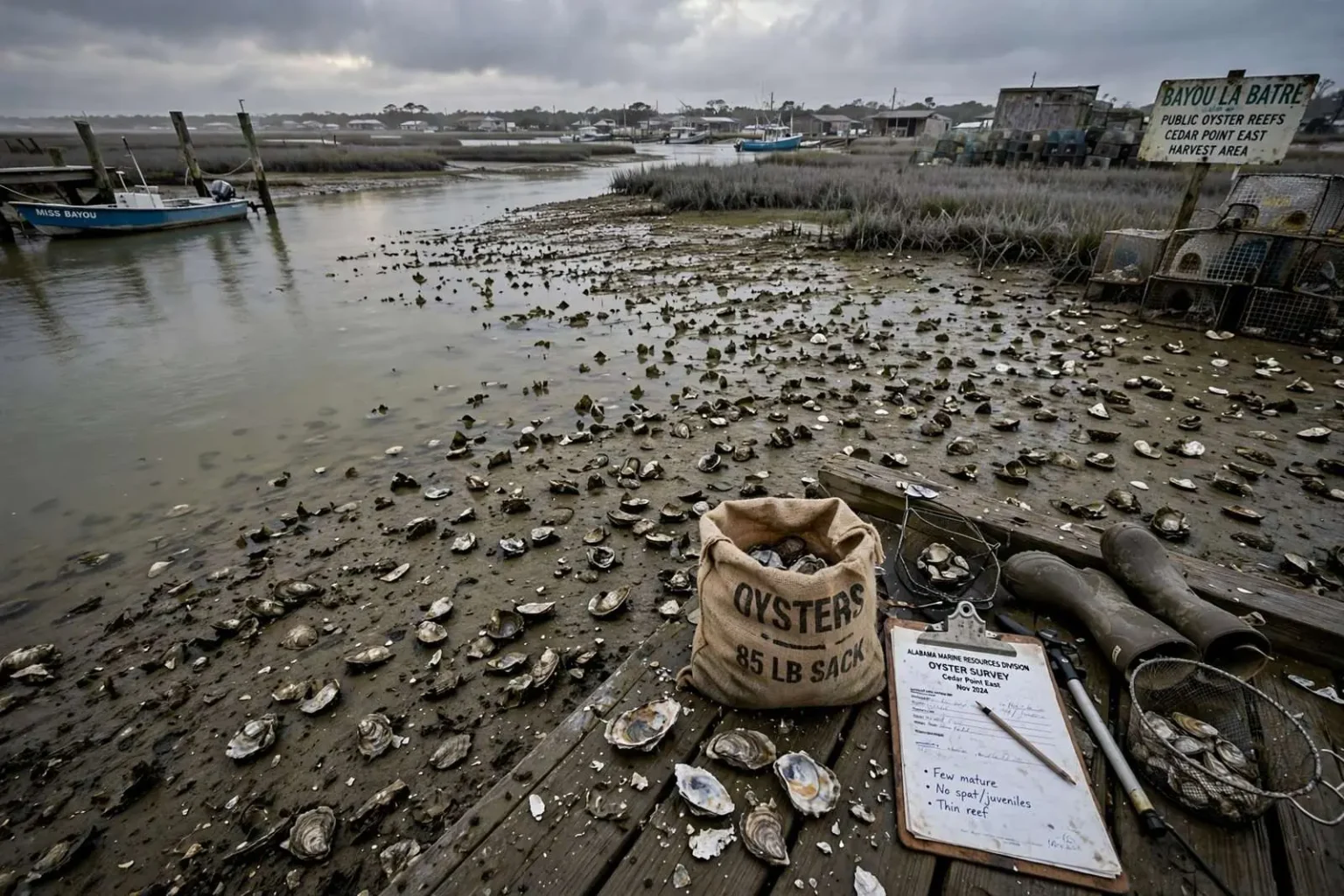
BAYOU LA BATRE, Ala. — Alabama’s wild oyster season will open a month late this year, on Nov. 2, and state biologists were blunt about why: their exploratory dives found even fewer mature oysters than last year, and almost no juveniles or spat to suggest the situation will improve soon.
Officials with the Marine Resources Division of the Alabama Department of Conservation and Natural Resources presented those findings Wednesday afternoon at the Bayou La Batre community center, in the annual pre-season meeting the agency holds before the harvest begins.
The daily limit will again be eight sacks. In Alabama, a sack is roughly 85 pounds of oysters in the shell.
“Even though we’ve determined that it’s looking pretty poor out there, we’re giving you guys an opportunity to get out there,” said marine biologist Jason Herrmann. “We didn’t find much on Cedar Point East. There’s a possibility you guys could get out there and find some more sacks.”
A Decade-Long Slide
The numbers describe a fishery that has been sliding for years, with brief recoveries that have not held.
There was no wild oyster season at all in 2018; officials determined they had not found enough oysters to make one worthwhile. The harvest then climbed from 11,000 sacks in 2019 to 50,000 in 2021 — a genuine recovery that suggested the reefs were rebuilding.
Then it began to drop again. The harvest was about 25,000 sacks in 2024. Last season, which followed a pre-season assessment that found declining live oyster counts and scarce juveniles and spat, produced roughly 5,000 sacks — the worst result since 2017.
This year’s dives found even fewer mature oysters than last year’s, along with extremely low levels of juveniles and spat, the term for larval oysters that have settled onto a surface.
The Salinity Problem
Herrmann identified the primary cause without hedging. Since roughly 2008, Alabama’s oyster reefs have faced a recurring problem with periods of low salinity that kill oysters, and that are especially lethal to young ones.
The mechanism runs through the middle of the continent. When spring rains are heavy across the nation’s interior, floodwater outflow from the Mississippi and other rivers pushes into the northern Gulf and lowers salinity in the coastal waters where Alabama’s reefs sit.
Oysters are estuarine animals and tolerate a range of salinity, but that tolerance has limits, and it narrows sharply for the young. An extended period of fresh water over a reef can kill an entire year’s recruitment.
The timing has been the cruelest part. For years, Herrmann said, the freshwater surge has coincided with the oysters’ spring spawning season. The fall spawn has fared better — only to produce spat that get hit by low salinity the following spring, while they are still at their most vulnerable.
The result is a cycle in which each promising cohort is eliminated before it can reach the size that would let it survive the next one.
A Slight Opening
Herrmann offered one qualified piece of good news. The pattern weakened this year. There were no extended periods when salinity off Cedar Point dropped below 10 parts per thousand.
“It doesn’t mean the damage hasn’t been done over the last decade and gotten us to where we’re at,” he said.
He called this year’s salinity levels “a good upturn” but cautioned that it would take three or four consecutive years of similarly favorable conditions for a cohort of spat to reach maturity.
“I’m hopeful that we’ll see more spat next year, more sub-legals next year,” he said. “But I don’t know that for sure because I don’t know what next year is going to bring. But these are the types of things we can hope for. Mother Nature can give us a little drier year, don’t flood us out in the springtime, and allow some of those adult oysters to spawn optimally and allow some of those larvae to find a place to sit and grow and become the next generation we just haven’t seen for years.”
Marine Resources Division Director Kevin Anson framed the same problem in similar terms at a meeting the following day.
“The environmental conditions are just not been very conducive to producing oysters and allowing oysters to live. That’s really what we’re up against, unfortunately. Mother Nature is just not on our side,” Anson said.
What Thin Reefs Mean for the People Working Them
The statistics translate into hours on the water, and the arithmetic is unforgiving.
“With fewer oysters on the reef it takes people longer to reach their harvest limits. It’ll take 2 to 3 hours longer than would normally be expected to reach their limits in a day. That could be incredibly wearing and time consuming and exhausting,” said Kayla Boyd, oyster project manager for Mobile Baykeeper.
An eight-sack limit is a ceiling, not a guarantee. A harvester working thin reefs spends the same fuel, the same boat maintenance and the same labor to bring in the same maximum — while working two to three hours longer to get there. On days when the limit cannot be reached at all, the economics invert entirely.
Oyster harvesting in Alabama is largely a small-operator business, concentrated in and around Bayou La Batre, a working seafood town whose identity has been built on the fisheries of Mobile Bay and the Mississippi Sound. It is physically demanding work performed by people who often have generations of family history in it, and who have limited ability to shift to other fisheries when one fails.
Where the Harvest Happens
Alabama’s wild oyster harvest takes place in three areas, all near the north end of the causeway leading to the Dauphin Island Bridge. They are known as Cedar Point East, Cedar Point West and Heron Bay.
The concentration is itself part of the vulnerability. A fishery spread across many reefs in varied conditions has some natural insurance against a localized event. A fishery concentrated in three adjacent areas experiences the same salinity conditions across essentially all of its productive ground.
The Rebuilding Effort
The Marine Resources Division is working directly with oystermen to test different approaches to improving the reefs. Restoration work in Alabama has included cultch planting — placing clean shell or other hard substrate on the bottom to give larval oysters a surface to settle on — along with shell recycling programs that recover shell from restaurants and return it to the water.
Boyd was direct about the timeline.
“It’s going to take a community and it’s going to take a long time to see results. And we’re only going to see results if we are all working together… We can do it,” Boyd said.
That framing matters because reef restoration operates on a timescale that does not match a harvest season. Substrate placed this year produces settlement next year, harvestable oysters three or four years after that, and only if salinity cooperates throughout. Every intervening spring flood resets the clock.
The Aquaculture Alternative
While the wild fishery struggles, a different part of Alabama’s oyster industry has been growing. The state has 13 aquaculture oyster operations, which produced more than 10 million oysters in 2024, according to an Alabama Cooperative Extension System report released earlier this year.
Farmed oysters are grown in cages or baskets suspended in the water column rather than harvested off natural bottom reefs. That method gives growers a measure of control the wild fishery cannot offer: gear can sometimes be moved or adjusted in response to conditions, stock comes from hatchery-produced seed rather than natural settlement, and the crop is not dependent on whether spat found a suitable surface on a public reef.
Aquaculture does not replace the wild fishery — the reefs provide water filtration, habitat and shoreline protection that farmed oysters do not, and the two operate on different economic models. But the contrast is instructive about where the industry’s growth is occurring.
A Quiet Room
One detail from Wednesday’s meeting stood out. The annual gathering is sometimes contentious, with harvesters questioning the causes of the decline and challenging the Marine Resources Division’s methods.
This year’s meeting was lightly attended, and no one in the audience raised questions.
Practical Details
The season is expected to open Nov. 2 on parts of Alabama’s public oyster reefs, with a limit of eight sacks per harvester per day. Full information on the state’s wild oyster harvest, including licensing requirements and other aspects of the process, is available through the Alabama Department of Conservation and Natural Resources.
South Alabama News will report on the season as it opens.