Radio Host Paul Leslie Plans 52-Mile Gulf Coast Run to Benefit Alabama Coastal Foundation
Atlanta radio host Paul Leslie announced a 52-mile Run for the Gulf from Mobile County to Perdido Key, raising funds for coastal restoration.
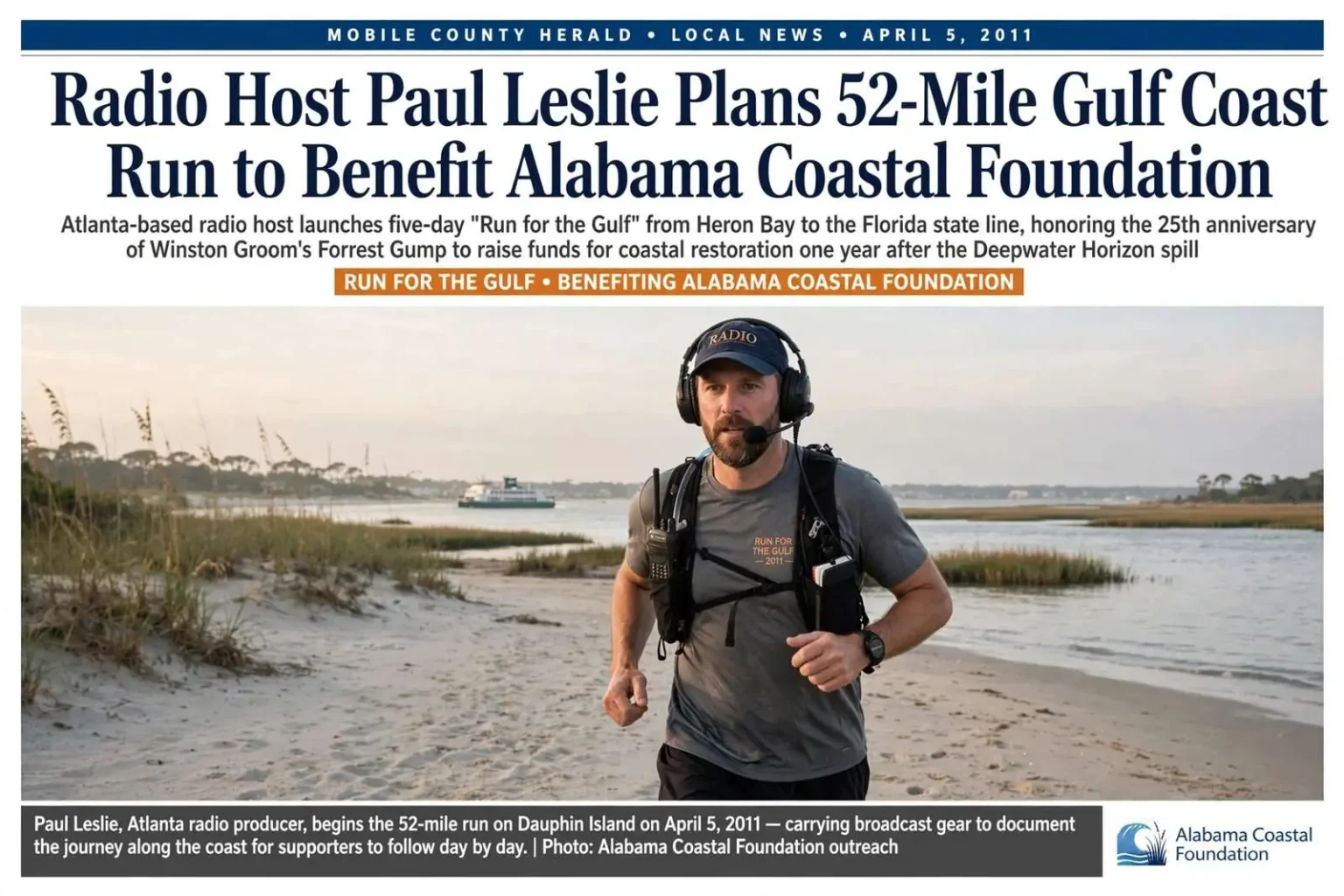
MOBILE COUNTY, Ala. — Atlanta-based radio host and producer Paul Leslie announced plans in the spring of 2011 to lace up his running shoes and hit the Alabama Gulf Coast for a 52-mile charity run benefiting the Alabama Coastal Foundation.
Leslie’s “Run for the Gulf” was designed as a multi-day journey stretching from Heron Bay in southern Mobile County to the Florida state line, covering between nine and 15 miles each day from April 5 through April 9. All donations raised through the event were directed to the Alabama Coastal Foundation, a nonprofit organization dedicated to preserving and protecting coastal Alabama’s natural resources.
The run’s premise was simple but demanding: cover the length of Alabama’s coastal edge on foot, one segment at a time, and use the journey itself to draw attention to the waters and shorelines the route traced. Leslie planned to carry his documentation gear along the way, posting updates as he went so that supporters could follow the run day by day.
A Tribute to Forrest Gump
The run paid tribute to the 25th publication anniversary of the novel Forrest Gump by Alabama author Winston Groom. The 1986 novel — which inspired the beloved 1994 film starring Tom Hanks — features a memorable sequence in which Gump runs across the United States several times, gathering followers along the way.
Leslie hoped to channel that same spirit, inviting the public to join him on the route in a show of solidarity for the Gulf Coast.
The literary connection gave the fundraiser a distinctly Alabama flavor. Groom, a Mobile native, set his picaresque novel in motion from the state, and the image of Gump running — resolute, unadorned, drawing strangers into his wake — became one of American fiction’s most recognizable symbols of persistence. Twenty-five years after the book’s publication, the anniversary offered a ready-made occasion for an endurance effort that echoed it, and Leslie leaned into the parallel as he recruited supporters and publicized the run.
The invitation to run alongside him was more than symbolic. Long-distance journeys like this one depend on companionship and moral support as much as on training, and opening the route to the public let Gulf Coast residents turn their concern for the shoreline into something tangible: miles logged together on the very ground they hoped to protect.
The Route
Leslie’s planned daily schedule took him through some of the most scenic stretches of the Alabama and Florida Gulf Coast:
April 5: Heron Bay to The Pelican Pub on Dauphin Island — 9.7 miles.
April 6: The Pelican Pub to The Beach Hut Cafe in Gulf Shores — 15.7 miles, including 4.5 miles aboard the Mobile Bay ferry.
April 7: Rest day.
April 8: The Beach Hut Cafe to Lulu’s at Homeport Marina in Gulf Shores — 13.5 miles.
April 9: Lulu’s to the Flora-Bama in Perdido Key, Florida — 13.4 miles.
The itinerary read like a tour of the coast’s landmarks. Heron Bay sits at the southern edge of Mobile County, where the causeway country gives way to the bay’s open water. Dauphin Island, the barrier island community at the route’s start, offered beaches, bird sanctuaries and the Fort Gaines historic site. The Mobile Bay ferry that carried Leslie across the bay’s mouth between the island and Fort Morgan has run for generations, linking the two halves of the route the way it has long linked the peninsula and the island for daily travelers.
On the eastern shore, the route passed through Gulf Shores, the heart of Alabama’s beach tourism, before finishing at the Flora-Bama, the legendary honky-tonk straddling the Alabama-Florida line on Perdido Key. Ending at the state line gave the run its geography: all 52 miles tracing Alabama’s coastal ribbon from the bay’s western shore to the border.
Raising Awareness for the Coast
The event came roughly a year after the Deepwater Horizon oil spill devastated the Gulf Coast region, and the run served as both a fundraiser and a visible reminder of the ongoing need to support coastal restoration and conservation efforts across South Alabama.
The timing gave the fundraiser its urgency. The explosion of the Deepwater Horizon drilling rig in April 2010, and the months of oil that flowed into the Gulf afterward, had coated shorelines, closed fishing grounds and cast a shadow over the coastal economy from Louisiana to the Florida panhandle. Baldwin and Mobile county beaches had been among the affected shores, and even a year later, residents and business owners were still living with the aftermath — crews working the sand, questions about seafood safety, and uncertainty about the long-term health of the marshes, bays and barrier islands that define the region.
Against that backdrop, a man running the length of the Alabama coast was a small act, but a legible one. It said that the coast was worth crossing on foot, mile by mile, and that the work of restoring and protecting it would require the same persistence.
The Alabama Coastal Foundation, the run’s beneficiary, had spent years building its role as a convener of conservation interests along the coast. Based in Mobile, the organization works with volunteers, businesses and government partners on programs ranging from water quality monitoring to habitat protection and public education. Fundraisers like Leslie’s run fed directly into that mission, providing both dollars and visibility at a moment when coastal Alabama’s environmental challenges were front-page news.
Leslie documented his progress through social media updates along the route, and the Alabama Coastal Foundation tracked the run on its website.
That digital component mattered. Social media in 2011 was a far younger landscape than it is today, but it was already the tool of choice for endurance fundraisers, letting supporters follow a run in real time and donate as the miles accumulated. Each day’s updates carried photos and reports from the route — the ferry crossing, the beach segments, the faces of people who came out to run alongside — and gave donors far from the Gulf a window into the cause their money supported.
The coast Leslie crossed is a fragile strip of land doing heavy work. The barrier islands and peninsulas of coastal Alabama absorb storms coming out of the Gulf, shelter the estuaries that nurture Gulf seafood, and support a tourism economy that anchors communities from Dauphin Island to Orange Beach. Protecting that landscape is a permanent undertaking, not a one-time repair, and it depends on organizations like the Alabama Coastal Foundation and on the steady attention of the people who live along and love the shoreline.
For Leslie, the run represented a crossover of sorts between his professional life and his philanthropic instincts. As a radio host and producer, he made his living with his voice — interviewing, narrating, and connecting with audiences through sound. The run flipped that equation, putting his body on the line over five days and letting the Gulf Coast scenery speak for itself while he documented the journey mile by mile.
Multi-day charity runs occupy a particular place in the culture of endurance sports. Unlike a single-day race, they demand logistical planning that resembles a small expedition: daily routes mapped around meals and lodging, weather contingencies, support for nutrition and recovery, and the discipline to wake up sore each morning and do it again. Runners who take them on speak of the rhythm that develops over consecutive days — the body adapting, the scenery accumulating meaning, the cause growing larger than the discomfort.
The route’s landmarks added their own texture to the effort. The Pelican Pub on Dauphin Island and the Beach Hut Cafe in Gulf Shores served as daily waypoints where the run could begin and end within sight of the water. Lulu’s at Homeport Marina, at the foot of the Intracoastal Waterway in Gulf Shores, offered a fitting staging point for the final push east. And the Flora-Bama, the beach bar that has long marked the state line for travelers along the coast, provided the finish line — a destination recognizable to just about anyone who has spent time on the Gulf Coast.
Locals along the route knew the landmarks well, and that familiarity was part of the run’s appeal. Every segment passed through communities with a stake in the Gulf’s recovery, from the fishing families of the bay’s western shore to the tourism workers of the beach towns, and each stop along the way was a chance to talk about why the coastline deserved their attention.
Whatever the run’s final tally of miles and donations, its deeper purpose was the one Leslie borrowed from Winston Groom’s novel: the simple, stubborn act of putting one foot in front of the other for something that matters. A year after the spill, with the coast still healing, that message found its audience one milestone at a time.