Dredging Project at Langan Park Lake Expected to Begin Later This Year
Mobile city officials say an 18-month dredging project to remove 350,000 cubic yards of sediment from the Langan Park lake is expected to begin by the end of the year, eventually opening the water to kayaks and canoes.
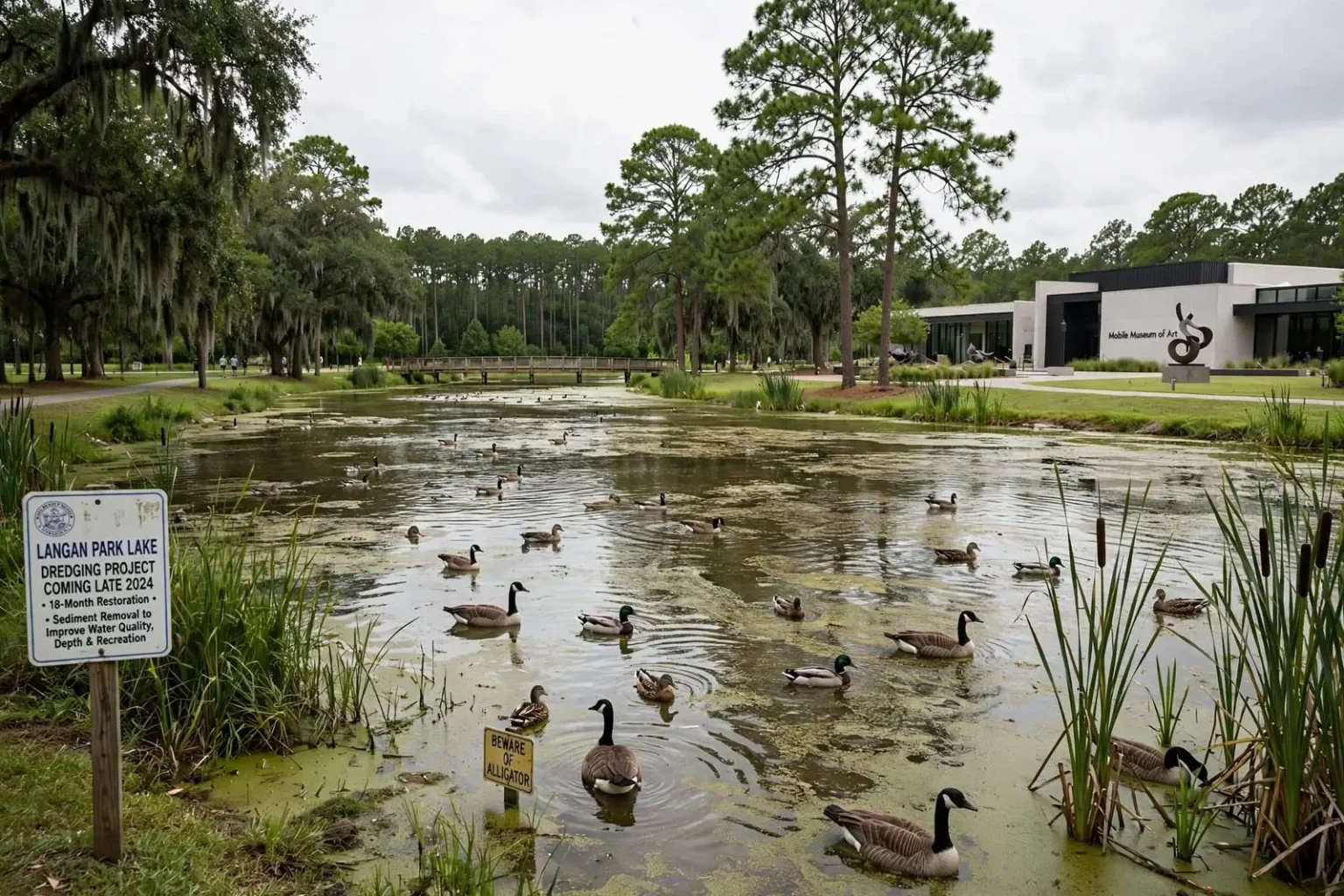
For now, it’s mostly geese and ducks paddling around the lake at Langan Park, but Mobile city officials say that could soon change. An 18-month dredging project aimed at restoring the popular park’s lake is expected to get underway later this year, with the goal of eventually opening the water to kayaks and canoes. “It’ll be able to be boated through, so you’ll be able to kayak and canoe in there,” said Jennifer Greene, Mobile’s Director of Programs and Project Management. “Dredging will clear away some of the nuisance algae.”
The project represents one of the most visible investments the city has planned for its flagship west Mobile park in years. Langan Park’s lake has long served as the park’s centerpiece — the first thing visitors see from the Mobile Museum of Art’s grounds and the backdrop for the walking paths that ring the water — but decades of sediment have quietly shrunk what was once a functional body of water into a shallow pond struggling under a layer of muck and algae.
City officials say decades of sediment buildup have left the lake shallow and choked with algae, limiting its use for recreation and hurting the health of the small ecosystem that surrounds it. The upcoming project is designed to reverse that, removing accumulated muck from the lake bed so the water can support boating and healthier plant and fish life once again. The environmental logic is straightforward: as a lake fills with sediment, sunlight penetrates less, oxygen levels drop, and the conditions that once supported fish and aquatic plants give way to the algae-dominated state that park visitors see today.
The scale of the work
According to Greene, the bidding process for the project is set to begin at the end of summer, with construction crews expected to move onto the site and begin work by the end of the year. Once underway, crews will spend a year and a half removing sediment that has washed into the lake over time from the surrounding watershed. An 18-month timeline makes this a multi-season disruption of parts of the park, and the city’s scheduling of the work — bidding in late summer, mobilization by December — is designed to front-load the heaviest operations into months when the park’s seasonal usage patterns can best absorb them.
The scale of the work is substantial. “It’s a large project, 350,000 cubic yards of sediment is going to be removed from the lake,” Greene said. That volume of material, once removed, is expected to leave the lake with an average depth of three to five feet, a significant improvement over its current shallow, silted condition. To put the quantity in perspective, 350,000 cubic yards would fill a line of dump trucks stretching for miles; in practical terms, it is the difference between a lake that can float a kayak and one that can barely float a duck.
Depth matters for more than boating. A deeper water column resists the summer algae blooms that flourish in warm, sun-baked shallows, holds more dissolved oxygen for fish, and gives the city’s parks staff a fighting chance at maintaining the lake’s health once the dredging equipment leaves. Three to five feet of average depth is a modest figure for a natural lake, but for an urban park pond fighting decades of siltation, it represents a genuine restoration.
Fixing the problem upstream first
The dredging project is part of a broader, multi-year effort by the city to address sedimentation problems that begin well upstream of Langan Park. Greene said crews have spent the past several years working in Twelve Mile Creek, which feeds into the lake, to reduce the amount of sediment and debris flowing downstream into the park. “We’re already seeing a 70% reduction in sedimentation coming down in there. It’s very successful,” Greene said of the upstream work.
That 70% figure is the quiet key to the entire project’s long-term prospects. Dredging a lake without addressing the watershed that fills it is like mopping a floor while the faucet still runs — the new depth would simply fill back in over the following years. By working Twelve Mile Creek first, stabilizing the stream channel and intercepting sediment before it reaches the lake, the city has attempted to slow the refill rate enough that the dredging investment can hold for years rather than a few seasons. The approach reflects modern stormwater practice: treat the watershed as a system, not just the symptom at the bottom of it.
Sedimentation in urban watersheds like Twelve Mile Creek’s comes from decades of development — construction sites, eroding stream banks, stormwater outfalls that deliver silt directly into the drainage network with every heavy rain. Mobile’s climate makes the problem relentless; the Gulf Coast’s intense rainstorms move enormous volumes of water through small urban creeks, and each storm carries soil toward the lowest point in the system, which in west Mobile is the park’s lake.
A park worth the investment
Langan Park, one of Mobile’s largest and most heavily used green spaces, draws residents for walking, picnicking, disc golf and other outdoor activities throughout the year. The sprawling park in west Mobile — home to the Mobile Museum of Art, playgrounds and miles of trails — functions as the recreational center of gravity for a broad swath of the city, and its lake is the feature most visitors photograph first. City leaders hope that restoring the lake will add another recreational draw to the park, giving residents a new way to get out on the water without leaving the city.
Kayaks and canoes on the lake would be a first in recent memory for a generation of Mobilians who have only ever known the water as an algae-green shallow. Paddle craft require no boat ramp, no motor and little infrastructure — just accessible shoreline and enough depth to float — making the restored lake an unusually low-cost recreational amenity once the dredging is complete. Cities across the country have found that urban paddle water is among the most heavily used recreation assets a park can offer, particularly in warm climates where the season stretches across most of the year.
Officials have not yet released a detailed construction timeline or a total cost estimate for the dredging work, both of which are expected to become clearer once bidding concludes later this year. The bidding process will determine the contractor, the final schedule and the price tag, and city staff have indicated those details will be public once the award is made.
In the meantime, the lake will remain open to wildlife and park visitors as the city finalizes plans to begin the long-awaited restoration. The geese and ducks that currently have the water to themselves are about to share it — with kayakers, canoers, and a lake that finally has room for them all.
What the work will look like
Dredging a park lake is heavy, methodical work. Crews typically remove sediment with either a barge-mounted hydraulic dredge, which pumps a slurry of muck and water through a pipeline to a dewatering site, or mechanical equipment operating from the shoreline. Either way, the process requires staging areas within the park, temporary fencing around the work zones, and a plan for handling hundreds of thousands of cubic yards of material once it comes out of the lake bed. Where that material ends up — whether it can be beneficially reused as fill or topsoil, or must be hauled to a disposal site — is one of the cost drivers the bidding process will reveal.
For park visitors, the disruption will be visible but manageable. The walking trails, disc golf course, playgrounds and museum grounds are expected to remain in use while the work proceeds, with construction activity concentrated at and around the water. An 18-month project spanning a year and a half means residents should expect to see the dredging equipment in place through at least two full seasons.
Why it took decades to get here
The lake’s decline was gradual enough that each year looked much like the last, which is precisely how urban lakes lose themselves. A modest accumulation of sediment — inches at a time, carried in by the creeks and storm drains that serve a growing west Mobile watershed — compounded over decades into the shallow, algae-choked water that visitors see today. Restoring it required two things the city only recently assembled: the upstream sediment controls along Twelve Mile Creek that cut the inflow by 70%, and the funding and engineering capacity to take on a dredging job of this size.
The payoff, if the project performs as designed, is a lake that functions again — deep enough to paddle, clear enough to support fish and plant life, and protected enough by the upstream work to stay that way. For the geese and ducks that currently have the water to themselves, the company is about to grow considerably.