A Campaign Strategist Called Mike Dow the Man to Beat, If He Ever Chose to Run for Governor
The consultant behind Sam Jones' mayoral win said Mobile's four-term former mayor would be the odds-on favorite in the governor's race if he entered it. Dow, busy with a new venture, was out of town.
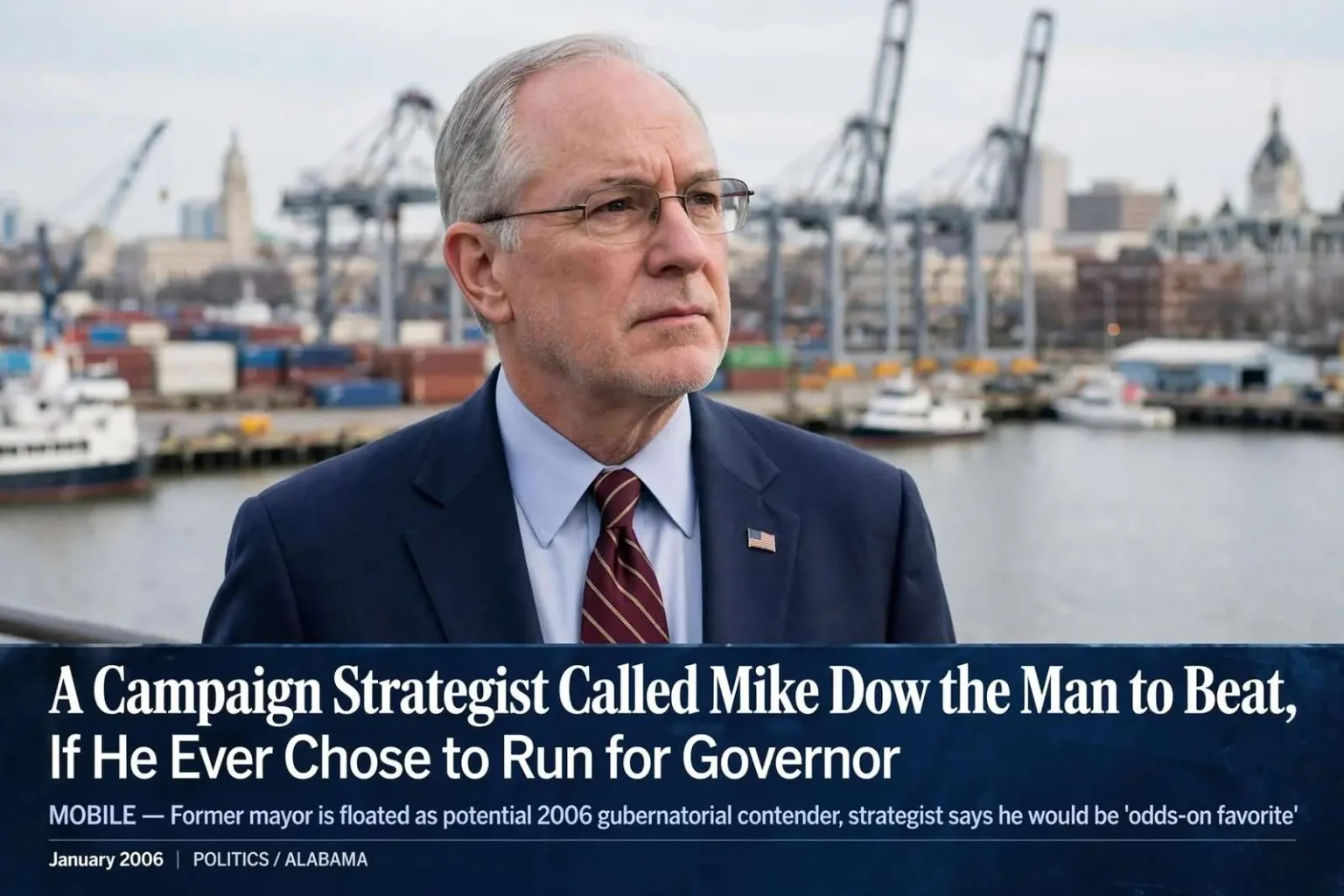
MOBILE — He had been out of office barely long enough for the paint to dry on his successor’s nameplate, but former Mobile Mayor Mike Dow was already being talked about as a candidate for governor — and not by an idle observer. Rick Heartsill of Direct Communications in Birmingham, one of the architects of Sam Jones’ successful mayoral campaign in Mobile, offered an unusually blunt assessment of the four-term mayor’s prospects in that year’s gubernatorial race.
“I think he would be the odds-on favorite to win the governor’s race if he entered it tomorrow,” Heartsill said. “Yes, I think he would win. He would be very strong in the (Democratic) primary. He would match up extremely well against (incumbent GOP Gov. Bob) Riley, who has weak spots.”
It was a striking thing for a professional strategist to say about a man who was not a candidate, from a man whose business was picking candidates. Heartsill had just come off one of the most consequential municipal elections in Mobile history, and his firm’s judgment carried weight in Democratic circles around the state. The remarks, made in January 2006, put a specific name on a question that Alabama Democrats had been quietly asking since Dow left City Hall: whether the man who had remade Mobile could be persuaded to try to remake the statehouse.
The case for a Dow candidacy
The argument was not hard to follow. Dow had presided over Mobile through four terms and had made economic development the signature of his tenure, courting industry and pressing the case for a city that had spent much of the late 20th century watching opportunity go elsewhere. He was, by 2006, closely associated with the run of announcements — port expansion, aerospace ambitions, downtown revival — that had begun to change how Alabama’s political class talked about Mobile.
For decades the state’s economic conversation had been dominated by Huntsville’s research corridor and Birmingham’s corporate base, with Mobile often treated as a scenic afterthought. Dow’s tenure had pushed back on that framing. The push to grow the State Docks into a deeper, more capable container port, the pursuit of aerospace work along the Gulf Coast corridor, and the slow rebuilding of downtown’s storefronts and sidewalks had given the city a story to tell, and Dow had told it relentlessly — at trade shows, in boardrooms, and in the kind of persistent recruitment that rarely makes headlines but eventually produces them.
A Democrat with credibility on business and jobs, a strong base in the state’s second-largest media market, and a record that Republicans would have found awkward to attack was, in a strategist’s eyes, a formidable proposition. That combination was precisely what Alabama Democrats had lacked in recent cycles: a candidate who could raise money in the business community, campaign credibly on economic growth, and still hold the party’s traditional base in the Black Belt and the working-class neighborhoods of its largest cities.
Riley, seeking a second term, had his own vulnerabilities, not least the lingering resentment among some conservatives over his failed 2003 tax-reform referendum. The governor had gambled his first term’s capital on a sweeping $1.2 billion package of tax and accountability reforms, and when voters rejected it overwhelmingly in September 2003, the defeat left scars on both flanks — anti-tax conservatives who never forgave the proposal, and educators and budget advocates who felt the promise had been abandoned. A well-funded opponent with a jobs record would have tested that coalition from the start.
The candidate was in Orlando
There was, however, one complication with the scenario: the prospective candidate did not appear to be pursuing it. Dow was heading marketing for a new venture, Centralite Systems, launched by his brother-in-law Jim Busby. When word of Heartsill’s remarks circulated, Dow was on a business trip to Orlando and was not immediately available to comment.
The company made home-automation technology — the systems that let a homeowner control lighting, climate and security from a single panel — a field that was just moving from luxury custom installs toward the broader residential market. It was a genuine second act rather than a placeholder: a start-up in a new industry, built by family, demanding the travel and salesmanship that had defined Dow’s decade of recruiting industry to Mobile, now pointed at selling its products instead of the city.
That silence was itself a kind of answer. Alabama governors’ races are won by candidates who begin assembling money and organization a year or more before the primary, and a former mayor absorbed in a start-up was not behaving like a man about to run statewide. The money that fuels a credible Democratic primary campaign does not appear in the spring of an election year; it is raised in increments over many months, against a schedule and a network that a candidate has to build personally. Every month spent on a young company’s product launch was a month the trial balloon lost altitude.
There were personal calculations as well that those close to Dow pointed to in that season. A governor’s race would have meant uprooting the life he had built in Mobile, subjecting his family to a year of statewide scrutiny, and trading a city record he was proud of for an uncertain contest against a sitting governor with a war chest. Mayors who eye higher office weigh those costs constantly; most conclude, as Dow appeared to have concluded, that the life they have is worth more than a race they might lose.
Consultants, clients and the art of the trial balloon
It is worth noting who was doing the talking. Heartsill’s firm had just helped elect Sam Jones — Dow’s successor and a longtime county commissioner — and Direct Communications was also part of the re-election team for state Sen. Gary Tanner. Praise from a strategist with a full book of Mobile clients is not disinterested; it is a way of keeping a name in circulation, of testing whether a constituency exists, and of reminding the political world where a firm’s talents lie.
Strategists trade in exactly this kind of talk. A well-placed compliment to a prospective candidate costs nothing, generates coverage, and quietly opens a door: if the candidate ever leans toward running, he remembers who believed in him first. If he does not, the consultant has still signaled to every other officeholder in the region that his firm spots strength early. Reading a trial balloon means reading the interest of everyone holding the string — and Heartsill’s interest was transparent enough that most observers took the assessment as sincere but self-interested in equal measure.
Still, the remark landed because it described something real. In the middle of the last decade, Mobile’s political stock was rising, and the men and women who had run the city were increasingly mentioned in conversations that used to be held entirely in Birmingham and Montgomery.
An unspent possibility
Dow did not enter the 2006 governor’s race, and the speculation of that January went the way most such speculation goes. Riley won re-election that November, and the Democratic field that ran without Dow underscored what Heartsill had been implying: the party had trouble finding a candidate with the same blend of executive experience and business credibility that the former Mobile mayor embodied.
What remained was the shape of the possibility rather than the thing itself. A four-term mayor of Alabama’s second-largest city, freshly retired with a development record the state’s business press had celebrated, polling — at least in one strategist’s confident assessment — ahead of a sitting governor. It is the kind of opening that comes to a politician once, and it came to Dow while he was in another state selling thermostats and lighting controls.
The episode said as much about Alabama politics as it did about Dow. Gubernatorial candidacies in the state are built years in advance, financed by networks that a mayor of a single city does not command, and won by candidates who commit to the grind of a statewide campaign more than a year out. Talent that arrives late — no matter how real — usually stays on the sideline. Mobile’s rising stock, meanwhile, would have other chances to convert into state influence, through the port and aerospace successes Dow had set in motion rather than through his own name on a ballot.
And the former mayor, for his part, seemed content with the trade he had made. The city he had led for sixteen years had a new mayor continuing many of the same development themes, the port project he had championed was moving through its federal reviews, and his new company gave him a stake in an industry with a future. The governor’s office would be decided by other men; the home-automation venture, at least, was his to build.