Former Alabama GOP Chairman Says His Own Party Helped Pave the Road to Bigger Government
Marty Connors, former chairman of the Alabama Republican Party, argued that Republicans could not credibly attack federal spending without first admitting how much of it they had authorized themselves.
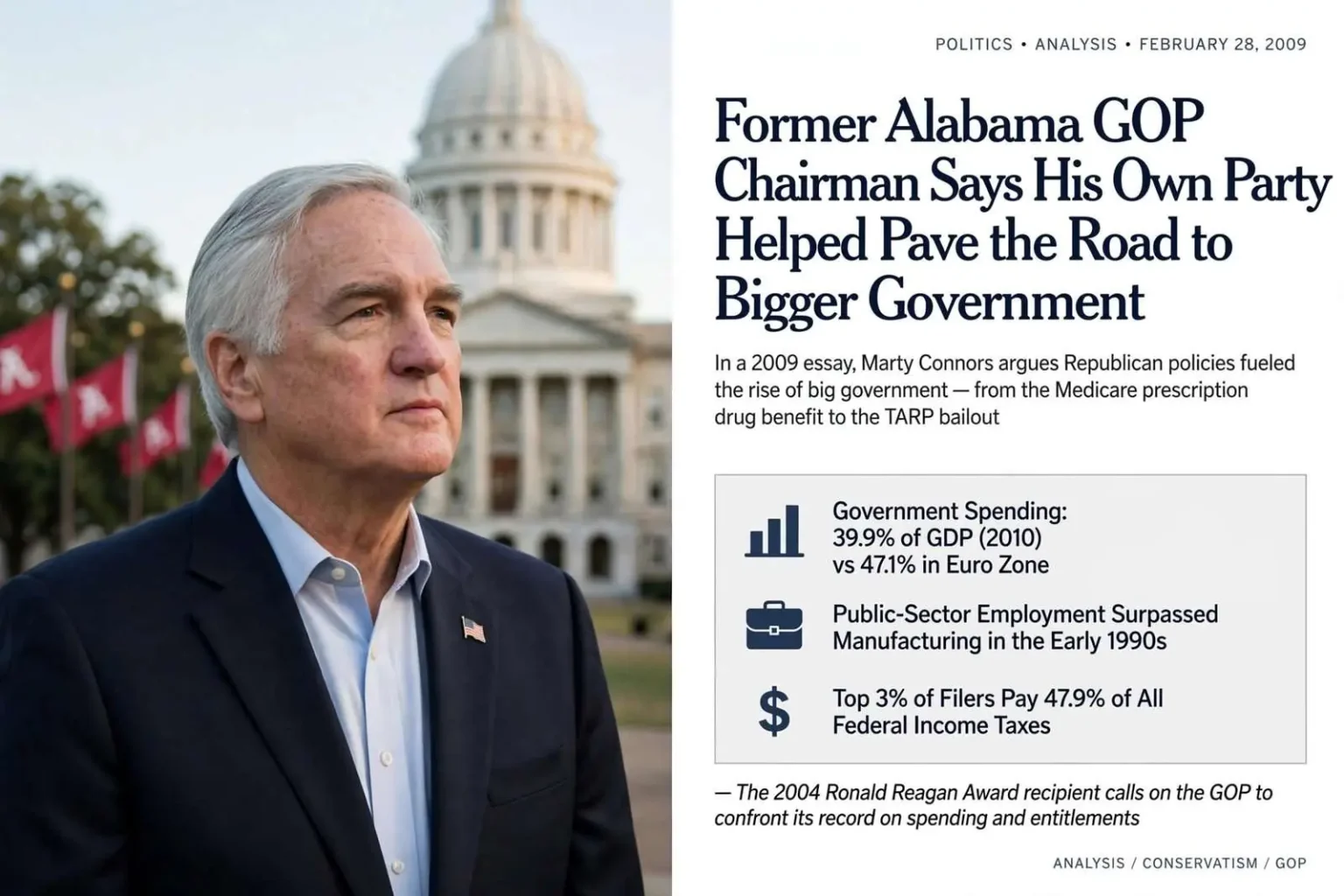
Marty Connors, the former chairman of the Alabama Republican Party, published an essay at the end of February 2009 that spent as much of its energy scolding his own party as it did the new administration in Washington. The occasion was a Newsweek cover story titled “We Are All Socialists Now,” which arrived just weeks after Congress passed the largest stimulus package in the nation’s history. Connors, the 2004 recipient of the American Conservative Union’s Ronald Reagan Award, seized on the magazine’s numbers and turned them into an argument about Republican responsibility.
The Numbers He Built the Case On
Connors led with figures drawn from the Newsweek piece. U.S. government spending was projected to reach 39.9 percent of gross domestic product in 2010, against 47.1 percent in the Euro Zone — a gap of less than eight points. A decade earlier the comparison had been 34.2 percent against 48.2 percent, a spread of roughly 14 points. The distance between American and European government, in other words, was closing fast. He paired that with a second statistic: according to the U.S. Census Bureau, government jobs, including the military, accounted for about eight percent of all employment in America, and public-sector employment had surpassed manufacturing employment back in the early 1990s. The only growth in union membership, he noted, was in that public sector.
A third figure closed the loop. Roughly three percent of American filers reported incomes above $250,000, and those same filers paid, by his account, 47.9 percent of all federal taxes. The numbers painted a picture of a country where the tax base had narrowed, the public sector had swollen, and the gap between the American model and the European social democracy model had shrunk to a matter of degrees rather than kind. Connors argued these trends accelerated during Republican administrations as much as Democratic ones.
The Uncomfortable Part
Where the essay departed from ordinary partisan commentary was in its assessment. Republicans, Connors wrote, could point to the war on terror, the economic shock of Sept. 11 and two devastating hurricanes as partial justification for the spending increases of the previous decade. But they also had to look honestly in the mirror at the prescription drug benefit and at the bailouts. “The first was a genuine entitlement expansion, the second a genuine abandonment of market discipline,” he wrote. Both bore Republican fingerprints. The Medicare Prescription Drug, Improvement, and Modernization Act of 2003 passed with a Republican House, Republican Senate, and Republican president. The Troubled Asset Relief Program of 2008 originated in a Republican Treasury Department and was signed by a Republican president.
Connors knew the territory. He had chaired the Alabama GOP from 2001 to 2005, a period that spanned the 2002 midterms, the 2004 presidential campaign, and the early years of the Iraq War. He had watched the party’s small-government rhetoric collide with the realities of governing. His essay was not a renunciation of conservatism but a demand that the movement confront its own record. “We have become the party of big government,” he wrote. “We just prefer our big government to benefit different constituencies than the Democrats do.”
Alabama Context and Political Career
Connors’s perspective was shaped by Alabama politics, where the Republican transformation of the Deep South played out in accelerated form. When he became chairman in 2001, Republicans held a minority of congressional seats and a bare foothold in the legislature. By 2005, they controlled the governorship, both Senate seats, a majority of House seats, and were closing in on legislative majorities. The shift mirrored the national trajectory: the GOP’s rise to power coincided with an expansion of federal spending that contradicted the party’s founding philosophy.
His 2004 Ronald Reagan Award from the American Conservative Union recognized his role in building the Alabama Republican Party into a dominant force. But the award also highlighted the tension at the heart of his critique: the institutional success of the party had come alongside the policy failures he now diagnosed. Connors had recruited candidates, raised money, and built county organizations — the mechanics of political power. He understood that the same activists who knocked doors for small-government candidates often benefited from the federal programs those candidates criticized.
The 2008 Financial Crisis and Republican Response
The 2008 financial crisis shattered the fragile consensus. The collapse of Lehman Brothers in September, the ensuing credit freeze, and the panic that gripped global markets forced the Bush administration into interventions that would have been unthinkable months earlier. TARP, the auto industry bailout, the Federal Reserve’s unprecedented lending facilities — all represented a massive expansion of federal authority into the private economy. Congressional Republicans split sharply on TARP, with House Republicans initially defeating the bill before a revised version passed with Democratic support and a minority of Republicans.
Connors viewed the crisis response as the culmination of a decades-long drift. The prescription drug benefit had established the principle that Republicans would expand entitlements when politically advantageous. The post-9/11 security spending had normalized trillion-dollar deficits. The financial crisis removed the last rhetorical restraints. “We have spent the last eight years proving that we are not the party of limited government,” he wrote. “The question is whether we have the courage to admit it and change course.”
Reception and Legacy
The essay, published on Connors’s personal blog and circulated among conservative journalists, drew both praise and condemnation. Some fellow Republicans dismissed it as airing dirty laundry while the new Democratic administration was still assembling its cabinet. Others, particularly in the libertarian wing of the movement, treated it as a necessary truth-telling. The blog post was cited in National Review, The Weekly Standard, and various conservative blogs as evidence of an intra-party debate that the 2008 election had not resolved.
Connors did not seek another term as chairman after 2005, returning to his law practice and lobbying work in Montgomery. His essay anticipated the Tea Party movement that would erupt within weeks of its publication, channeling similar frustrations into a grassroots insurgency that would reshape the GOP from the outside. The Tea Party’s targets — bailouts, deficits, the expansion of federal power — echoed Connors’s indictment, though the movement’s tone was more populist and less institutional.
The Decade That Followed
In retrospect, Connors’s essay reads as a prelude to the Republican civil war that defined the 2010s. The Tea Party’s primary challenges to establishment Republicans, the 2013 government shutdown over Obamacare funding, the rise of the Freedom Caucus, and ultimately the 2016 nomination of Donald Trump — all reflected the unresolved tension between the party’s limited-government rhetoric and its governing record. Trump’s presidency would see federal spending increase further, deficits widen before the pandemic, and the national debt cross $27 trillion, with Republican congressional majorities for the first two years.
The specific numbers Connors cited have only grown more stark. Federal spending as a share of GDP exceeded 40 percent during the pandemic and has settled around 24-25 percent in non-crisis years — still well above the pre-2001 baseline. The top 1 percent of earners now pay a larger share of federal income taxes than in 2009, while the bottom 50 percent pay virtually none. Public-sector union membership remains the only growing segment of organized labor. The convergence with European social democracy that Connors warned about has continued, albeit through a different policy mix than he might have predicted.
Alabama’s Federal Footprint
For Alabama, the federal spending debate has particular resonance. The state receives roughly $1.50 in federal spending for every dollar its taxpayers send to Washington, according to Tax Foundation analyses — a ratio driven by military installations (Redstone Arsenal, Maxwell-Gunter Air Force Base, Fort Novosel), NASA’s Marshall Space Flight Center, and disproportionate participation in means-tested programs like Medicaid and SNAP. Alabama’s Republican congressional delegation has consistently voted against spending bills while securing earmarks and defense appropriations that benefit the state. Connors, a Montgomery lobbyist after his chairmanship, knew this dynamic intimately.
The prescription drug benefit that Connors cited as a Republican betrayal disproportionately benefited Alabama, which has one of the nation’s highest per-capita Medicare enrollment rates. The auto bailout preserved jobs at the Mercedes-Benz plant in Vance, the Honda plant in Lincoln, and the Hyundai plant in Montgomery — all facilities recruited with generous state incentive packages that Republican governors championed. The tension between ideological purity and constituent interest is not unique to Alabama, but the state’s economic structure makes it unusually acute.
Assessment
Connors’s 2009 essay did not spark an immediate course correction. The Republican Party won the House in 2010, the Senate in 2014, and the presidency in 2016 without resolving the contradiction he identified. If anything, the party’s governance record moved further from its rhetoric. But his critique remains a reference point for conservatives who argue that the GOP’s intellectual credibility depends on acknowledging its own history. The numbers he cited — the narrowing gap with European spending levels, the shift from manufacturing to government employment, the concentration of the tax base — have only become more pronounced. The question he posed in February 2009 remains unanswered: whether a party built on the promise of limited government can govern that way when the political incentives all run the other direction.