After Years of Reporting and Rewriting, Curran’s Siegelman Book Heads for Mobile Shelves
Mobile reporter Eddie Curran said his long-awaited book on covering Gov. Don Siegelman's administration is finished and will reach bookstores within weeks, with the first signings planned in Mobile and Baldwin counties.
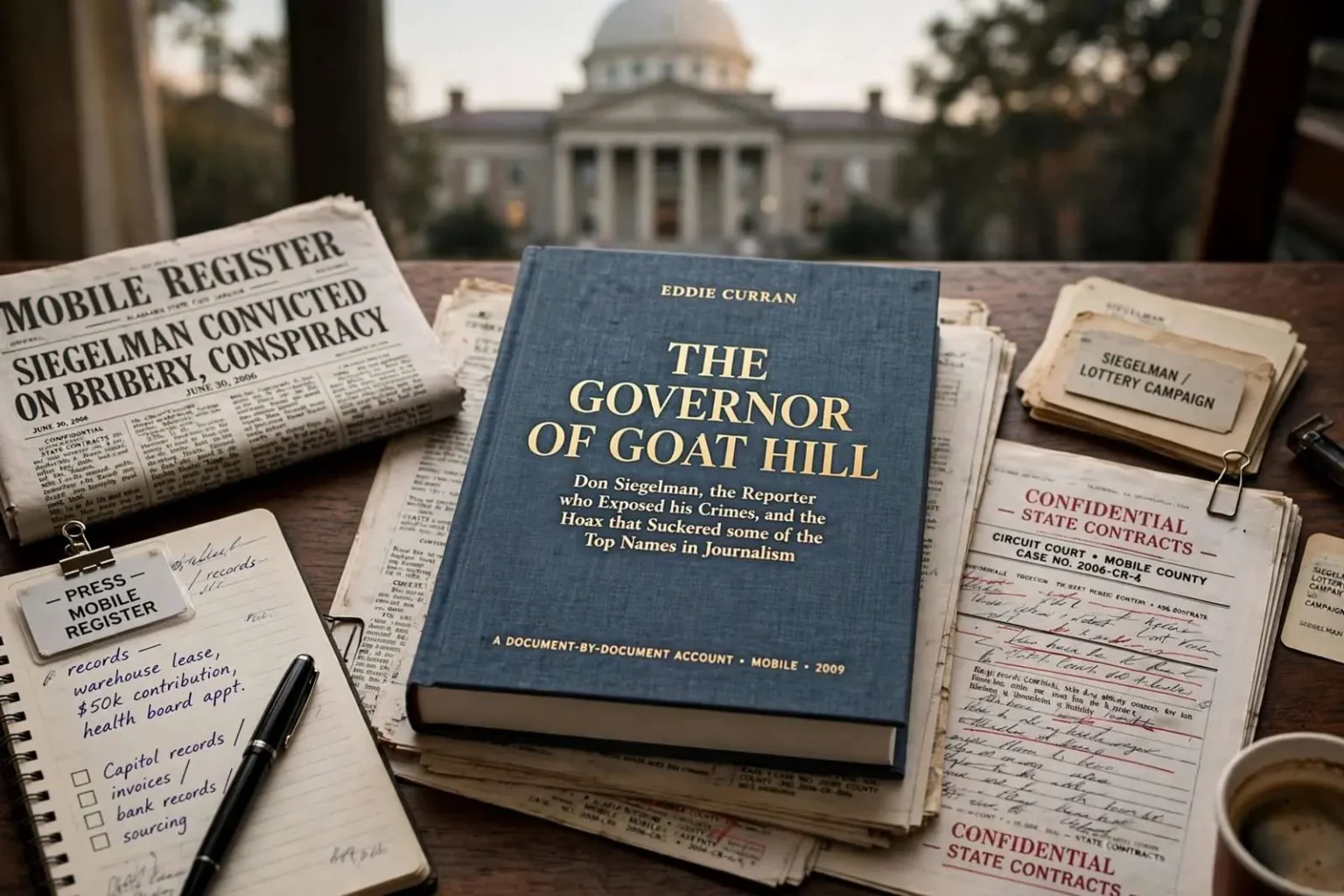
The book that consumed Eddie Curran’s sabbatical is finished. Curran, the veteran newspaper reporter whose investigative work on Gov. Don Siegelman’s administration ran for years across the front pages of Mobile’s daily newspaper, confirmed in an email early Friday that his account of that coverage is complete and headed to press.
“The book is finished and, or so I am led to believe, will be available in late December or early January,” Curran wrote.
For readers who followed the Siegelman story as it unfolded, the announcement closed a chapter that had run for most of a decade. Curran’s reporting had been a fixture of the Mobile newsroom through two administrations’ worth of state contracts, court filings and political intrigue, and the book project had kept him away from daily journalism long enough that word of its completion circulated quickly among the reporters and editors who had watched him work.
The title tells the story
It is called “The Governor of Goat Hill: Don Siegelman, the Reporter who Exposed his Crimes, and the Hoax that Suckered some of the Top Names in Journalism.” Goat Hill is the old Montgomery nickname for the rise on which the Alabama State Capitol sits, a hill that has carried the label since the nineteenth century, when legislators and lobbyists made the street around the Capitol the center of the state’s political commerce.
The subtitle is the argument. By Curran’s account, the book is less about Siegelman than about the business of covering him — the administration, the documents, the sourcing, and everything that came to be attached to the story afterward.
The “hoax” in the title refers to the national narrative that grew up around Siegelman’s federal bribery conviction, in which the former governor was portrayed in prominent national outlets as the victim of a politically motivated prosecution. That framing drew coverage from national television programs and major magazines, and it made Siegelman a cause celebre far beyond Alabama’s borders, with the case recast as an emblem of prosecutorial abuse rather than a story about what the documents showed.
Curran, whose reporting had done more than anyone’s to expose the underlying conduct, did not accept it — and the book is, in substantial part, his rebuttal. His position, developed across years of stories, was that the case rested on records he had examined and sourced himself, and that the national version of the story had been written largely by people who had never read them.
A Mobile story before it was a national one
The Siegelman saga began, for most readers, as local reporting. Curran’s stories about state contracts, warehouse deals and the movement of money in and around the governor’s office appeared first in a Mobile newsroom, the product of the kind of records work that rarely produces a headline in any given week and occasionally produces a decade of them.
Siegelman, a Mobile native who had served as secretary of state, attorney general and lieutenant governor before winning the governorship in 1998, was convicted in 2006 on bribery and conspiracy charges in a case that centered on an appointment to a state health board following a large contribution to the governor’s lottery campaign.
The conviction did not end the argument. Appeals, motions and a parade of commentary followed, and the debate over whether the case was a legitimate prosecution or a political one remained contested at the time the book was announced. In Alabama the dispute divided along familiar lines, with Siegelman’s supporters arguing that Republican appointees had pursued him for partisan advantage and his critics pointing to the records that had prompted the investigation in the first place.
Curran occupied an unusual position in that argument: he was the reporter whose work had helped launch the investigation, which made him both a source for the prosecution’s narrative and, in the eyes of Siegelman’s defenders, a compromised witness against it. The book is his answer to that charge, laid out at book length.
How to buy it
Curran laid out the plan on his website. He intended to hold signings throughout the state, focusing first on Mobile and Baldwin counties, with dates and locations to be posted as they were set.
“Considering my patience level at this point,” he wrote, “the first signing may occur on my porch in midtown Mobile, as soon as my order arrives.”
He said he would approach bookstores across Alabama about carrying the title, and that it would be sold online through Amazon and Barnes & Noble. Until the book went “live” in publishing parlance, he cautioned, it could not be ordered anywhere, because it would not yet exist in booksellers’ computer systems. Excerpts were posted on his website.
The timetable put the release in the heart of the holiday season, when Alabama’s gift-buying habits turn reliably toward books about the state’s politics. Self-published and small-press titles about Alabama political figures have long found ready audiences here, and a book about a former governor written by a reporter whose name had been attached to the story for a decade arrived with an audience already waiting.
The reporter’s position
Curran had been on sabbatical from the newspaper while writing, and had not yet rejoined the newspaper. That detail carried its own weight in December 2009. Newspapers across the country were shedding investigative staff, and the kind of long-form records reporting that produced the Siegelman stories was becoming an expensive luxury for regional dailies.
The timing of the book’s completion, coming at the end of a decade that had hollowed out newsrooms nationwide, gave the project an unintended second meaning. A reporter who spent years on a single governor was, increasingly, an artifact of a previous era of the business. The economics that had once allowed a Mobile paper to keep a reporter on one story for years had collapsed, and stories like the Siegelman investigation were becoming harder to produce anywhere.
Local readers of a certain age remembered when the state’s newspapers routinely kept two and three reporters on the Statehouse in Montgomery; by the time the book was announced, the capital was covered by a shrinking corps, and the documents-first style of reporting Curran practiced had largely migrated to nonprofits and the few remaining metro investigative desks.
Siegelman had no comment on the book’s release.
Whether the book would change the national narrative remained to be seen. The “hoax” framing had been repeated often enough to harden into conventional wisdom in some quarters, and rebuttals of established narratives rarely travel as far as the narratives themselves. But Curran’s account carried the one credential the story had always lacked on the national stage: the reporter who had read the documents first, and had the front pages to prove it.
What the book walks through
For readers outside Alabama, the volume promises something the national coverage never supplied: a document-by-document account of how the story was built. The reporting that Curran describes centered on ordinary paperwork — contracts, invoices, lease arrangements, bank records — the unglamorous trail that state government leaves behind it, and the book walks through how those records were obtained, what they showed, and how they eventually reached federal investigators.
That method is worth understanding on its own terms. Most political coverage in Alabama, as elsewhere, runs on announcements and speeches; the records-based alternative takes months of reading in courthouses and state offices before it yields a single story. The warehouse deals and contract questions Curran pursued were the kind of subjects that generate no press conferences and no rebuttals at the time, which is precisely why they can sit unexamined for years.
Siegelman’s rise through Alabama politics
The book’s subject had one of the more improbable careers in recent Alabama politics. Siegelman came out of Mobile, made his name young, and climbed through each of the state’s constitutional offices in turn — secretary of state, attorney general, lieutenant governor — before reaching the governor’s office. Few Alabama politicians have held that many statewide posts, and his movement up the ladder was treated at the time as a model of how a career in the state’s politics could be assembled.
His signature issue as governor was a state lottery, pitched as a funding stream for education, and the campaign for it dominated Alabama politics during his term. The lottery fight mobilized churches, business interests and out-of-state consultants, and its failure left the administration searching for footing. The health board appointment at the center of the federal case came in that same circle of fundraising and political obligation that the lottery campaign had created.
Alabama’s governors tend to leave office under strain — the state’s constitution concentrates power in the Legislature, scrambles budgeting, and invites the sort of closed-door dealing that prosecutors later find interesting. The Siegelman case has often been read through that larger pattern, though Curran’s account insists on the narrower question: what the particular documents in this particular case actually established.
Goat Hill and its stories
Goat Hill itself has accumulated two centuries of lore, and the nickname has appeared in the titles of countless books, columns and barroom histories of Montgomery. The statehouse where Siegelman’s predecessors governed still anchors the hill, and the phrase carries a whiff of the trading and horse-trading that Alabamians have long assumed goes on around it. Choosing it for the title placed the book squarely in a tradition of Alabama political writing that runs from courthouse memoirs to the heavyweight histories of the Wallace years.
The Wallace comparison is difficult to avoid. Siegelman’s rise came in the generation after George Wallace, when Alabama’s politics were slowly reorganizing around new alignments, and his election in 1998 was read statewide as a sign that the old order was loosening. His fall, prosecuted in federal court, became part of the same ongoing argument about who holds power in Alabama and how it is policed.
Curran’s book enters that argument with the advantage of having been there first. Its arrival on shelves in Mobile and Baldwin County, where the stories first ran, will give local readers the chance to see the full account behind headlines they lived through — and give the national audience, if it is paying attention, the records-first version of a story it thought it already knew.