Counting to Five: The Sales Tax Vote Rests on One Council Member
Mayor Sam Jones has made his case for a penny sales tax. The measure was laid over Tuesday, and the arithmetic on a seven-member council now points to a single undecided vote.
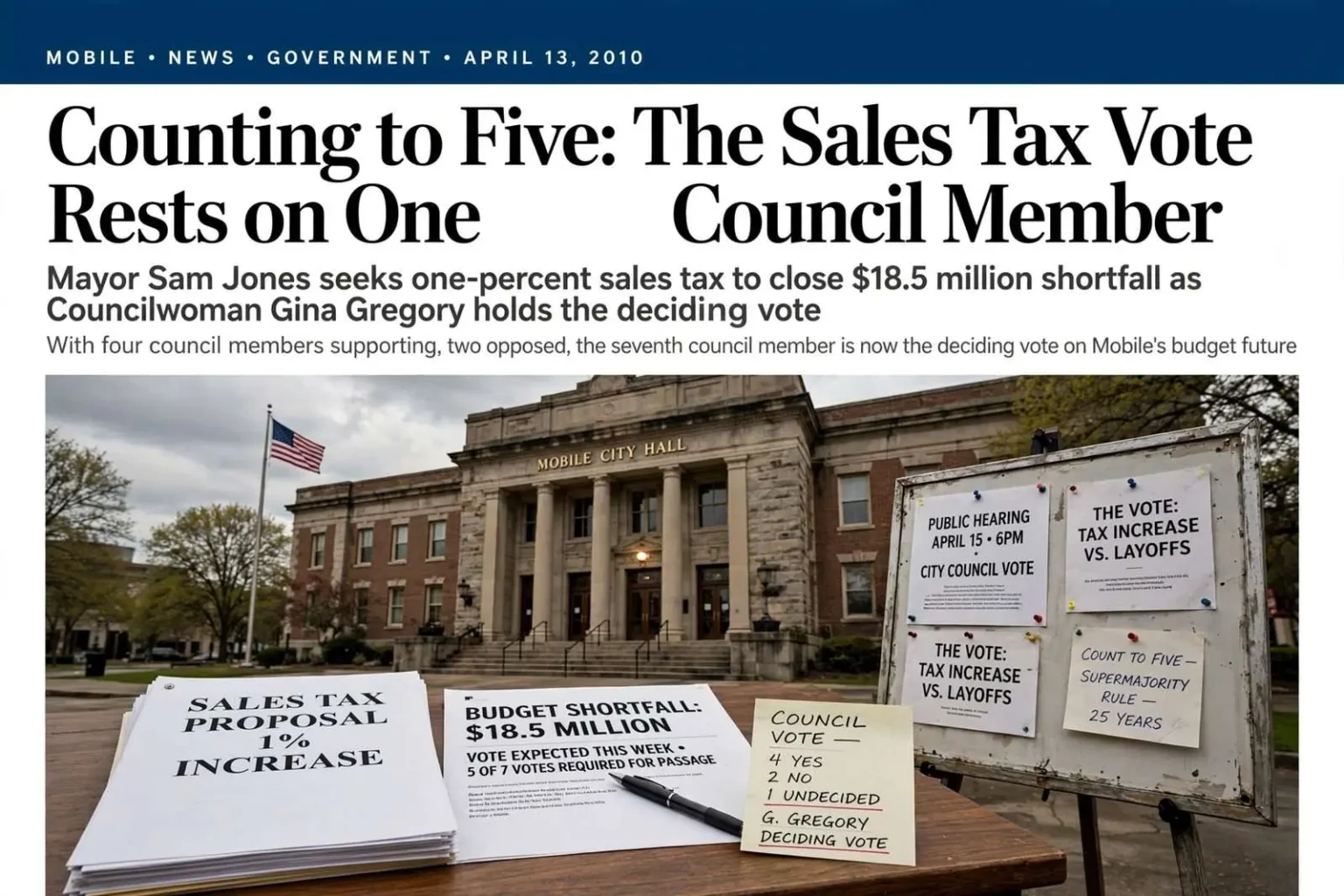
Mayor Sam Jones has presented his case to the Mobile City Council for a one-percent sales tax increase to close the city’s $18.5 million shortfall. Now the council must decide whether he made it well enough.
The proposal was laid over Tuesday, buying City Hall a few days to prepare the public for a heavier burden. A vote is expected later this week as officials try to contain what has become a volatile issue.
The stakes are the shape of Mobile’s government for the next several years: whether the city closes a recession-driven budget hole on the revenue side, on the payroll side, or on the backs of both at once. One penny on the sales tax, a workforce cut to the bone, or some combination — that is the entire menu, and the council knows it.
Where the seven stand
Passage requires five votes — a super-majority written into Mobile’s form of government when it was created 25 years ago. Here is the arithmetic as it appears today.
Mayor Sam Jones: Flexible on method, immovable on outcome. Having leapt from a 10-percent employee pay cut to a substantial tax increase, Jones is nonetheless emphatic in refusing to consider laying off even one of the city’s roughly 2,500 workers. Five votes or bust.
Councilman Fred Richardson: Reliably in the mayor’s column. Yes — vote one.
Councilman William Carroll: As the council member most immersed in the finance discussions, Carroll had advocated a temporary garbage collection fee as a bridge to better economic days. The numbers and the politics both came up short. He is a yes — vote two.
Councilman Jermaine Burrell: Absent from the council’s pre-meeting conference Tuesday, but reportedly back in town and available later in the day. Counted as yes — vote three.
Councilman John Williams: Early in his second term and not yet inclined to abandon a live-within-your-means philosophy. No — vote one against.
Council President Reggie Copeland: At 80, with a long background in athletics, Copeland retains a team-first outlook. Politicians do not like tax increases, but he appears prepared to take one for the team. Yes — vote four.
Councilwoman Connie Hudson: Committed to a conservative fiscal game plan and unmoved by appeals to solidarity. Her District 6 constituents appear to like it that way. No — vote two against.
Councilwoman Gina Gregory: Four to two. Time out. The whole question now rests here.
Gregory’s district holds the same fiscal anxieties as the rest of the city, and her vote carries the additional weight of being the deciding one. A council member with a safe vote can posture; the seventh vote has to choose. However she lands, the margin will be one — and the losing side will know exactly whom to hold responsible.
The pitch to the public
For the next day or two, the administration and its allies will preach the gospel of no choice: that a sales tax increase, rolled back as the economy improves and possibly expiring altogether, is the city’s only viable path.
The talking points are set. A penny on the dollar would generate roughly $7 million for the remainder of this fiscal year and $28 million in fiscal 2011. A sunset clause would cut the increase in half after Oct. 1, 2012. Mobile’s rate would then match Birmingham, Montgomery, Prichard, Bayou La Batre, Gulf Shores and Orange Beach. And city departments, the administration notes, have already cut $21 million since the fiscal year began.
Each point is designed to answer a specific objection. The rollback promise answers the complaint that temporary taxes never are. The comparison list answers the argument that Mobile would be taxing itself into uncompetitiveness — the administration’s point being that the city would merely join its peers rather than exceed them. And the $21 million in cuts answers the charge that the tax substitutes for discipline rather than following it.
Opponents have answers of their own. A sales tax is the most regressive instrument a city can pull — it takes a larger share of a working family’s income than a wealthy one’s, and Mobile County shoppers already pay the state’s four percent plus county levies. Adding a city penny in the middle of the worst economy in a generation, they argue, compounds a private-sector downturn with a public-sector one: every dollar collected at the register is a dollar not spent in a local store.
The garbage fee debate, for all that it failed, lingers in the background. Carroll’s proposal — a modest monthly charge for a service the city already provides — was rejected because the arithmetic did not close the gap and the politics were no better than the tax’s. But its ghost shapes the debate: if a fee was too small to matter and a tax is too large to stomach, the council has narrowed its own options to layoffs versus revenue, with nothing in between.
The question underneath
Whether a yes vote is the hard choice in a tough situation or the easy way out depends entirely on how one frames the underlying question: do you manage expenditures to meet revenues, or manage revenues to meet expenditures?
The administration’s answer is that revenues collapsed through no decision of the city’s own — sales tax receipts, property values and business activity all fell together — and that a city cannot shrink to meet a recession without hollowing out the services residents pay for. The opposition’s answer is that every government believes its own spending is indispensable, and that a council unwilling to cut has not truly looked at what cutting means.
A no vote sets a course toward significant layoffs in a workforce of 2,500 — an outcome the mayor has declared intolerable in terms fierce enough to make one curious, and a little wary, about how he would react if it came to pass.
The arithmetic of layoffs is unforgiving in its own way. Fire and police make up the core of any municipal workforce, and their payrolls are the last line anyone wants to cross; the positions that remain — planners, inspectors, maintenance crews, the administrative staff that keeps the city’s paperwork moving — cannot fill an $18.5 million hole without deep cuts to services that Mobile residents use daily. A layoff-driven budget is not a neutral alternative to a tax; it is a different budget for a different, smaller city.
The timing is not without its ironies. Wednesday, April 14, is the mayor’s birthday. Thursday is April 15 — a date the taxpaying public has never needed reminding of.
A mayor signing a tax increase into law on his birthday, one day before Tax Day, is the kind of coincidence columnists are grateful for. But the council’s vote, expected within the week, will not hinge on the calendar. It will hinge on Gregory — and on whether four of her colleagues have truly counted to five.
Twenty-five years of counting to five
The five-vote requirement itself is a piece of Mobile’s political history. The mayor-council form of government now in use was adopted a quarter-century ago, and its drafters wrote the super-majority provision into it deliberately — a check designed to stop a slim council majority from enacting sweeping fiscal policy on a bare 4-3 vote. Tax increases, annexations and land-use decisions of major consequence all clear the higher bar, which means every ambitious mayor must maintain a coalition, not merely a plurality.
The provision has aged into the defining fact of Mobile budgeting. Mayors who could count to five governed; mayors who could not negotiated. Jones’s predicament this week — four announced allies, two announced opponents, one council member holding the deciding card — is the arithmetic the charter’s authors intended, and it forces the administration to build genuine consensus before the tax becomes law rather than after.
It also means the public lobbying has a specific target. The administration’s case will be made, in the end, less to the city at large than to one councilwoman and her constituents, whose concerns — fiscal conservatism, the credibility of the sunset promise, the credibility of the $21 million in claimed cuts — will decide whether the count reaches five.
What the recession has already done
The context for the vote is a budget year in which the shortfall appeared faster than any spending plan could absorb it. Sales tax receipts, the city’s most volatile revenue stream, fell with consumer spending; business licenses and other activity-based revenues followed. The $18.5 million gap is not a projection error — it is the recession arriving in a municipal ledger.
The administration’s response so far has leaned on attrition, hiring freezes and program trims, accumulating the $21 million in reductions it now cites. What remains on the table, the mayor argues, is the workforce itself — and he has drawn the line there, refusing to trade employees for budget balance. His leap from endorsing a 10-percent employee pay cut to championing a tax increase is the strategy in miniature: shared pain first, layoffs never, and revenue as the last resort that is now, in his telling, the only one left.
Whether the council accepts that telling is what the vote this week will record. The city will either add a penny at the register — temporary, sunsetted, matched to its neighbors’ rates — or it will learn precisely what an $18.5 million reduction looks like in a workforce of 2,500. Both outcomes are honest answers to the recession. The council’s job, starting with its seventh vote, is to choose between them.