

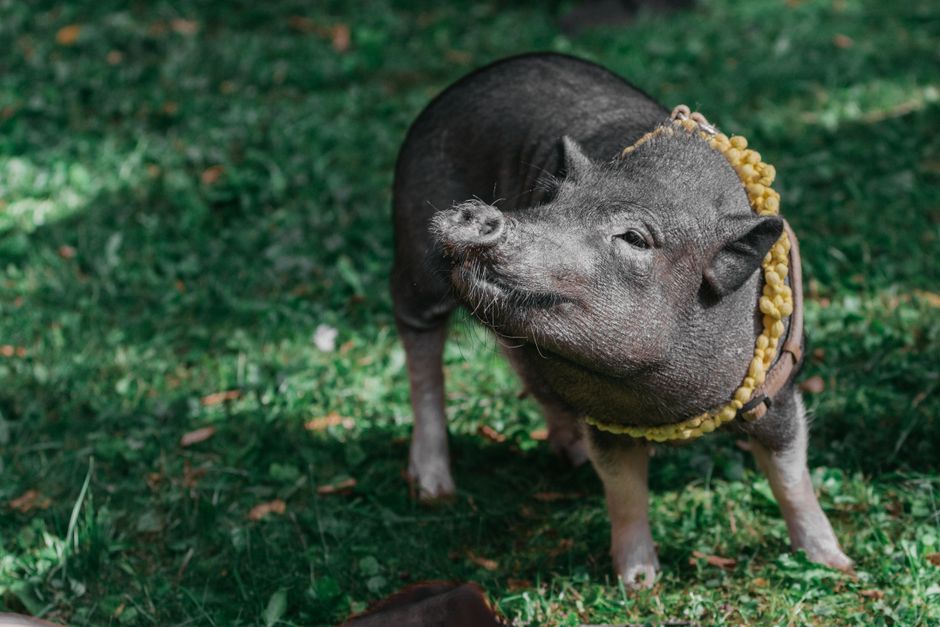
A Chickasaw family is fighting to keep their pet potbellied pig after the city issued a second citation accusing the household of violating an ordinance against keeping livestock inside city limits.
The pig, named Henry, has lived with his owner for roughly two years. According to the woman, who works in patient accounts at a Mobile medical practice, Henry was neutered by a local veterinarian early on to correct some undesirable behavior. Afterward, she said, his temperament changed completely.
“He has every characteristic of a dog,” she said.
Henry shares the rented home with his owner, her fiance, her two daughters, her 93-year-old grandmother, two dogs, a cat and a bird. For a while he relieved himself in a baby pool kept on the front porch, and he was generally too timid to venture down the porch steps on his own. The arrangement worked until a neighbor complained, prompting the city to issue a citation.
The pig’s owner said the Chickasaw police chief was understanding at first, warning her she could keep Henry as long as there were no further complaints, but that another one would mean a trip to court. That trip is now set.
After returning home from taking one of her daughters to have her wisdom teeth removed, the woman said she found a second citation waiting for her, this one for “keeping a potbellied pig in violation of a city ordinance after a warning.” She is scheduled to appear in Chickasaw municipal court in late August.
He Is Not Livestock, She Says
City code in Chickasaw prohibits residents from keeping hogs and livestock, but the pig’s owner argues Henry doesn’t fit that description.
“He is not livestock. He is a pet,” she said, describing him as crate-trained, food-motivated and quick to learn commands like sitting on cue.
Moving is not a simple option. The family has rented the same home for more than two years, and her daughters attend Chickasaw schools.
“The kids are happy there, and I’m happy there,” she said. “There are so many other things in Chickasaw you could worry about besides a potbellied pig.”
The dispute has turned a quiet neighborhood disagreement into a test of how the small north Mobile County city handles animal ordinances written for a different era. Chickasaw incorporated as a city in 2008, breaking away from Mobile after more than half a century as a company town built around the Gulf Shipyard Corporation, and many of its codes were carried over from earlier decades when the community’s character was more rural.
A Growing Question in Small Cities
Potbellied pigs have become increasingly common household pets across the United States since the 1980s, when the breed was first marketed to American buyers as a compact alternative to farm hogs. Owners’ groups describe them as intelligent, clean animals that can be litter-box trained, walked on a harness, and taught tricks — characteristics Henry’s owner says he displays daily. Veterinary care for the breed is available in the Mobile area, and Henry was neutered by a local practice shortly after he joined the family, a step owners take both for health reasons and to curb behaviors like rooting and aggression.
But municipal codes across Alabama were largely written with traditional farm animals in mind, and many cities group all pigs — potbellied or otherwise — under prohibitions on hogs and livestock. The result is a category of pet that is legal in some municipalities and banned in others, sometimes a few blocks apart across city limit lines.
In Chickasaw, the ordinance at the center of the case prohibits keeping hogs and livestock within city limits, and the municipal court will now decide whether Henry falls under that definition. The citation language — “keeping a potbellied pig in violation of a city ordinance after a warning” — signals that the city considers the warning stage complete and the matter ripe for enforcement.
How the Case Reached Municipal Court
The path from complaint to court date in Chickasaw runs through the city’s police department, which enforces municipal ordinances in the community of roughly 6,000 residents just north of Mobile. The city contracts with its own police force, and the chief’s initial response — a warning rather than an immediate citation — reflected the discretionary approach small-city departments often take with quality-of-life complaints.
That discretion ended with the second complaint. Under the arrangement the chief described to the pig’s owner, any additional complaint would trigger enforcement, and when another citation was issued the family’s options narrowed to municipal court or compliance. Municipal court in Chickasaw handles ordinance violations and misdemeanors, and penalties in such cases are typically fines ordered by the judge rather than jail time.
The owner’s decision to contest the citation rather than rehome Henry sets up an unusual hearing. Defenses in pet-ordinance cases usually turn on the plain language of the code: whether “hogs” or “livestock” can fairly be read to include a neutered potbellied pig that lives indoors, or whether the term is limited to animals raised for food or agricultural use. Courts and city councils around the country have split on that question, and outcomes often depend on whether the ordinance defines its terms or leaves the classification to a judge’s common-sense reading.
What the Family Stands to Lose
For the household, the stakes are practical as much as legal. Henry has been part of a multigenerational family that includes a 93-year-old grandmother and two school-age daughters, alongside two dogs, a cat and a bird. The family rents its home, which limits the alternative of simply relocating outside city limits — a move that would mean leaving the Chickasaw school system, where the daughters are enrolled and settled.
Chickasaw’s school system, one of the few independent city school districts in Mobile County, has been a point of civic pride since the city’s incorporation, and the owner said the girls are happy in their schools. Uprooting the family to accommodate a pig is, she indicated, the wrong trade.
Her argument to the court is straightforward: Henry is a household pet in the same sense as the family’s dogs, kept clean, contained and cared for, and the livestock ordinance was never meant to reach him. She has described his routines — the baby pool on the porch, the crate, the tricks — as the habits of a companion animal, not a farm animal.
The city’s position, reflected in the citation, is that the ordinance draws a bright line and that the warning period has passed. Municipal prosecutors generally argue that enforcing such codes uniformly is the only fair approach, since exceptions for one household would invite disputes over every other animal on the edge of the code’s definition.
A Familiar Fight Elsewhere
Chickasaw is hardly the first community to confront the potbellied pig question. Cities across the country have faced organized campaigns from owners seeking to legalize the breed, and some have responded by amending their codes to permit miniature pigs with weight limits, registration requirements or permit fees. Others have held firm, leaving owners to choose between moving or rehoming their pets.
Alabama municipalities have seen their own versions of the dispute, and the outcomes have varied with each city’s code language. Where ordinances name potbellied pigs explicitly, owners can register and comply; where the code simply bans hogs, courts have had little room to distinguish a family pet from an agricultural animal.
That gap between an old ordinance and a modern pet is exactly what the Chickasaw case will test in late August. Whether the municipal judge reads the code narrowly or broadly will determine whether Henry stays with the family or the household must look for a home outside the city limits — a decision that, for one Chickasaw family, will resolve a question that has upended two years of quiet life on their street.
Living With Henry
Day to day, Henry’s routines look less like farming and more like the schedule of any house pet. He eats on a regular schedule, sleeps indoors, and has learned commands that his owner demonstrates for visitors, including sitting on cue. His early behavioral issues disappeared after the neutering, she said, leaving an animal she describes as gentle with the children and respectful of the family’s dogs and cat.
The baby pool on the front porch served as his bathroom for much of his time with the family, a container solution that kept the yard clean and confined his mess to a washable basin. His timidity — he rarely ventured down the porch steps on his own — underscored, in his owner’s telling, how little he resembles the roaming hog the ordinance was written to keep out of neighborhoods.
Neighbors on the street have seen the dispute play out in citations rather than confrontation, and the single complaint that started the enforcement chain remains the only one on record. The second citation arrived without a fresh incident the family was aware of, coming home with the owner on the day her daughter had wisdom teeth removed — an ordinary errand followed by an envelope that set a court date for late August.
Between now and the hearing, the family’s plans are simple: keep Henry’s care unchanged, gather documentation of his veterinary history and training, and make the case to the municipal judge that a potbellied pig who lives in a crate on a porch is not the “hog” the ordinance describes. Whatever the ruling, the case is likely to prompt the city council to take a second look at animal codes drafted long before miniature pigs became porch pets in south Alabama.