University of South Alabama Chickasaw
Mobile Democrats Opened Their Season With Karaoke, a Food Drive and a Treasurer’s Race in Flux
County Democrats planned a kickoff reception with neighboring party chairs from three states, a retired union leader weighed a run for treasurer, and a Bishop State student announced for school board.
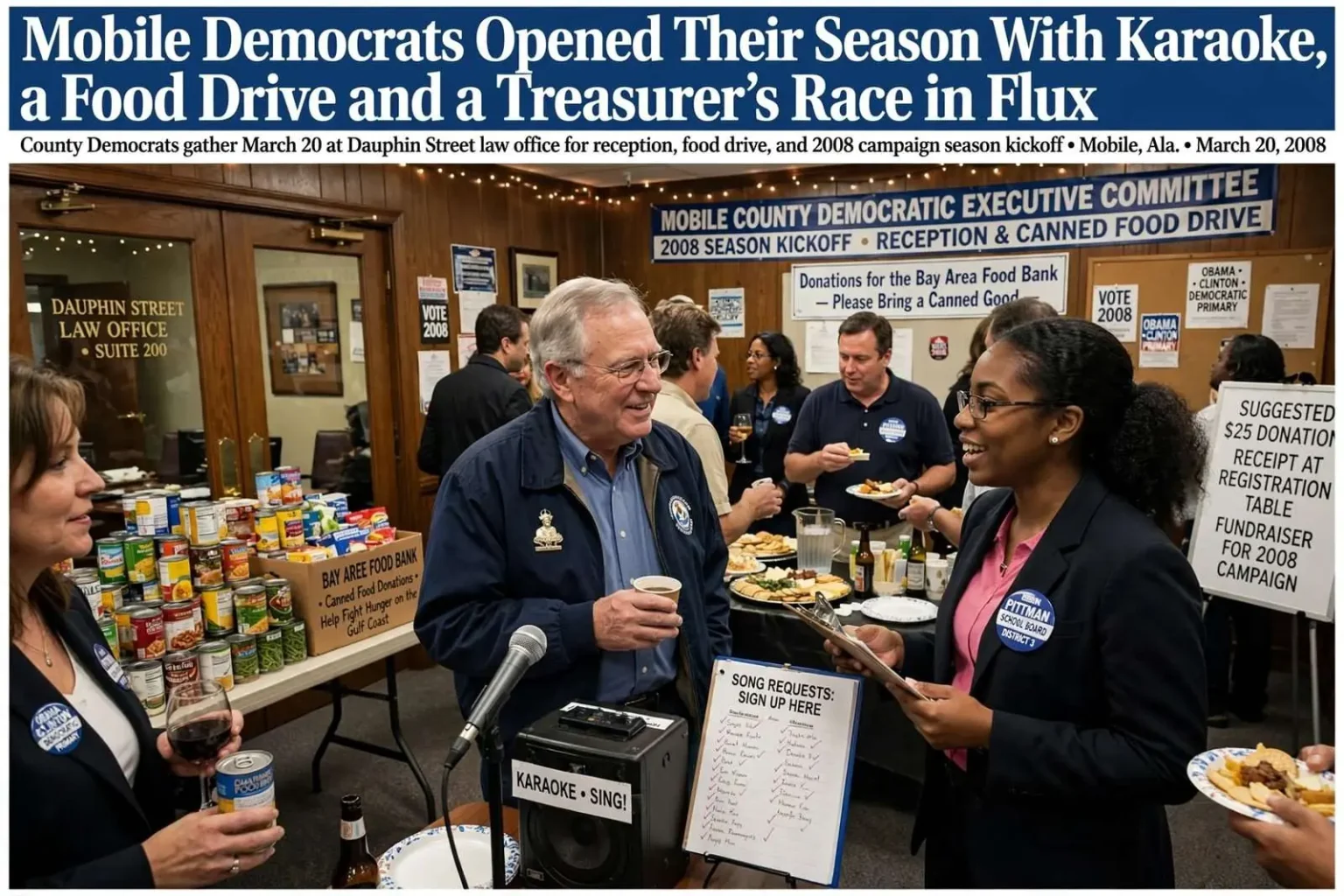
Mobile County Democrats prepared to open the 2008 election season in March with a reception, a canned food drive and, in a nod to the informality of the moment, karaoke. The mix of politics and party games reflected the mood of a party that spring: a presidential contest still unsettled in some respects, a county treasurer’s race already shaping up as one of the strangest on the local ballot, and a school board district in Prichard drawing one of the most crowded fields of the cycle. For the county’s Democratic executive committee, the reception was both a fundraiser and a show of force, a chance to gather the county’s elected officials, candidates and activists in one room before the campaign machinery began to turn in earnest.
The Mobile County Democratic Executive Committee scheduled its reception for Thursday, March 20, from 5:30 to 8:30 p.m. at a law office on Dauphin Street. A $25 donation was requested, covering hors d’oeuvres, food, beer, wine and music. Attendees were also asked to bring a canned good for the Bay Area Food Bank, the regional hunger-relief organization that collects and distributes food to pantries, shelters and soup kitchens across the central Gulf Coast. The request folded a small act of charity into an evening of political mingling, and it was in keeping with a party that had spent years emphasizing community service alongside campaign work.
The guest list was notable for its geography. County party chairs were invited from across the central Gulf Coast: Washington and Baldwin counties in Alabama, Hancock and Jackson counties in Mississippi, and Escambia, Santa Rosa and Okaloosa counties in Florida. The Mobile County chairman and the president of the Mobile Area Democratic Association rounded out the roster. Inviting party leaders from three states to a county party’s season kickoff was unusual on its face, but it tracked with the way politics actually works along the northern Gulf.
The Gulf Coast as one market
The regional guest list reflected a strategic view that the Gulf Coast functioned as a single political and media market — one in which Mobile television reached Pensacola, and Mississippi’s coastal counties shared the same hurricanes, the same seafood economy and the same insurance problems. A candidate running in Mobile was, in a practical sense, also broadcasting into Baldwin County and the Florida Panhandle, because the television signals, radio stations and newspapers that carried a campaign’s message did not stop at the state line. The reverse was equally true: a message tested in Pensacola or Pascagoula could be heard in Mobile living rooms the same night.
That shared market has consequences for anyone who wants to organize the Gulf Coast politically. Coastal residents on both sides of the Alabama-Mississippi line ride out the same storm seasons and argue with the same insurance carriers, and the fishing and seafood industries that anchor communities from Bayou La Batre to Ocean Springs rise and fall with the same regulators, the same fuel prices and the same foreign competition. Voters in Hancock County, Mississippi, and Baldwin County, Alabama, may sit in different statehouses, but they watch many of the same newscasts and often feel that the same issues are being decided without them. Democrats who understood that could build networks that crossed county and state lines; those who did not tended to be surprised when a message that played well in a county seat fell flat one market over.
The timing mattered as well. By late March 2008, the presidential primaries had settled into a long contest between Barack Obama and Hillary Clinton for the Democratic nomination, while John McCain had effectively wrapped up the Republican side. Whatever happened at the top of the ticket, Democrats in Mobile County had their own races to sort out, and the reception was designed to introduce candidates and volunteers to one another months before qualifying deadlines and summer campaigning arrived. An election season in Alabama runs long, and the party that shows up organized in March is usually the party that shows up organized in November.
A labor leader weighs the treasurer’s race
Veteran labor leader Don Langham, 66, said he was considering a Democratic campaign for Mobile County treasurer. He had been approached by party leaders and agreed to think it over, while noting he had only recently retired. The invitation was a sign of how party leaders viewed the race: as an office worth contesting seriously, with a candidate who could bring his own constituency and his own credibility to the ballot.
Langham had stepped down the previous July as international vice president of the steelworkers’ union, capping a career spent organizing and representing workers across the region. The union post had made him a familiar figure to working families throughout southwest Alabama, and labor’s institutional knowledge of county government — budgets, payrolls, contracts and the unglamorous machinery that keeps a county running — is exactly the background a finance office rewards.
His résumé extended well beyond the union hall. He had served on the state and national Democratic executive committees, sat on the board of trustees of the University of South Alabama, was vice president of the Mobile Housing Authority, and served on the boards of Volunteers of America, Leadership Mobile and Mobile United. That is a range of public service that spans higher education governance, public housing, human services and civic leadership training, and it gave Langham a network of acquaintances across nearly every sector of Mobile’s public life.
The treasurer’s office itself is the kind of post most voters pay little attention to until something goes wrong. The treasurer is the custodian and disbursing agent for county money, responsible for receiving, safeguarding and paying out the funds the county collects, and for keeping the kind of careful records that let auditors — and taxpayers — see exactly where public money sits. It is a job of Ledgers rather than headlines, and campaigns for it are usually quiet affairs decided by name recognition and party label. The 2008 race was shaping up to be anything but quiet.
His potential candidacy complicated an already unusual race. The Republican incumbent, Al Sessions, was seeking re-election. The chairman of the Mobile County Democratic Party had announced he would run on a pledge to abolish the office entirely. Langham, if he ran, would offer voters a third proposition: elect someone who actually wanted to do the job. A ballot that featured an incumbent defending the office, a challenger who wanted to eliminate it and a seasoned former labor executive promising to run it well would give county voters a genuine debate about what the treasurer’s office is for — whether it is a necessary check on county finances, a redundant layer of bureaucracy or a platform for something else entirely.
A student runs for school board
LaVeeshia Pittman, 28, a Prichard resident and a student at Bishop State Community College, announced her candidacy for the District 3 seat on the Mobile County school board. Pittman, a Sacramento native majoring in office management with a minor in education, said it was time for new ideas on the board. Bishop State, the two-year college anchored in downtown Mobile with deep roots in the city’s African-American community, has long been a launching point for students in the region, and Pittman was pursuing her degree while already stepping into public life.
“If you’re ready for a School Board member that will work for the children and not the politicians, a Board member who will be more fiscally responsible with taxpayers money,” she said, “then I am your candidate.”
Her priorities included equal funding for facilities in District 3, school security, and treating system employees with dignity. She served as secretary of the Democratic Coalition of the South and attended Mt. Carmel Baptist Church in Mobile. Each of those priorities pointed at a familiar tension in large school systems: the gap between the schools in a system’s growing suburbs and those in its older, poorer neighborhoods, the difficulty of keeping campuses safe without turning them into fortresses, and the morale of the teachers, aides, bus drivers and custodians on whom everything else depends.
District 3, which includes Prichard and surrounding communities, drew one of the most crowded fields of the cycle. The Mobile County Public School System is one of the largest school districts in Alabama, and its board decides policy for tens of thousands of students across the county. A seat representing Prichard and nearby communities carries the particular weight of a city that has watched schools, jobs and population shift over the decades, and the crowded field suggested that voters there were ready to hear competing visions for the district’s future.
Odds, appointments and a pie
The week’s county political news also carried its share of items that did not fit any category, which is one of the pleasures of covering county politics in an election year. Mobile oddsmaker Danny Sheridan pegged the Democrats as a 3-to-2 favorite to win the presidential election that November, and said he would post vice presidential odds for both parties once a delegate dispute in Texas played out. Sheridan, who has made a national career out of translating political and sporting events into betting lines, was doing in March what oddsmakers do: quantifying uncertainty. The Democratic delegate fight that spring, dragged out in caucuses and courtrooms, was the reason the vice presidential odds had to wait, and Sheridan’s 3-to-2 line was his way of saying the general election was a genuine contest rather than a coronation.
Mobile-area attorney Adam Bourne, already a member of the Chickasaw Industrial Development Board, was appointed by the Chickasaw City Council to the city’s Commercial Development Board. Appointments like this rarely make headlines, but they are how industrial recruitment actually works in the small municipalities that ring Mobile. Chickasaw, like many of the county’s smaller cities, depends on its development boards to court employers, assemble property and manage the incentive deals that determine whether a vacant site becomes a plant or stays vacant. Service on such boards is a proving ground, and cross-appointment of a member from one board to another is a common way of keeping institutional memory in place.
And in the category of civic duty that no one anticipates: Al Stokes, chief of staff to Mayor Sam Jones, agreed to stand still while members of the public threw pies at him. For $25, anyone could take a shot, with proceeds benefiting the American Heart Association. The event was set for Friday, March 14, in the atrium at Government Plaza — rescheduled from the previous week because of a tanker contract press conference, which was, that spring, the only thing in Mobile that outranked a chief of staff with a pie in his face.
The pie-throwing fundraiser belonged to a long tradition of Southern civic fundraising, in which respected public officials agree to be publicly humiliated for a good cause and everyone pretends not to enjoy it too much. The $25 price of a throw was a modest barrier, the American Heart Association was a beneficiary with broad appeal, and the Government Plaza atrium offered both space and foot traffic. Stokes’s willingness to serve as the target said as much about his standing as anything: a chief of staff who cannot take a pie in the face for charity will not last long in a city hall where the chief of staff is the person everyone blames.
The tanker contract press conference that bumped the event, meanwhile, was itself a marker of what mattered in Mobile that spring. The competition for a major aerial refueling tanker contract was the largest economic story in the region, with billions of dollars and thousands of jobs attached to the outcome, and any press conference connected to it could displace a charity pie fight without apology. Priorities at City Hall were clear.
Taken together, the reception, the treasurer’s musings, the school board race and the assorted appointments and oddsmaking sketched a Democratic Party in Mobile County that was doing what parties do in March of an election year: raising money, recruiting candidates, making appointments and keeping its network humming. The karaoke would come later in the evening, after the checks were written and the canned goods were stacked. The campaign itself would take considerably longer.