New Weekly Container Service Links Port of Mobile to Northern Europe
A new weekly container service will connect the Port of Mobile directly to ports across Northern Europe starting in May, as five international ocean carriers begin calling on APM Terminals Mobile for the first time.
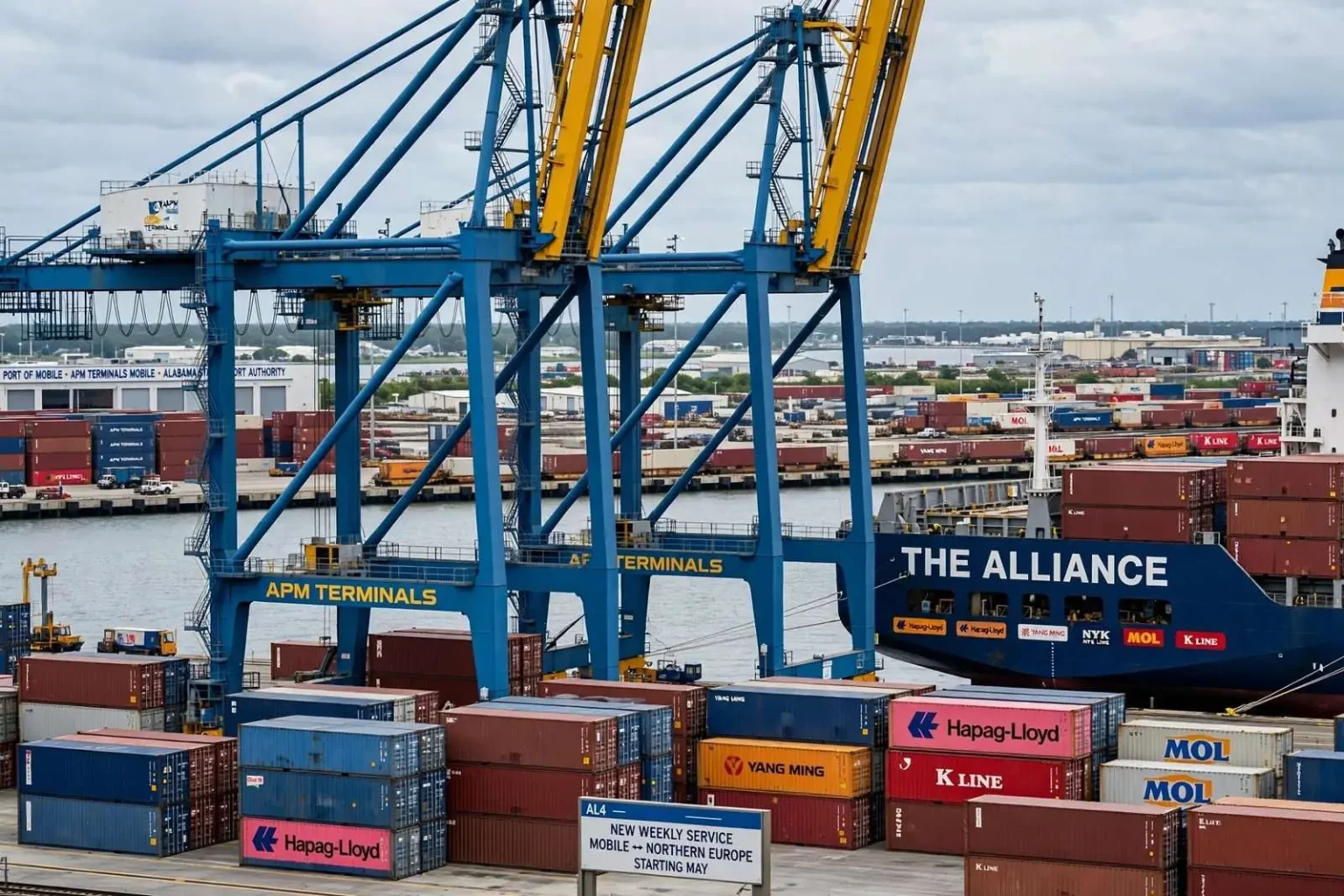
A new weekly container shipping service connecting the Port of Mobile directly to major ports in Northern Europe is set to begin operating in May, giving Alabama shippers another route to move goods across the Atlantic. The Alabama State Port Authority and APM Terminals Mobile jointly announced the launch of the service, known as AL4, which will be operated through a vessel-sharing agreement among five international ocean carriers: Germany’s Hapag-Lloyd, Taiwan’s Yang Ming, and Japan’s NYK Line, Mitsui O.S.K. Lines and “K” Line.
The group of carriers operates jointly under the name THE Alliance. Under the new rotation, vessels will call at Mobile before sailing to Southampton, England; Antwerp, Belgium; and Bremerhaven, Germany, then on to Le Havre, France, before crossing to Veracruz and Altamira in Mexico and Houston and New Orleans, returning to Mobile to complete the loop.
The addition of the transatlantic route means Mobile is now served by all three of the world’s largest global container shipping alliances, port officials said. For each of the five carriers involved, the AL4 rotation will mark the first weekly container vessel service calling at the Port of Mobile, a milestone port leaders say reflects growing recognition of the terminal’s capacity and location along the Gulf Coast.
“We are extremely excited to welcome THE Alliance and its carriers to APM Terminals Mobile,” said Brian Harold, managing director of APM Terminals Mobile. “The trade lane between North Europe and the U.S. Gulf has been a good market for us, particularly over the past few years. It’s great to see THE Alliance take notice of that, and we’re looking forward to working with them as they grow in Mobile.”
A terminal built for growth
APM Terminals Mobile opened in 2008 and handled a record 277,307 twenty-foot equivalent units, or TEUs, of cargo in 2016, a figure that underscores the steady growth in container traffic moving through the port in recent years. The Alabama State Port Authority and APM Terminals have continued to invest heavily in the container terminal since it opened.
Last year, APM Terminals announced a $47.5 million Phase 2 expansion project designed to increase the terminal’s annual throughput capacity to 500,000 TEUs. The terminal’s berths currently have a depth of 45 feet and are served by two ship-to-shore cranes capable of reaching 18 rows across a vessel. As part of the Phase 2 expansion, crews are adding two new super-post-Panamax cranes with a 22-row reach and expanding the container yard by 20 acres, with that work expected to be completed by June. The larger cranes will allow the terminal to handle some of the biggest container vessels in operation worldwide.
The port’s newly deepened lower harbor turning basin can accommodate vessels up to 1,300 feet long calling at the container terminal, giving Mobile the capacity to handle larger ships as global carriers continue to add bigger vessels to their fleets. That matters to a service like AL4, where the member carriers’ ships are growing with each round of newbuild deliveries, and where a port that cannot take the larger classes of vessels risks being dropped from rotations entirely.
The timing of the terminal upgrades and the alliance’s arrival is no coincidence. Ocean carriers consolidate services around ports that can handle their largest ships efficiently, and the investments in cranes, yard space and channel depth are what allow Mobile to compete for weekly calls against larger Gulf gateways. For shippers, the practical effect of the expansion is more sailings, more direct services and less reliance on trucking containers to distant ports for transshipment.
Rail connections broaden the reach
The Port Authority and APM Terminals have also collectively invested more than $55 million in a new Intermodal Container Transfer Facility, which opened in June 2016. That facility connects the port to Canadian National/Illinois Central rail lines, providing direct rail service to Memphis, Indianapolis, Detroit, Decatur and Chicago, as well as destinations in Canada.
The intermodal facility changes the math for shippers across the interior Southeast and Midwest. A container arriving at Mobile can move by rail directly to distribution hubs in the heart of the country, putting inland customers within a single rail haul of a Gulf Coast berth. For European importers routing goods to the American interior, and for Alabama exporters — from paper and forest products to auto parts and agricultural goods — the combination of a weekly Europe service and direct rail access makes Mobile a workable alternative to congested East and West Coast gateways.
James K. Lyons, chief executive officer of the Alabama State Port Authority, said the new service strengthens Mobile’s position as a shipping gateway for the region. “We’re extremely pleased to have THE Alliance call our port, and we appreciate their confidence in Mobile as an alternate gateway,” Lyons said. “The service will provide more options and fast transit times into Europe, which will greatly benefit both our current and future shippers.”
Local officials also point to the competitive dynamics behind the announcement. Shippers choose gateways on total landed cost — ocean freight plus inland transport plus time — and Mobile’s pitch is that a vessel calling directly on the Gulf, tied to the CN/IC rail lines north, beats the combined cost of an East Coast call followed by a thousand-mile inland move. The more frequently that schedule repeats, the more cargo the port captures, and the more the terminal’s fixed investments pay for themselves. That loop, port leaders say, is what the alliance’s arrival sets in motion.
Why the Europe lane matters here
The North Europe trade is one of the container shipping industry’s most established lanes, carrying everything from machinery and chemicals to foodstuffs, retail goods and industrial components. Before services like AL4, Gulf Coast shippers moving cargo to or from Europe often relied on transshipment through other hubs or overland drayage, adding cost and days to each move. A direct, weekly call at Mobile shortens that chain for Alabama businesses and gives European carriers a growing Gulf gateway at which to consolidate cargo.
Mobile’s port has spent the past decade positioning itself for exactly this kind of service. The container terminal on Pinto Island, the deepened turning basin, the new cranes and the rail-connected intermodal yard together form an integrated package that few mid-sized Gulf ports can match. Port officials note that each new weekly service also creates demand for trucking, warehousing, customs brokerage and stevedoring jobs in the region, multiplying the economic effect of the vessel calls themselves.
The alliance structure also reduces risk for the carriers themselves. Vessel-sharing agreements allow lines to pool space on ships, spreading the cost of a fixed weekly rotation across five companies rather than requiring each to fill a vessel alone. That is how mid-sized ports like Mobile now earn direct weekly calls that a single carrier’s cargo volume could not sustain, and it is why the service’s stability depends less on any one shipper than on the health of the entire Gulf-Europe trade.
What shippers can expect
Under the rotation, cargo bound for England, Belgium, Germany or France can move from Mobile on a fixed weekly sailing, with the loop’s Gulf and Mexico calls — Veracruz, Altamira, Houston and New Orleans — collecting and delivering cargo between European and North American ports on the same voyage. Fixed-day weekly service is the standard importers and exporters plan their supply chains around, allowing manufacturers to time production runs and retailers to schedule replenishment.
Port officials say the combination of deeper berths, expanded crane capacity and direct rail connections positions the Port of Mobile to continue attracting new shipping partners as international carriers look for efficient alternatives to more congested East and West Coast ports. With the Phase 2 work due for completion in June and the AL4 service starting in May, the terminal’s trajectory — from a 2008 opening through record container volumes — continues upward, and Mobile’s place on the map of global container alliances is now complete.
A hub for Alabama industry
For Alabama manufacturers, the service lands at a moment of rising export volume. The state’s automotive plants and their supplier networks ship components and finished vehicles through Gulf gateways, and the state’s forest products industry — pulp, paper and lumber — has long depended on Mobile’s berths for overseas sales. A weekly, scheduled Europe call gives those shippers a predictable window for loading, and gives European suppliers feeding Alabama industry a reliable import channel that terminates hours from the state’s industrial corridors rather than days away at a coastal transshipment point.
Warehousing and distribution activity around the port has grown alongside the terminal itself, with distribution centers locating in Mobile and along the I-10 corridor to take advantage of the port’s reach. Each new service adds to that pull, and the alliance’s commitment suggests confidence that the demand will keep pace with the terminal’s expanded capacity as the 500,000-TEU build-out comes online.