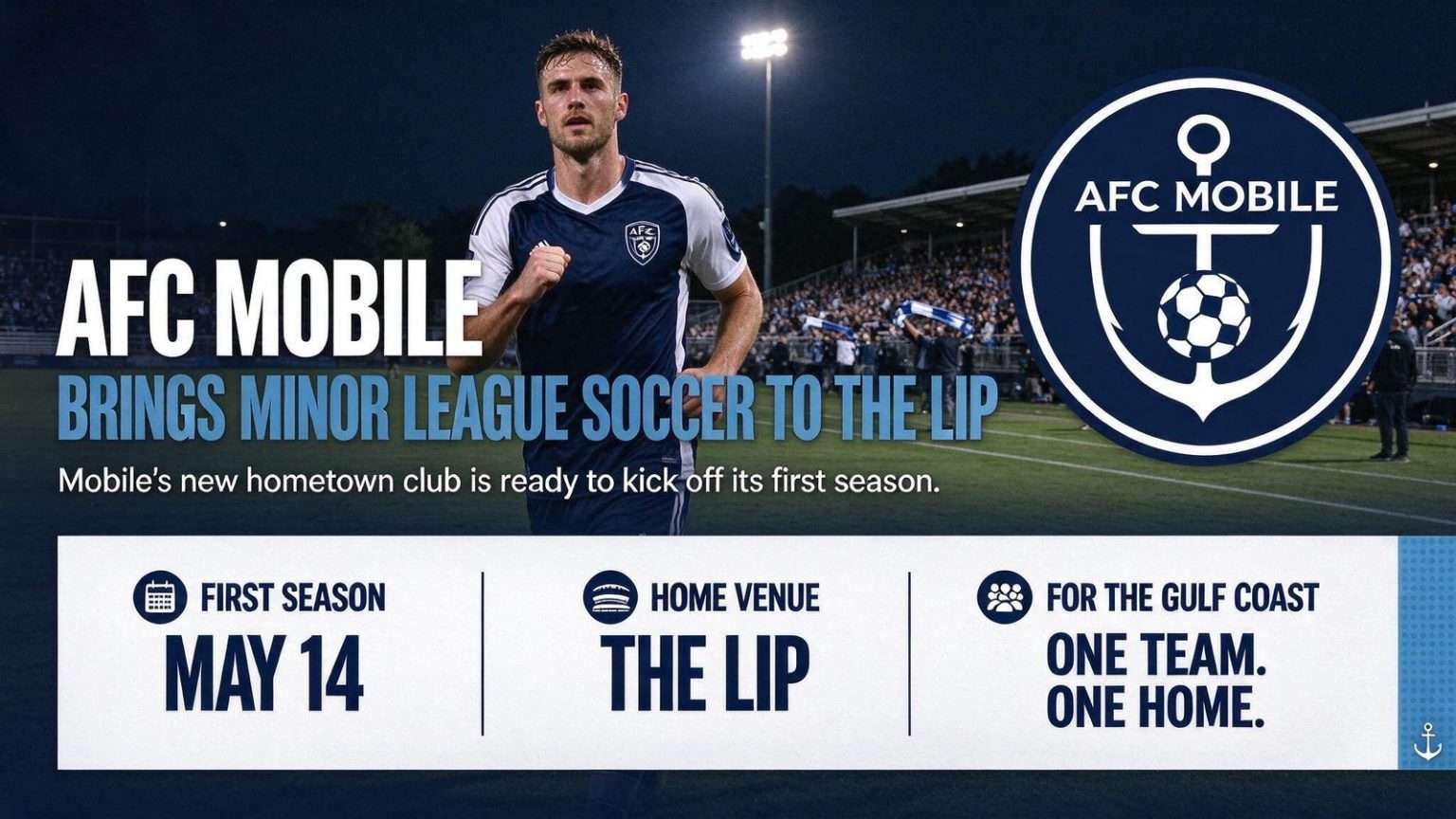
Mobile has a new hometown soccer club. AFC Mobile, a grassroots minor league side, will kick off its first season May 14 against the Gulf Coast Texans, and the organization says it wants to give the Gulf Coast’s soccer community a team to rally behind — a hometown badge in a sport whose local fans have long followed clubs from other cities.
The club grew out of a casual comment. President Abram Chamberlain, who played youth soccer in Massachusetts and in a club side at Tuskegee University, said he joked after a trip to watch a match in Pensacola that Mobile could do the same. “We took that idea and said, let’s see what happens. It kept growing from there,” he said.
That offhand remark became an organization. AFC Mobile started by backing a youth team in the city league and supporting the Mobile chapter of the American Outlaws, one of Alabama’s oldest U.S. national team fan clubs — a base of committed soccer people who had been gathering in bars and living rooms to watch matches played thousands of miles away. The natural question, organizers say, was why all that passion shouldn’t have a team of its own to cheer for on a Saturday night.
In January, the Gulf Coast Premier League expanded to Mobile, Pensacola and Baton Rouge, and momentum built quickly. The Birmingham Hammers and clubs in New Orleans and Biloxi offered guidance — veterans of the same journey from idea to kickoff, sharing lessons on everything from league paperwork to finding a home ground.
A Coach With a Winning Pedigree
The team landed Nate Nicholas as coach. The McGill-Toolen coach previously led UMS-Wright to two state titles, giving the expansion side a leader who knows the local soccer landscape from every angle — the club ranks, the high school sidelines and the players moving between them.
Nicholas’s hiring signals the club’s seriousness. Expansion teams in minor league soccer often struggle for identity in their first season; a coach with championships on his resume and deep relationships with Mobile-area players and families gives AFC Mobile instant credibility in tryouts, recruiting and the stands.
Home matches will be played at the Archbishop Lipscomb Athletic Complex — “The Lip” — on Michael Boulevard, a choice Chamberlain called the best facility for the group’s needs. The complex gives the club a proper pitch, seating and parking inside the city, close enough to Mobile’s core for fans to build a genuine home-match tradition.
Who Plays, and Why They Play Free
Players must be at least 18 and finished with high school eligibility; many are home from college for the summer. The roster model is common across lower-division American soccer: college players returning to their hometowns for the summer, local players past or between college stints, and talented young adults who never left — all getting competitive minutes in a structured league.
There is no pay, since most retain NCAA eligibility, but the exposure is the draw. Summer leagues like this one serve as a proving ground: a strong season in front of local coaches and scouts can translate into a college roster spot, a bigger role back at school, or simply the chance to keep playing organized, competitive soccer at a high level without leaving home.
For the soccer community, the roster rules also mean every match features players with local roots — names recognizable from high school sidelines, club seasons and college programs across the region. That connection between the team and its hometown is precisely what the founders set out to create.
Getting In the Gate
Admission is $5 for those 13 and older, with season tickets at $20 — pricing deliberately set so a family can make an evening of it without a second thought. At that price, the club is betting on volume and atmosphere rather than gate revenue: fill the bleachers, build the noise, and let the matchday culture grow.
The schedule opens with Pensacola on the road, then brings the home crowd a run of dates against Biloxi City FC, Louisiana Fire SC, Gaffa FC and CD Motagua of New Orleans. The mix of opponents traces the Gulf Coast Premier League’s footprint — from the Alabama line through south Louisiana — and gives Mobile fans visiting clubs with their own following to test the new rivalry energy.
Haint Blue Brewing is the lead sponsor, a Mobile business whose support ties the club to the city’s growing local-economy identity. Craft breweries and minor league soccer have proven a natural pairing across the country, and the partnership gives the club both operating support and a gathering place for fans before and after matches.
Soccer’s Moment on the Gulf Coast
AFC Mobile arrives as the sport’s American following swells. The U.S. national team’s matches draw packed watch parties, Premier League broadcasts fill Gulf Coast sports bars on weekend mornings, and youth soccer participation across Mobile and Baldwin counties has made soccer parents and players a sizable constituency. What the region lacked — until now — was a local club to channel that support.
The Gulf Coast Premier League’s January expansion into Mobile, Pensacola and Baton Rouge answered that need at the regional level, joining the dots between existing clubs in Birmingham, New Orleans and Biloxi. For players, it creates a summer pathway that keeps local talent on the pitch; for fans, it turns scattered match-watching into a season with standings, home dates and away trips.
The club’s leaders emphasize the grassroots DNA at every turn. AFC Mobile did not arrive with an investor group or a stadium plan; it grew out of fans who supported a city-league youth team, kept the American Outlaws chapter active and decided Mobile deserved its own side. That origin story is part of the pitch to the community — this is a club built by its supporters, in the classic minor league tradition.
The Home Opener and Beyond
The May 14 opener against the Gulf Coast Texans sets the stage, but the home schedule is where the club’s future will be decided. Matchday culture in lower-division American soccer lives or dies on the first few home dates: whether the chants start, whether the crowd returns, whether “The Lip” becomes a place teams dread visiting.
Organizers point to the pieces already in place — a $5 gate, a $20 season pass, a brewery sponsor, a championship-winning coach and a roster of local players with something to prove. The remaining ingredient is the one only Mobile’s soccer community can supply: showing up.
Chamberlain’s joke that started it all — that Mobile could support a club the way Pensacola does — gets its answer beginning May 14. If the stands fill and the season builds, the Gulf Coast Premier League’s newest outpost will have proven the point: the Gulf Coast’s soccer fans were always here. They were simply waiting for a team of their own.
Season tickets and matchday details are available through the club, with home matches at the Archbishop Lipscomb Athletic Complex on Michael Boulevard. Kickoff times for individual dates will be announced on the club’s schedule as the season approaches.
The path from joke to kickoff moved faster than anyone involved expected. Once the idea took hold, the founders worked backward from the basics every club needs: a league to join, a ground to play on, players to sign and money to keep the lights on. Each step, Chamberlain says, kept growing from the last — the youth team sponsorship led to the fan club involvement, the fan club network led to the league conversation, and the league’s January expansion turned possibility into a fixed schedule.
The guidance from established clubs proved essential. The Birmingham Hammers, navigating their own early seasons, and the organizations in New Orleans and Biloxi shared practical knowledge that no manual covers — how to schedule around summer travel, how to recruit a roster that respects college eligibility rules, how to price a gate that fills rather than empties the stands.
A League Built for the Region
The Gulf Coast Premier League occupies a familiar niche in American soccer’s pyramid: semi-professional and amateur competition that sits below the professional leagues but above recreational play, organized around regional travel that keeps costs sane. Teams from Louisiana, Mississippi, Alabama and the Florida Panhandle play summer schedules designed to coexist with college calendars.
That regional footprint matters for fans too. Away days at Biloxi or New Orleans are drivable trips, which is how lower-division soccer culture builds — caravans of supporters, away-section chants and rivalries that intensify each season. The league’s expansion into Mobile and Pensacola tightened the geographic cluster along the Gulf, making every road trip and every home date a neighborly affair.
For the players, the league’s summer window is the entire point. College rosters break for the summer; many players return home to jobs and family. AFC Mobile offers a structured, coached, competitive season in that window — better preparation than pickup games, closer than a club hours away, and free enough of cost barriers that any eligible player can try out.
Nicholas’s dual role adds an intriguing local angle. Coaching at McGill-Toolen while leading a club side draws from the same deep pool of Mobile-area talent, and his two state titles at UMS-Wright mean he has evaluated — and often coached — the very players who will wear AFC Mobile’s crest. Few expansion clubs anywhere get a coach so thoroughly networked into their home talent base.