Clotilda Documentary ‘Descendant’ Set to Stream on Netflix in October
The documentary 'Descendant,' exploring the legacy of the Clotilda and Africatown, is set to begin streaming on Netflix on October 21, 2022.
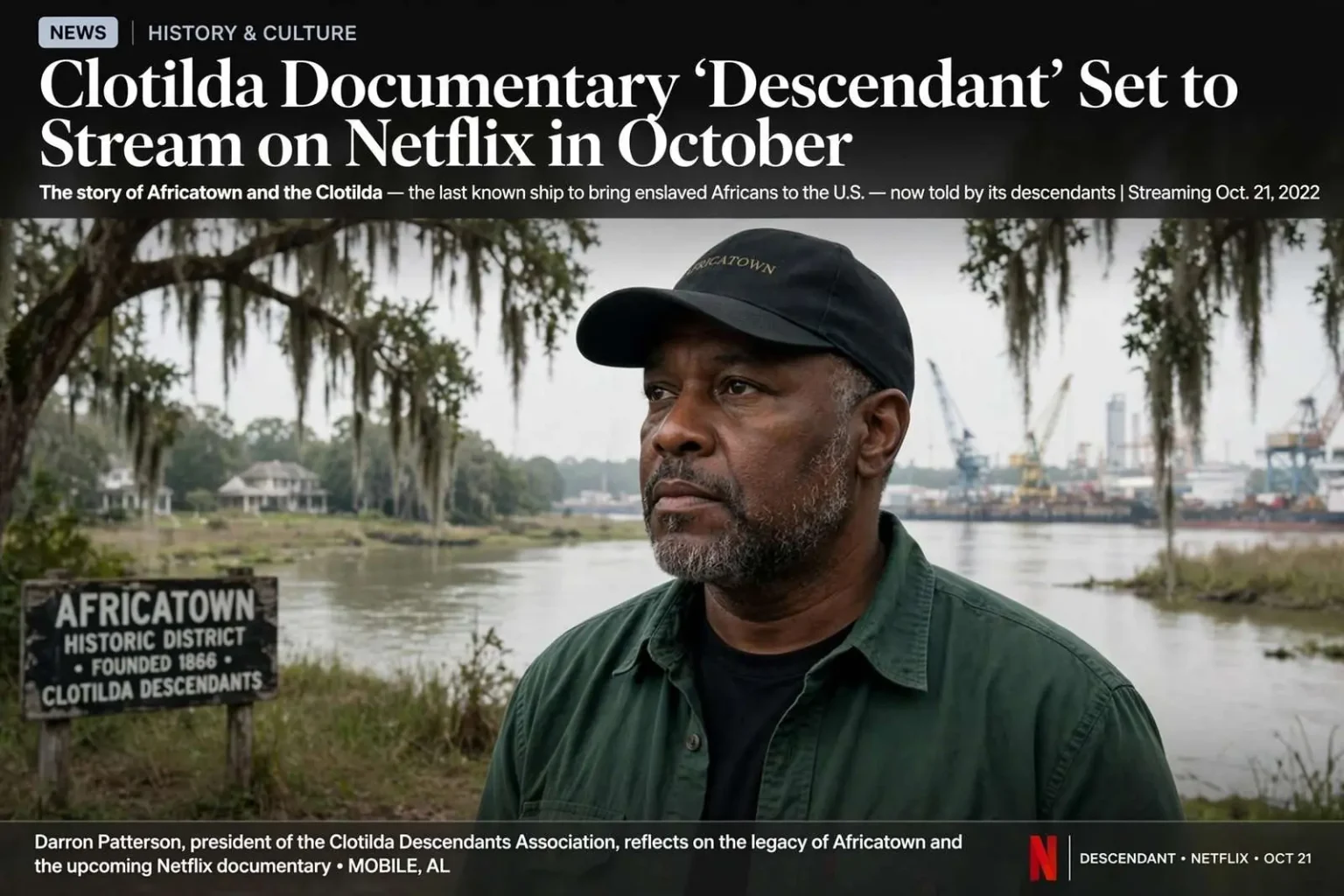
The story of Africatown and the Clotilda, the last known ship to bring enslaved Africans to the United States, is set to reach a global audience when the documentary “Descendant” begins streaming on Netflix on October 21, 2022. The film chronicles the lives and legacy of the descendants of the Clotilda’s captive passengers, who established the Africatown community north of downtown Mobile after emancipation.
Darron Patterson, president of the Clotilda Descendants Association, described the documentary as emotionally powerful and said he believes it has the ability to shake the nation.
A call for Mobile to confront its history
“You will be overwhelmed at a city’s efforts to wipe out an entire community,” Patterson said. “We have an opportunity, Mobile, to teach the world something from this movie depending on how we react to what we see on screen.”
Patterson expressed hope that the film would break barriers in a city that has lived with this story for centuries. “We want Mobile to be a city for all the people,” he said. “Not just the rich, not just the white, not just the black, not just the people who have come here to work for Austal or Airbus. They bring different cultures from all over the world. Mobile needs to recognize that and step up to the plate.”
His words connect the Clotilda’s history to Mobile’s present. The city’s modern economy draws workers from around the world — to the shipyards and aerospace plants Patterson named, among other industries — and he argues that a city welcoming new arrivals from everywhere should also face honestly the story of the people who were brought here against their will more than 160 years ago.
Connecting descendants worldwide
The Clotilda arrived near Mobile Bay in 1860, roughly 40 years after African slave trading became illegal in the United States. Its survivors founded Africatown, and the ship’s wreck was confirmed in the Mobile River in 2019, energizing preservation and heritage tourism efforts across the community.
That 2019 confirmation transformed the story from family tradition into documented history. For generations, Africatown residents passed down accounts of the ship and their ancestors’ voyage, even as outsiders sometimes treated the story as legend. The physical discovery of the wreck gave those oral histories the weight of proof, and it set off a wave of archaeological work, historic designation efforts, and planning around how the community’s story should be preserved and told.
The survivors’ achievement deserves emphasis. Unlike most enslaved people in America, the Clotilda’s captives spent only a brief period in bondage before emancipation arrived — meaning they carried living memories of their African homelands, names, and languages into freedom. Africatown thus became one of the few communities in the United States founded by Africans who remembered Africa, a distinction that has made it a subject of study for historians, linguists, and anthropologists for more than a century.
Patterson also hopes the Netflix release will teach history to locals and people around the world. “When this movie comes out, the phones are going to ring off the hook of people saying I think I’m a descendant of Captain Foster, I think I’m a descendant of Timothy Mayor, I think I’m a descendant of Cooper Lee,” Patterson said. “They’re out there, and it’s important for the young people to know where they came from.”
The names he recites are those of Clotilda survivors whose descendants remain scattered across the country. Patterson expects the film to function as a national roll call, prompting families who left Africatown decades ago — or who never knew their connection to it — to trace their roots back to the 110 captives who crossed the Atlantic aboard the ship.
The ship and the crime behind it
The Clotilda’s voyage was a crime from its beginning. The importation of enslaved Africans had been outlawed in the United States since 1808, and by 1860 the transatlantic trade was enforced by British and American naval patrols. The ship’s backers undertook the voyage as a wager, gambling that a fast schooner could slip through the blockade and deliver human cargo to the Alabama River basin, where labor demand from plantation interests remained intense.
After delivering its captives, those responsible burned and scuttled the ship in the waters north of Mobile Bay to destroy the evidence. For more than a century, the wreck’s location was a matter of local lore — stories placed it in the river’s muddy reaches, and repeated searches tried and failed to confirm the site. The 2019 identification ended that uncertainty, using archaeological and archival verification to establish which vessel in the river’s graveyard of barges and ships was actually the Clotilda.
The survivors, freed after the Civil War, did something remarkable with their freedom: they pooled resources and built a community of their own. Africatown, settled north of downtown Mobile, was founded largely by people who had grown up in West African societies and who worked to preserve their languages, names, and traditions in a new land. Its early decades were shaped by that determination to remain a people rather than simply scatter into the surrounding economy.
The documentary’s path to Netflix
Details regarding the film and a trailer were expected to be released later that week. Netflix released the official trailer for “Descendant” in late September 2022, giving audiences a first look at the film ahead of its October debut. The documentary had already premiered at the 2022 Martha’s Vineyard African American Film Festival before heading to the streaming platform.
That festival premiere positioned “Descendant” among the year’s most anticipated documentaries on Black history, and the film’s move to a platform with Netflix’s global reach meant the story would be available to audiences in dozens of countries and dozens of languages — scale that no local museum exhibit or regional broadcast could approach.
While the Clotilda’s discovery has already inspired books and other docuseries, “Descendant” is the first feature documentary to center on the residents of Africatown themselves — exploring both their ancestors’ history and the modern-day challenges facing the community today.
Earlier treatments of the Clotilda story generally followed the ship: the wager, the voyage, the burning, the search for the wreck. By putting descendants on screen as narrators of their own history, the film shifts the center of gravity from the vessel to the people it carried and the community they built — a framing Patterson and other descendants fought for and regard as the difference between having a story told and telling it.
A community facing modern pressures
That distinction — centering Africatown’s living residents — matters to the people Patterson represents. The community north of downtown Mobile has spent decades navigating the consequences of industrial development that surrounded it: zoning decisions, environmental burdens, and infrastructure that lagged behind the city’s growth. Residents and their advocates have long argued that the neighborhood founded by the Clotilda survivors was treated as a place to build around rather than a heritage site to protect.
The film’s arrival coincides with a period of renewed attention and investment. Since the wreck’s confirmation, state and local officials have supported heritage tourism planning, historic markers, and proposals for an interpretive center that would tell the Clotilda story on the ground where it happened. Community leaders have balanced that welcome against a determination that development should benefit Africatown’s residents rather than displace them — a concern Patterson’s comments about Mobile being “a city for all the people” speak to directly.
What the streaming release means
For the Clotilda Descendants Association and Africatown’s families, the Netflix release represents the widest audience the story has ever had. A history that lived in family oral tradition, then in scholarly books, then in news coverage of the wreck’s discovery, will now be available instantly to viewers worldwide — many of whom will encounter the Clotilda for the first time and learn that the last slave ship to reach America lies in Alabama waters, and that the community it created still exists.
Patterson’s expectation of ringing phones reflects a practical hope: that visibility will translate into membership and engagement for the descendants’ organization, and that young people — his stated priority — will learn where they came from while the elders who carry the story are still here to tell it.
For Mobile, the film poses the challenge Patterson framed. A global audience will watch a story that is inseparable from the city — its river, its industries, its neighborhoods — and how the city responds, from heritage preservation to the treatment of the Africatown community today, will be part of what that audience sees. The documentary’s October 21 debut begins that test, and Patterson’s hope is that Mobile meets it by teaching the world something about how a community confronts its history and honors the people who survived it.