Mobile Police Make Arrest in Shooting Death of Woman
Mobile police arrested a 23-year-old man in connection with the shooting death of a woman found in an apartment complex parking lot early Wednesday.
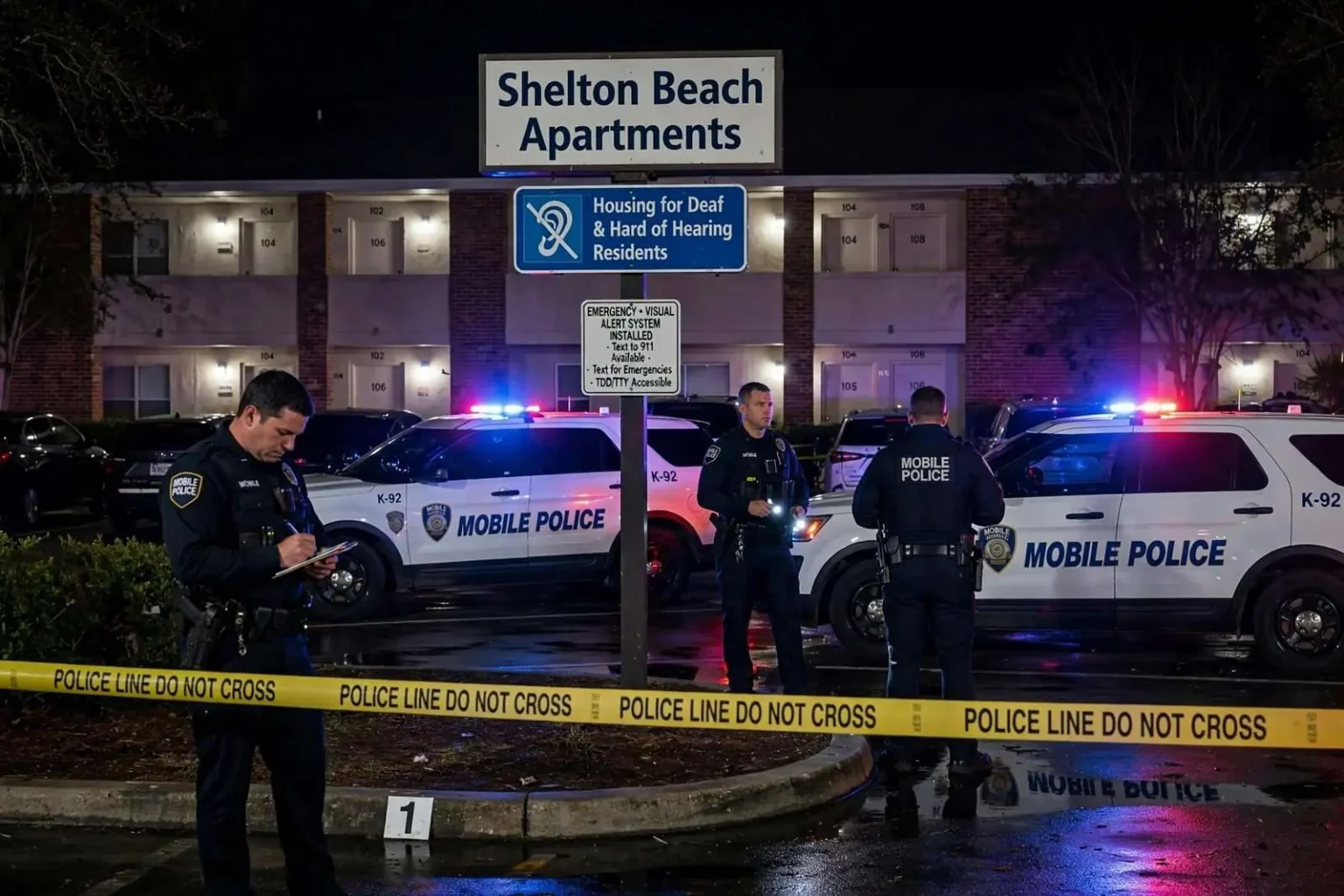
Mobile police have arrested a man they say was involved in the shooting death of a woman found in the parking lot of an apartment complex earlier this week. Officers responded to a report of shots fired at approximately 3:20 a.m. at an apartment complex on Shelton Beach Road. When they arrived, they found a woman on the ground with a gunshot wound. She was transported to a local hospital, where she later died from her injuries. The complex where the shooting occurred serves as housing for hearing-impaired residents, adding a layer of concern from neighbors and advocates for the deaf and hard-of-hearing community, who noted that residents there may face unique challenges responding to or reporting emergencies involving gunfire.
A 23-year-old man was arrested Wednesday evening and charged with murder and possession of a controlled substance in connection with the shooting. Police have not released additional details about a possible motive or the relationship, if any, between the man arrested and the victim. Authorities have not publicly released the identity of the woman who died, and it remains unclear whether additional charges could be filed as the investigation continues.
The 3:20 a.m. call placed officers in one of the more challenging scenarios overnight policing presents. Shelton Beach Road runs through a busy corridor of western Mobile, lined with apartments, small businesses and residential streets connecting the city’s central districts to its western neighborhoods. A shots-fired call in a parking lot at that hour forces responding officers to secure a dark, open area, locate victims and witnesses, and determine whether a shooter is still nearby, all before the scene can be processed. Finding the woman on the ground and moving her to emergency medical care was the first priority; building the case that followed began in the hours after the ambulance left.
The arrest within roughly a day of the shooting reflects how quickly evidence and witness accounts can come together when officers canvass immediately. Homicide investigators working an overnight scene typically knock on doors, review surveillance video from the complex and surrounding businesses, and interview everyone present when officers arrived. Detectives said they are continuing to piece together the events leading up to the shooting, including whether other individuals were present at the time gunfire erupted, a question that will shape whether investigators seek additional arrests or charges.
A Complex Serving the Deaf Community
The apartment complex’s role as housing for hearing-impaired residents gave the case dimensions that ordinary overnight crime scenes do not have. Neighbors and advocates for the deaf and hard-of-hearing community noted that residents there may face unique challenges responding to or reporting emergencies involving gunfire. A sleeping resident may not hear shots fired outside, a screaming neighbor, or the arriving sirens that alert others, and standard emergency notification tools assume an ability to hear. Advocates have long emphasized that deaf and hard-of-hearing residents benefit from visual alert systems, text-based emergency reporting options and building-wide notifications that do not depend on sound.
Mobile police and emergency dispatchers serve residents across a range of communication needs, and the department accepts text-based tips in addition to phone calls. Crime Stoppers programs likewise allow anonymous tips to be submitted online or by text, channels that advocates for the deaf community encourage residents to know about in advance rather than discover during a crisis. For the residents of the Shelton Beach Road complex, the hours after the shooting involved the same uncertainty any apartment community experiences after a violent crime, compounded by the question of whether everyone in the complex had even known what happened until morning.
The shooting adds to a string of violent incidents Mobile police have investigated in recent months, prompting continued community concern about gun violence in residential areas of the city. Mobile’s homicide investigations have repeatedly clustered in overnight hours and in the parking lots and common areas of apartment communities, settings where limited lighting and open access complicate both prevention and investigation. Neighborhood associations and community groups across the city have pressed for a combination of approaches in response, from improved lighting and controlled access at apartment complexes to the community outreach programs the department supports.
Local advocates have called for expanded outreach and safety resources for vulnerable populations, including residents of specialized housing complexes who may face communication barriers during emergencies. Their argument is straightforward: a community that houses deaf and hard-of-hearing residents has a distinct emergency-planning obligation, and the same principle applies to complexes serving elderly or disabled residents. Emergency plans tailored to a building’s actual population — visual alarm systems, posted instructions in accessible formats, relationships between property management and first responders — are the measures advocates say make the difference when violence or fire arrives without warning.
The Case Moving Forward
Anyone with information related to the case is asked to contact Mobile police or Crime Stoppers. As is standard in ongoing homicide investigations, authorities have not released a full account of the incident while the case moves through the legal process. The murder charge filed against the 23-year-old will now move through the court system, beginning with an initial appearance and, in Alabama, an eventual preliminary hearing or grand jury review that determines how the case proceeds to trial. The possession of a controlled substance charge filed alongside the murder count typically reflects evidence gathered during the arrest rather than at the scene.
The arrest marks a swift break in the case, with police identifying and taking a suspect into custody within roughly 24 hours of the shooting. Investigators have not said what led them to the suspect or whether the public provided tips, but the timeline indicates the department’s overnight and detective divisions moved the case from a 3:20 a.m. shots-fired call to a murder arrest in a single day. Whether that speed produces a conviction will depend on the evidence assembled in the weeks ahead, including forensic results, surveillance footage and the witness interviews still underway.
For the residents of the Shelton Beach Road complex and the surrounding neighborhood, the arrest answers the first question a community asks after violence — whether someone has been held responsible — but not the others. What led a woman to be shot in her own parking lot in the early morning hours, whether others were involved, and how the family of a woman who has not yet been publicly named will find justice are questions that remain open. The investigation continues, and Mobile police have said additional details may be released as the case develops.
Emergency Communication and the Deaf Community in Alabama
The concerns raised after this shooting fit into a long-running effort by advocates across Alabama to close the emergency communication gap for deaf and hard-of-hearing residents. Text-to-911 service, where available, allows a resident to reach dispatchers without speaking or hearing, and public safety agencies have gradually expanded its availability as technology allows. Deaf community organizations also train residents on relay services and on carrying identification cards that explain their communication needs, tools that matter in encounters with police as well as in emergencies. The advocates who spoke after the Shelton Beach Road shooting were pointing to a straightforward reality: when a complex’s residents cannot hear an alarm, a siren or a shout, the systems built around sound leave them last to know and hardest to warn.
Property managers of specialized housing bear part of that responsibility as well. Building safety plans that account for hearing-impaired residents include strobe-equipped smoke alarms, written evacuation procedures, and staff protocols for making personal contact during emergencies. Advocates note that these measures are inexpensive relative to their value and that complexes serving the deaf community are natural places to pilot them. The shooting in the parking lot of this complex gave those arguments fresh urgency among neighbors who had never considered how a late-night emergency would actually reach them.
Mobile’s experience with overnight violence in apartment communities has also fed a broader conversation about what prevention looks like. The measures most often cited — brighter lighting across parking areas, controlled entry gates, security cameras with working recorders, and property management that maintains relationships with the police officers patrolling the corridor — are the same measures that help investigators after a crime and deter it beforehand. For a complex whose residents include people who cannot rely on hearing to detect trouble, those physical measures carry extra weight, because they protect residents who may never hear the warning signs that others would.
The case now rests with the courts, and the questions that remain — motive, relationship, whether others were present — will be answered through the legal process rather than by further public statements from police. What the record already shows is a rapid response by the department: officers on the scene within minutes of a 3:20 a.m. call, a victim rushed to a hospital, and a 23-year-old man in custody charged with murder by the following evening. For a community still processing the death of a woman who lived among hearing-impaired neighbors, that speed is a measure of how seriously Mobile police treated the case from its first minutes, and the legal proceedings ahead will determine the rest of the story.