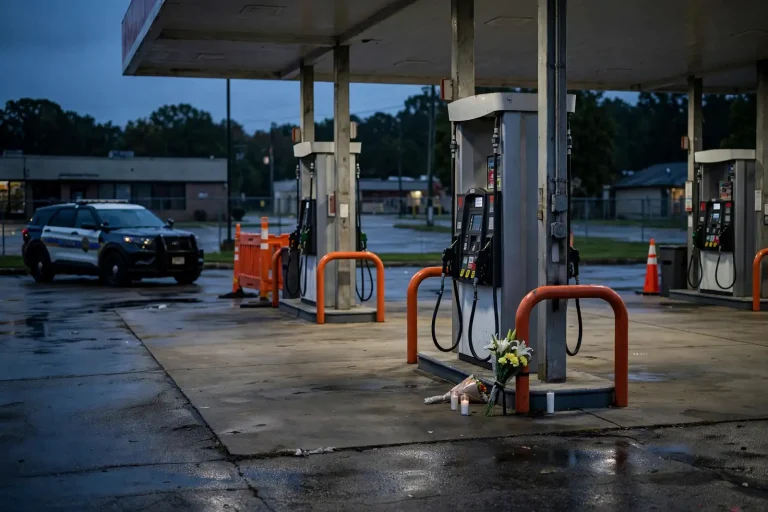
Prichard Homicide Suspect Still Awaits Charges Despite Being in Custody
A man in custody on unrelated charges remains a suspect in a Prichard convenience store shooting death, though no homicide charges have been filed yet.
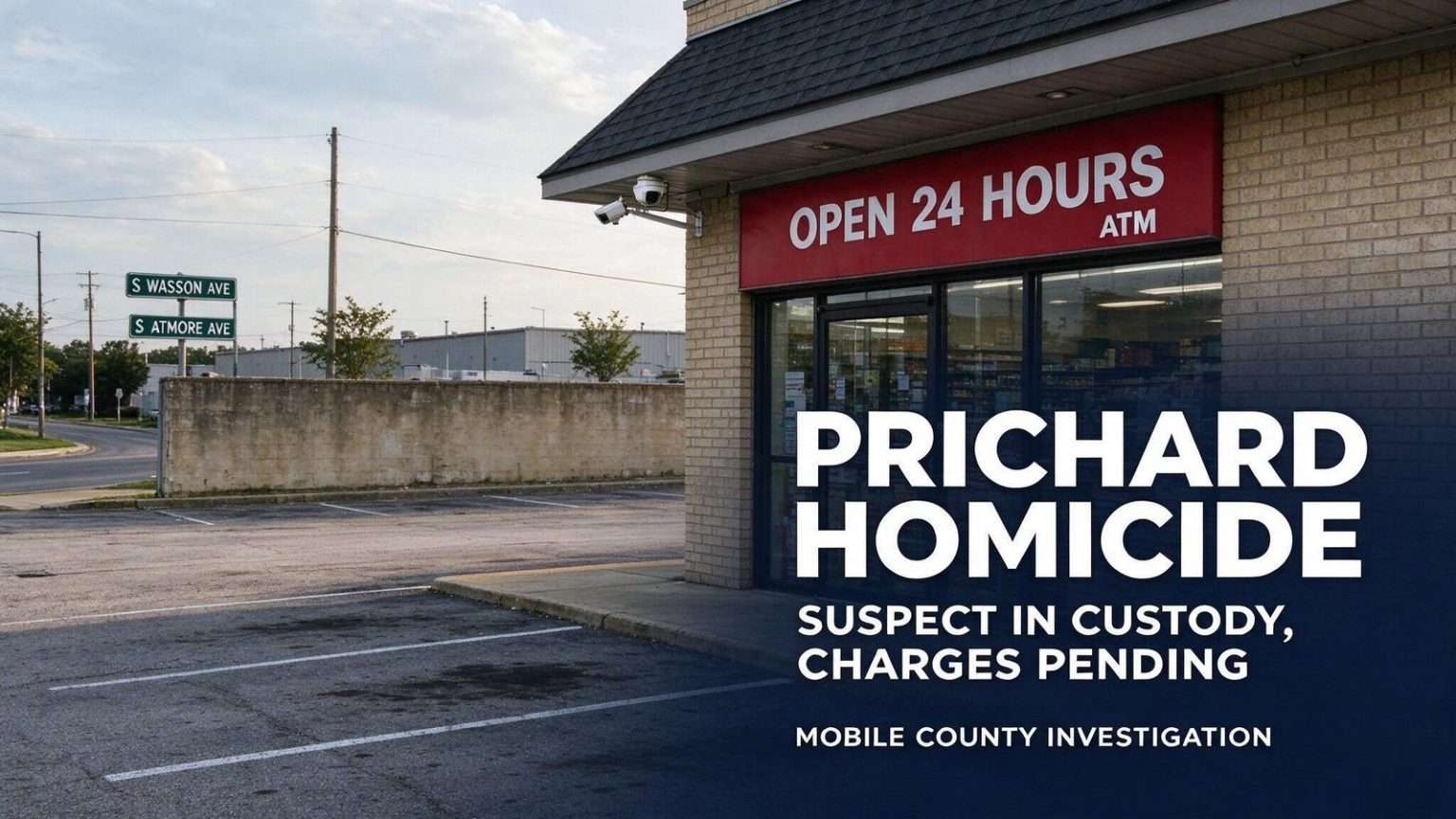
More than three weeks after a Prichard man was gunned down outside a local convenience store, one of the suspects in his killing remained in custody on unrelated charges without yet facing charges directly tied to the homicide, according to Mobile County jail records. The gap between an arrest and a murder charge is unusual but not unheard of, and investigators say the case against the second suspect is still being built.
Andrew Shane Herlong was found dead from two gunshot wounds at a convenience store between South Wasson and South Atmore avenues in Prichard just before 9 a.m. He was attacked while leaving the store, according to Philip Stiell, chief of staff for Prichard Mayor Troy Ephriam.
The morning timing put the killing in full public view: commuters, store employees and neighbors were already moving through the block when the shots were fired. Cameras at the business captured the scene, and Prichard police, arriving within minutes of the report, found a trail that included a gray vehicle carrying the alleged suspects — a vehicle they pursued and later found abandoned on Tate Court, having been reported stolen out of Mobile.
Persons of interest become suspects
Investigators named Bovaire Dewayne Brown, 21, and Andelair Flanthac Bettis, 19, as persons of interest in the case less than two weeks after the shooting. Stiell later confirmed that both men were considered suspects.
Brown was taken into custody days later, though not initially on charges related to Herlong’s death — he was booked into Mobile County Metro Jail on charges including attempting to elude police, resisting arrest and first-degree robbery. According to a criminal complaint, Brown and Bettis were also accused of carjacking a person days after the homicide, with Bettis allegedly armed during that incident.
That carjacking case gave detectives an additional strand of evidence connecting the two men to one another and to the days surrounding the shooting, even as the homicide count remained formally unfiled. A warrant was issued for Bettis’ arrest in connection with the robbery, though he remained at large along with two other unidentified individuals seen in surveillance footage from the convenience store. Investigators later said they no longer needed to interview one of the unidentified people captured on camera, a small sign of the case’s gradual tightening.
Police believe as many as four people may have been involved in the shooting itself — a number that, if accurate, makes the case more complex than a single-shooter killing and helps explain why prosecutors have not yet moved to charge the homicide while suspects remain unlocated.
Why a suspect can be jailed without a homicide charge
The arrangement that holds Brown in jail on other charges while the murder case matures is legally ordinary, even when it looks strange from the outside. Prosecutors charge homicide when the evidence is ready to survive scrutiny, and in a multi-suspect killing with suspects still at large, moving early can expose weaknesses investigators would rather test first. Meanwhile, the unrelated charges — attempting to elude police, resisting arrest and first-degree robbery — keep the suspect in custody without a bond or with bond set beyond his reach, ensuring he remains available for the homicide case whenever it is filed.
Brown was scheduled to appear in court for a preliminary hearing related to the robbery case, even as the homicide investigation continued without formal charges filed in Herlong’s death. A preliminary hearing exists to test whether probable cause supports the charges; testimony given there becomes a public preview of the state’s evidence, one reason prosecutors sometimes prefer to rely on grand jury proceedings instead. Either route ends the same way: a formal charge, an arraignment and a trial schedule — or, if the evidence falls short, no case at all.
The clock matters. Police and prosecutors in Alabama must present felony cases to a grand jury or by preliminary hearing within a reasonable period, and evidence held too long can erode — witnesses move, memories fade, surveillance footage degrades. Holding a suspect on other charges buys investigative time, but not indefinitely, which is why cases of this shape usually resolve within weeks or months rather than years.
The stolen gray car and the pursuit
The vehicle chase in the moments after the shooting gave investigators some of their strongest physical evidence. Shortly after officers arrived at the scene, they pursued a gray vehicle carrying the alleged suspects; that vehicle was later found abandoned on Tate Court, having been reported stolen out of Mobile.
An abandoned, stolen getaway car is a forensic trove: fingerprints, DNA, fibers and the route it traveled between the crime scene and the dump site. The car’s Mobile origin also connected the Prichard killing to the wider metropolitan crime picture, since suspects moving between the two cities pass through jurisdictions whose cameras, license-plate readers and patrol logs can corroborate a timeline. Detectives rebuilding that timeline — from the convenience store cameras to the pursuit to Tate Court — are assembling the kind of circumstantial web that homicide cases in Mobile County are often built on when there are no cooperating witnesses.
Prichard and its long struggle with violent crime
The killing landed in a city that has worked for years against the weight of violent crime. Prichard, just north of Mobile, is one of the Gulf Coast’s older industrial communities — a city of neighborhoods built around shipyards, plants and rail lines, whose economic base thinned over decades as industry left. Its police department operates with a fraction of the staffing and budget of neighboring Mobile, which makes cooperative cases like this one — with Mobile County sheriff’s investigators, metro crime analysts and federal partners all available — central to how the city pursues justice.
Prichard officials said the investigation remained active and that the city would pursue every suspect the evidence identifies, in the meantime pointing to the convenience store cameras and the public’s help as the case’s most valuable assets. City hall’s message to residents has been consistent in cases like this: the persons of interest were named because the evidence named them, and the public’s tips are what convert an investigative theory into an arrest.
For Herlong’s family, the three-week wait for formal charges has been its own ordeal. Families of homicide victims in such cases frequently describe the limbo as harder than the trial to come — a suspect identified, a suspect jailed, and yet no count on a court docket bearing their loved one’s name. Prosecutors’ caution is designed to make the eventual case trial-proof, but it leaves the family waiting on legal machinery rather than answers.
What happens next
The next public milestones are Brown’s preliminary hearing on the robbery and eluding charges and, separately, any movement on the warrant for Bettis, who remains at large with two unidentified figures from the surveillance footage. If police locate Bettis and the outstanding individuals, the case’s shape changes quickly: a four-person alleged crew in custody is a very different prosecution problem from one defendant jailed on other charges while three remain on the street.
Until then, the case stands as a snapshot of how a metro-area homicide investigation unfolds — a shooting at a convenience store just before 9 a.m., a pursuit and an abandoned stolen car, two named suspects, one in custody, and a murder charge deliberately still in reserve. The Mobile County District Attorney’s Office will file the homicide count when the evidence assembled by Prichard investigators is ready to carry it, and the court records that now show only robbery and eluding charges will eventually tell the fuller story of what happened outside that store between South Wasson and South Atmore avenues.
Convenience store homicides test a community’s relationship with its police in a particular way. The stores are neighborhood anchors — places where residents buy gas, groceries and coffee at all hours — and a killing in the parking lot before 9 a.m. makes violence feel ambient rather than remote. Prichard’s department has historically leaned on camera networks, resident tip calls and coordination with Mobile County agencies to compensate for its size, and this case used all three: surveillance footage that produced the persons of interest, a pursuit that produced physical evidence, and jail records that track where each suspect stands.
The unidentified figures still unaccounted for also illustrate why investigators hold back. Naming someone a person of interest without enough evidence to charge can compromise a later prosecution and expose the state to liability; releasing the images of unidentified people, by contrast, recruits the public into the search. The balance between those two imperatives — say enough to get help, hold back enough to protect the case — is exactly the line investigators were walking as they announced they no longer needed to interview one of the people captured on camera.